
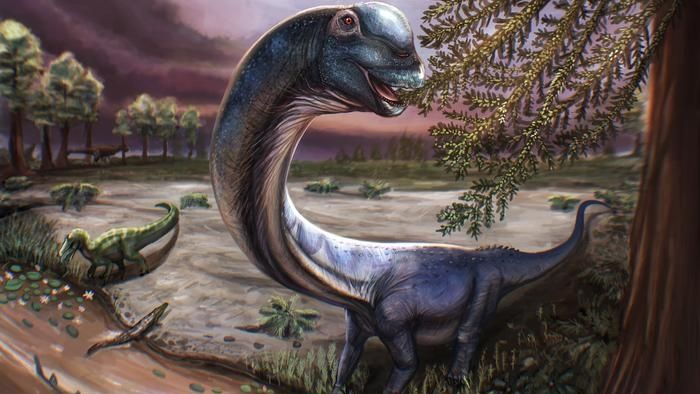
Gigantic fossils discovered in Thailand reveal the “last titan,” a long-necked dinosaur that lived up to 120 million years ago when the region was semi-arid, a new study finds.
Dubbed Nagatitan chaiyaphumensis, the newfound species is the largest sauropod, or long-necked dinosaur, found in Southeast Asia to date. It likely measured about 90 feet (27 meters) in length and weighed around 30 tons (27 metric tons), according to a study published Thursday (May 14) in the journal Scientific Reports.
“Our dinosaur is big by most people’s standards — it likely weighed at least 10 tonnes [11 tons] more than Dippy the Diplodocus (Diplodocus carnegii),” study first author Thitiwoot Sethapanichsakul, a paleontologist at University College London, said in a statement. However, it is not the largest known sauropod, weighing less than half as much as its South American relatives Patagotitan and Argentinosaurus.
The research team uncovered the fossils from the Khok Kruat Formation in the Chaiyaphum province of northeastern Thailand. A local resident first spotted the fossils in 2016 in a bone bed on the side of a drying pond.
Among the recovered fossils are several vertebrae, pelvic bones and leg bones, including the dinosaur’s right femur, or thigh bone. Though the femur had broken into several pieces, the scientists estimated it would have been about 6.5 feet (2 meters) in length — about as high as a tall human.

Paleontologist Thitiwoot Sethapanichsakul stands next to the humerus, or the front leg bone, of Nagatitan chaiyaphumensis.
(Image credit: Thitiwoot Sethapanichsakul)
N. chaiyaphumensis was a type of dinosaur known as a somphospondylan sauropod, a subgroup of large, long-necked dinosaurs that lived from the late Jurassic through the Cretaceous. Fossils from this group have been found on every continent. The shapes of N. chaiyaphumensis‘s vertebrae and leg bones set it apart from other previously known sauropods.
The team named the sauropod’s genus Nagatitan after Naga, “the mythological serpent-like creature found in various Asian cultures, especially in northeastern Thailand, often associated with water and Buddhism,” they wrote in the study. “Titan,” meanwhile, is from the giants in Greek mythology. The species name chaiyaphumensis is named for the Chaiyaphum province.
During the Cretaceous (145 million to 66 million years ago), northeastern Thailand would have been a semi-arid environment, and N. chaiyaphumensis would have used its long body and large surface area to shed heat and keep cool. The fossil site was likely part of a river system during that time, so N. chaiyaphumensis would have lived alongside crocodiles, fish and fish-eating pterosaurs.

A skeletal reconstruction of Nagatitan chaiyaphumensis, with the discovered bones highlighted in yellow.
(Image credit: Thitiwoot Sethapanichsakul et al)
The fossils were embedded in the youngest rocks in Thailand that still contain dinosaur fossils. Though additional rock layers accumulated atop the N. chaiyaphumensis fossils, the specific conditions later in the Cretaceous period probably prevented the formation of later dinosaur fossils, the researchers said.
“Younger rocks laid down towards the end of the time of the dinosaurs are unlikely to contain dinosaur remains because the region by then had become a shallow sea,” Sethapanichsakul said. “So this may be the last or most recent large sauropod we will find in Southeast Asia.”
Sethapanichsakul, T. et al. 2026 The first sauropod dinosaur from the Lower Cretaceous Khok Kruat Formation of Thailand enriches the diversity of somphospondylan titanosauriforms in southeast Asia. Sci. Rep. 16: 12467. https://doi.org/10.1038/s41598-026-47482-x
How much do you know about the king of the dinosaurs? Test your knowledge with our T. rex quiz!
