
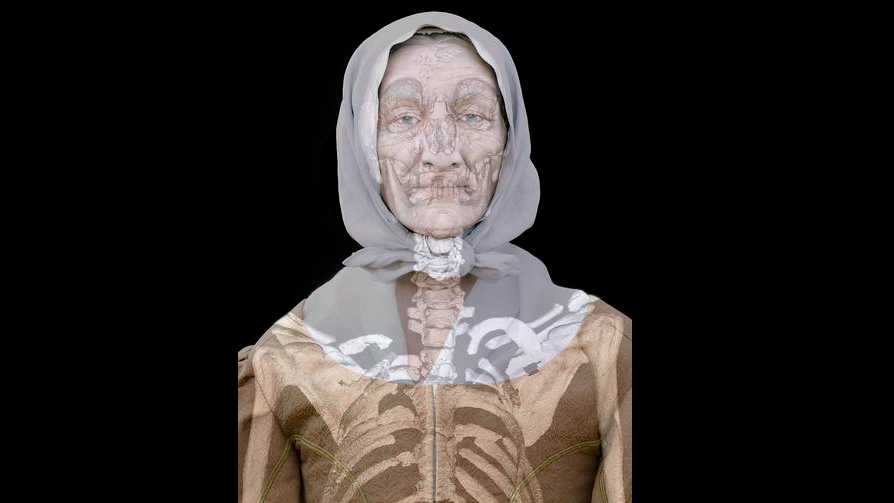

A composite image of Anne Wolseley Calvert, whose skeletal remains excavated from a 17th-century cemetery have been superimposed onto an image of what she may have looked like in life.
(Image credit: Chip Clark/Smithsonian Institution)
Two indentured servants and an 8-year-old boy who was possibly enslaved were buried alongside distinguished local families in Maryland’s first Colonial settlement, a new study finds.
The discovery of a young boy with majority African ancestry who was buried alongside European-ancestry individuals is a “significant finding that warrants additional consideration,” the researchers wrote in a study published Thursday (May 14) in the journal Current Biology.
The investigation, which looked at the DNA of a few dozen 17th-century skeletons, also detailed that the Maryland colony was established by people with genetic ancestry from western England and Wales.
St. Mary’s City was founded in 1634 as the capital of the British colony of Maryland. Around 300 people of mostly English ancestry settled the area after fleeing religious persecution and, by 1667, had erected a small church known as the Brick Chapel. Archaeological excavations over the past three decades have revealed dozens of Colonial-era burials, including three rare lead coffins, inside and surrounding the Brick Chapel.
Although historians have found numerous records on the founding families of St. Mary’s City, it was unclear who exactly was buried at the Brick Chapel and where they came from.

A photograph of the reconstructed 17th-century Brick Chapel in St. Mary’s City, Maryland.
(Image credit: Donald Winter/Historic St. Mary’s City)
In the new study, researchers detailed their analysis of the genomes of 49 people who were buried at the Brick Chapel between 1634 and 1730. They discovered that two eminent men — Thomas Greene, the second colonial governor of Maryland, and Philip Calvert, the fifth colonial governor of Maryland — were buried there along with their families. Calvert was interred in a lead coffin, as was his first wife, Anne Wolseley Calvert, and Philip Calvert’s infant son with his second wife.
Although researchers had already known about Calvert and his family’s burials, Greene had been unidentified until now. He was identified by comparing his DNA to the 23andMe genetic database and by analyzing genealogical records.
“This is the first time that ancient DNA has been used to help identify unknown individuals, without any prior knowledge of who they might have been,” study first author Éadaoin Harney, a senior scientist at the 23andMe Research Institute, said in a statement. “And it just so happens that one of those individuals [Greene] turned out to be one of colonial Maryland’s most prominent figures.”
The majority of the skeletons from the Brick Chapel revealed ancestral ties to Wales and western England, and by cross-referencing those genomes with data contributed by 23andMe research participants, the researchers discovered that there are over 1.3 million living genetic relatives of this founding Colonial population. The largest number of close relatives of this founding group — over 200 people — have ancestral ties to Kentucky, likely due to the migration of Maryland Catholics to Kentucky after the Revolutionary War.
“Detecting such a clear genetic signal of this documented historical migration to Kentucky highlights the power of our approach,” Harney said.

The foundation of the Brick Chapel in St. Mary’s City. Burials were found in and around the outside of the chapel.
(Image credit: Henry M. Miller/Historic St. Mary’s City)
Enslaved people and indentured servants
Three of the 49 skeletons were a bit unusual, though. This included the 8-year-old boy with African ancestry and two young men. The men were in their 20s when they died sometime between 1634 and 1667 and had chemical signatures suggesting they were recent immigrants from Ireland. Neither was buried in a coffin, and both of their skeletons showed signs of heavy physical labor and poor health. “Although their status of bondage is unknown, these features are consistent with the profile of indentured servants,” the researchers wrote.
Indentured servitude was a common practice in Colonial America, making up about 80% of white immigrants, according to Anna Suranyi, a historian at Endicott College in Massachusetts who was not involved in the study.
“Servants were quite different from slaves in that the period of servitude was limited, usually four or seven years, and afterwards, they were expected to join colonial society,” Suranyi told Live Science in an email.
Both indentured servants and enslaved people often lived in the same household as their masters and mistresses, she said. But in terms of cemeteries, “white people, including indentured servants, were generally buried in segregated cemeteries, with enslaved people sometimes being buried in isolated and unmarked locations.”
The fact that the boy with African ancestry was buried in the Brick Chapel cemetery in line with English customs may indicate he was not enslaved. The distinction between indentured servant and enslaved person was more fluid in the 17th century, Suranyi said, “with some people of African ancestry being treated more like indentured servants, though with longer periods of servitude — 20 years, for instance.”
The results of this project have been years in the making, study co-author Douglas Owsley, curator of biological anthropology at the Smithsonian’s National Museum of Natural History, said in the statement. The lead coffins containing Philip Calvert and his family were first discovered in the 1990s, but their genomes have been formally published for the first time in the new study.
“This work highlights the power of ancient DNA analyses to fill in gaps in the historical record,” study co-author David Reich, a geneticist at Harvard University, said in the statement. “While written records are extraordinarily rich, genetic data can still address gaps in that record and yield surprises.”
Harney, É., Jewett, E., Micheletti, S., Curry, R., Bruwelheide, K.S., Freyman, W.A., Miller, H., Akbari, A., Barca, K., Bryc, K., Deering, S., Ancona Esselman, S., Kalkus, K., Kearns, A., Moran, A., Nguyen, D.T., Olalde, I., Sedig, J., Sirak, K., […] Reich, D. (2026). The genetic legacy of the 17th-century American colony of St. Mary’s City, Maryland. Current Biology. https://doi.org/10.1016/j.cub.2026.04.046
How much do you know about the first people to reach the Americas? Find out with our First Americans quiz.
