Close Menu
  • Home
  • UNSUBSCRIBE
  • News
  • Lifestyle
  • Tech
  • Entertainment
  • Sports
  • Travel
Facebook X (Twitter) WhatsApp
Trending
  • Arthritis drug shows antiviral effects against RSV, the leading cause of infant hospitalization
  • Daddy longlegs may be capturing and devouring frogs in the tropical forests of South America
  • Google wants to release 64 million bacteria-riddled mosquitoes across California and Florida. Here’s why scientists are enthusiastic.
  • ‘In an unrecoverable state’: NASA confirms MAVEN spacecraft is officially dead after loss of signal behind Mars
  • 2 rivers merged to form the Euphrates 3.6 million years ago, eventually leading to the Fertile Crescent
  • NASA confirms fireball meteor exploded over northeastern US with force of 230 tons of TNT
  • Astronauts could use lightning-like plasma jets to kill germs on the moon and Mars, demo hints
  • First whole-genome sequence of a Greenland shark holds clues to their extreme longevity
Facebook X (Twitter) WhatsApp
Baynard Media
  • Home
  • UNSUBSCRIBE
  • News
  • Lifestyle
  • Tech
  • Entertainment
  • Sports
  • Travel
Baynard Media
Home»Lifestyle»‘Woolly devil’ flowers in Texas desert are the 1st new plant genus discovered in a US national park in almost 50 years
Lifestyle

‘Woolly devil’ flowers in Texas desert are the 1st new plant genus discovered in a US national park in almost 50 years

EditorBy EditorMarch 29, 2025No Comments3 Mins Read
Share Facebook Twitter Pinterest LinkedIn Tumblr Reddit Telegram Email
Share
Facebook Twitter LinkedIn Pinterest Email

While walking in Big Bend National Park in Texas’ Chihuahuan Desert, a park volunteer came across a fuzzy flower that turned out to be a never-before-seen species. The “woolly devil,” as researchers have named it, is in the sunflower family and also represents a new genus.

This is the first time in nearly 50 years that a new plant genus has been described in a U.S. national park, since the discovery of the July gold shrub (Dedeckera eurekensis) in Death Valley National Park in 1976, according to a statement from the California Academy of Sciences.

The new discovery suggests that researchers are far from documenting all of the plant diversity of the Chihuahuan Desert, which covers parts of Mexico and the southwestern U.S.

“While many assume that the plants and animals within our country’s national parks have probably been documented by now, scientists still make surprising new discoveries in these iconic protected landscapes,” Isaac Lichter Marck, a botanist at the California Academy of Sciences and co-author of research describing the new species, said in the statement.

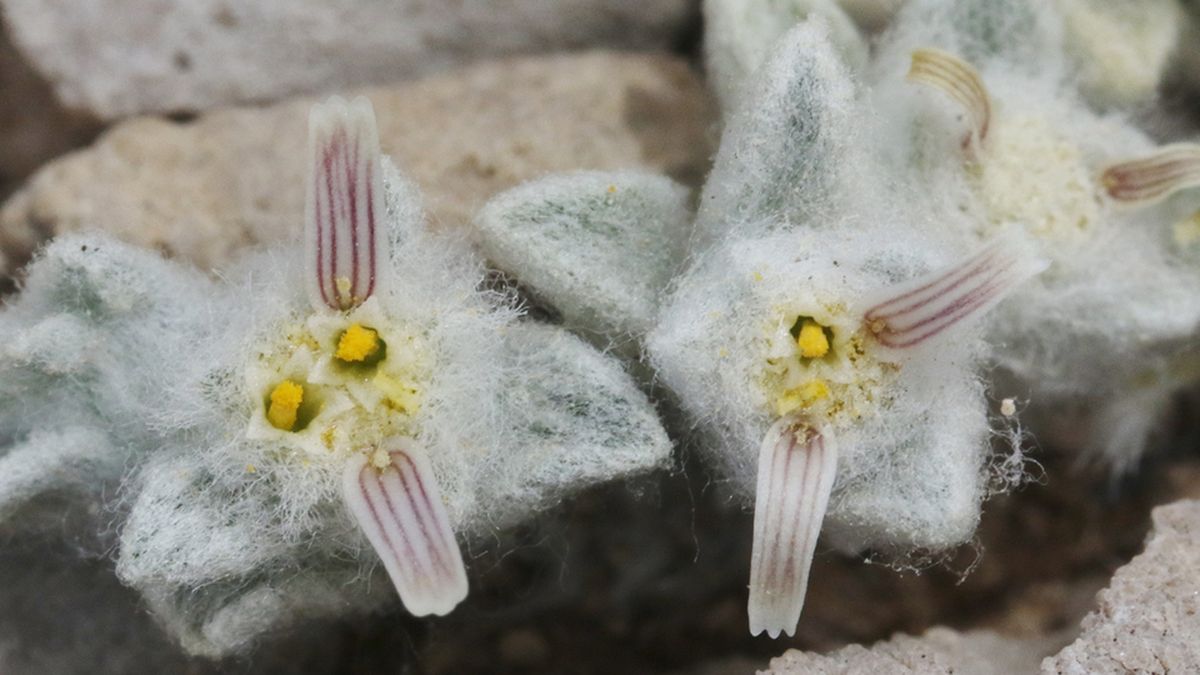
The small, fuzzy flower grows in the harsh, rocky soils of the Chihuahuan Desert.

The newly discovered species might already by at risk from climate change, researchers say. (Image credit: Big Bend National Park)

Discovering the woolly devil

In March 2024, the park volunteer, Deb Manley, shared photos of the flowers — which measured 1 to 3 inches (2.5 to 7.6 centimeters) across and were poking out from between desert rocks — to the citizen science platform iNaturalist, where an international community of botanists tried to identify the plant.

Manley and a team of botanists and biologists studied the flower’s characteristics and conducted genetic analyses, comparing its DNA with those of species from herbaria at Sul Ross State University in Texas and the California Academy of Sciences. They confirmed the plant as both a new species and a new genus, and identified it as a member of the sunflower family, according to the research, which was published Feb. 18 in the journal PhytoKeys.

Related: Giant, fungus-like organism may be a completely unknown branch of life

Get the world’s most fascinating discoveries delivered straight to your inbox.

The researchers chose the scientific name Ovicula biradiata. In Latin “ovis” comes from “sheep” and honors the desert bighorn sheep (Ovis canadensis nelsoni), an iconic and threatened desert animal. The plant has white and woolly leaves, with small, curved, red and white flowers that resemble horns. The flowers were found near a part of the park called Devil’s Den, leading the team to name the species the “woolly devil.”

The Chihuahuan Desert is North America’s largest and most biologically diverse warm desert, and Big Bend National Park contains a huge amount of this biodiversity. Many species found in the park have limited distributions, found only within the park or just outside it.

landscape view of Big Bend National Park with mountains in the background and an arid grassland in the foreground

The woody devil flowers were discovered in Big Bend National Park. (Image credit: Big Bend National Park)

So far, woolly devils are known to exist only in a small area of Big Bend National Park, and the researchers think that, based on its limited range, this plant might be particularly sensitive to changing weather patterns.

This part of the Chihuahuan Desert has faced recent severe drought conditions, and the problem is expected to worsen due to climate change. That means woolly devils could qualify as vulnerable and face a high threat of extinction.

“As climate change pushes deserts to become hotter and drier, highly specialized plants like the wooly devil face extinction,” Lichter Marck said in the statement. “It’s possible that we’ve documented a species that is already on its way out.”

Source link

Share. Facebook Twitter Pinterest LinkedIn Tumblr Email
Previous ArticleTrump commutes sentence of Ozy Media founder Carlos Watson
Next Article Three dead in South Texas after more than foot of rain falls in Rio Grande Valley
Editor
  • Website

Related Posts

Lifestyle

Arthritis drug shows antiviral effects against RSV, the leading cause of infant hospitalization

June 4, 2026
Lifestyle

Daddy longlegs may be capturing and devouring frogs in the tropical forests of South America

June 3, 2026
Lifestyle

Google wants to release 64 million bacteria-riddled mosquitoes across California and Florida. Here’s why scientists are enthusiastic.

June 3, 2026
Add A Comment

Comments are closed.

Categories
  • Entertainment
  • Lifestyle
  • News
  • Sports
  • Tech
  • Travel
Recent Posts
  • Arthritis drug shows antiviral effects against RSV, the leading cause of infant hospitalization
  • Daddy longlegs may be capturing and devouring frogs in the tropical forests of South America
  • Google wants to release 64 million bacteria-riddled mosquitoes across California and Florida. Here’s why scientists are enthusiastic.
  • ‘In an unrecoverable state’: NASA confirms MAVEN spacecraft is officially dead after loss of signal behind Mars
  • 2 rivers merged to form the Euphrates 3.6 million years ago, eventually leading to the Fertile Crescent
calendar
June 2026
M T W T F S S
1234567
891011121314
15161718192021
22232425262728
2930  
« May    
Recent Posts
  • Arthritis drug shows antiviral effects against RSV, the leading cause of infant hospitalization
  • Daddy longlegs may be capturing and devouring frogs in the tropical forests of South America
  • Google wants to release 64 million bacteria-riddled mosquitoes across California and Florida. Here’s why scientists are enthusiastic.
About

Welcome to Baynard Media, your trusted source for a diverse range of news and insights. We are committed to delivering timely, reliable, and thought-provoking content that keeps you informed
and inspired

Categories
  • Entertainment
  • Lifestyle
  • News
  • Sports
  • Tech
  • Travel
Facebook X (Twitter) Pinterest WhatsApp
  • Contact Us
  • About Us
  • Privacy Policy
  • Disclaimer
  • UNSUBSCRIBE
© 2026 copyrights reserved

Type above and press Enter to search. Press Esc to cancel.