Close Menu
  • Home
  • UNSUBSCRIBE
  • News
  • Lifestyle
  • Tech
  • Entertainment
  • Sports
  • Travel
Facebook X (Twitter) WhatsApp
Trending
  • Were about half of Duluth residents foreign born in the late 1800s? 
  • Average Cost of Living by State in the US in 2024
  • Alabama Gov Kay Ivey hospitalized after undergoing minor lung fluid procedure
  • Spitzer’s Office Faces $18M in Settlements and Judgements
  • ‘80% chance of a go,’ launch weather officer says at NASA’s Artemis II prelaunch conference
  • Florida Supreme Court keeps James Duckett’s execution on hold
  • Lawsuit over calories in David protein bars is dropped
  • Moving to Florida: Relocation Guide for 2024
Facebook X (Twitter) WhatsApp
Baynard Media
  • Home
  • UNSUBSCRIBE
  • News
  • Lifestyle
  • Tech
  • Entertainment
  • Sports
  • Travel
Baynard Media
Home»Lifestyle»AI-designed chips so weird that ‘humans cannot really understand them’ — but they perform better than anything we’ve created
Lifestyle

AI-designed chips so weird that ‘humans cannot really understand them’ — but they perform better than anything we’ve created

EditorBy EditorFebruary 20, 2025No Comments3 Mins Read
Share Facebook Twitter Pinterest LinkedIn Tumblr Reddit Telegram Email
Share
Facebook Twitter LinkedIn Pinterest Email

Engineering researchers have demonstrated that artificial intelligence (AI) can design complex wireless chips in hours, a feat that would have taken humans weeks to complete.

Not only did the chip designs prove more efficient, the AI took a radically different approach — one that a human circuit designer would have been highly unlikely to devise. The researchers outlined their findings in a study published Dec. 30 2024 in the journal Nature Communications.

The research focused on millimeter-wave (mm-Wave) wireless chips, which present some of the biggest challenges facing manufacturers due to their complexity and need for miniaturization. These chips are used in 5G modems, now commonly found in phones.

Manufacturers currently rely on a mix of human expertise, bespoke circuit designs and established templates. Each new design then goes through a slow process of optimization, based on trial and error because it is often so complex that a human cannot fully understand what is happening inside the chip. This leads to a cautious, iterative approach based on what has worked before.

Related: 6G speeds hit 100 Gbps in new test — 500 times faster than average 5G cellphones

In this case, however, researchers at Princeton Engineering and the Indian Institute of Technology posited that deep-learning-based AI models could use an inverse design method — one that specifies the desired output and leaves the algorithm to determine the inputs and parameters.

The AI also considers each chip as a single artifact, rather than a collection of existing elements that need to be combined. This means that established chip design templates, the ones that no one understands but probably hide inefficiencies, are cast aside.

Get the world’s most fascinating discoveries delivered straight to your inbox.

The future of chip design?

In this experiment, the resulting structures “look randomly shaped,” said lead author Kaushik Sengupta, a professor of electrical and computer engineering at Princeton. “Humans cannot really understand them.”

And when Sengupta’steam manufactured the chips, they found the AI creations hit performance levels beyond those of existing designs.

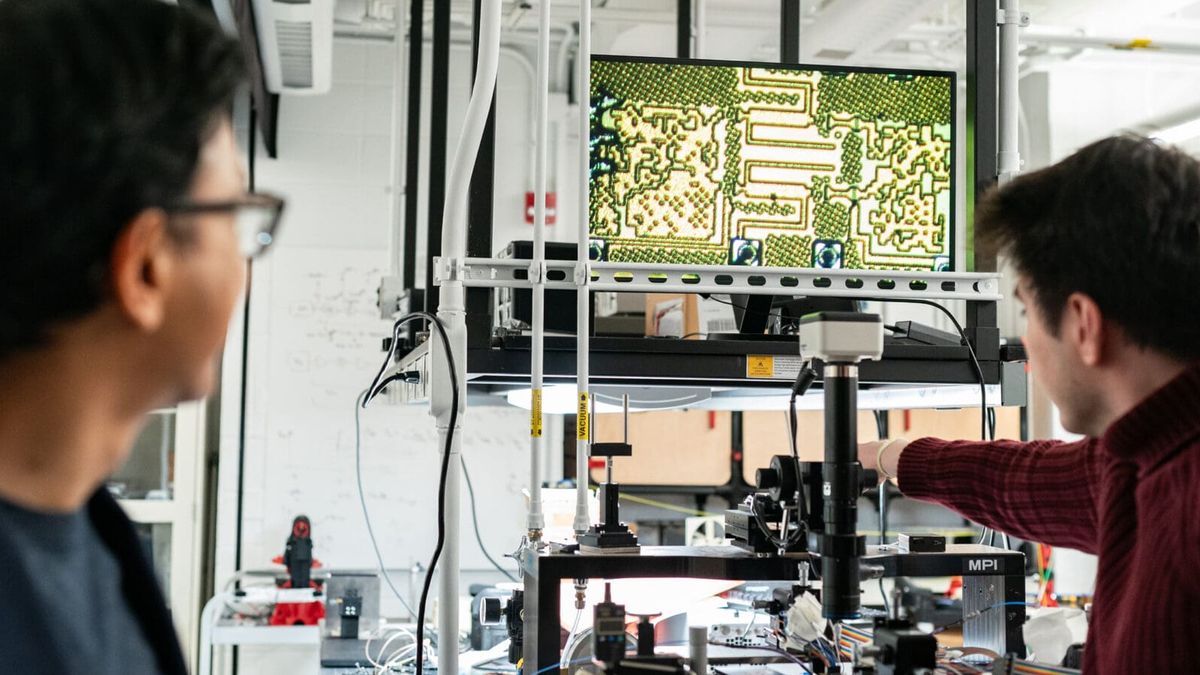
An enlarged image of the chip’s circuitry shows unusual patterns.

(Image credit: Princeton University)

Although the findings suggest that the design of such complex chips could be handed over to AI, Sengputa was keen to point out that pitfalls remain “that still require human designers to correct.” In particular, many of the designs produced by the algorithm did not work– equivalent to the “hallucinations” produced by current generative AI tools.

“The point is not to replace human designers with tools,” said Sengputa. “The point is to enhance productivity with new tools.”

The speed with which iterative designs can be developed opens up new possibilities, too. Some chip designs can be geared towards energy efficiency, others to outright performance or to extending the frequency range.

Wireless chips are of growing importance, with an ever-growing demand for miniaturization, so this research is a valuable step forward. But Sengupta said that if his team’s method can be extended to other parts of a circuit’s design, it could change the way we design electronics in the future. “This is just the tip of the iceberg in terms of what the future holds for the field.”

Source link

Share. Facebook Twitter Pinterest LinkedIn Tumblr Email
Previous ArticleJudge denies Bryan Kohberger motions to exclude key DNA evidence from trial
Next Article Jessica Simpson Shares Rare Insight Into Nick Lachey Divorce Aftermath
Editor
  • Website

Related Posts

Lifestyle

Average Cost of Living by State in the US in 2024

April 1, 2026
Lifestyle

‘80% chance of a go,’ launch weather officer says at NASA’s Artemis II prelaunch conference

April 1, 2026
Lifestyle

Moving to Florida: Relocation Guide for 2024

April 1, 2026
Add A Comment

Comments are closed.

Categories
  • Entertainment
  • Lifestyle
  • News
  • Sports
  • Tech
  • Travel
Recent Posts
  • Were about half of Duluth residents foreign born in the late 1800s? 
  • Average Cost of Living by State in the US in 2024
  • Alabama Gov Kay Ivey hospitalized after undergoing minor lung fluid procedure
  • Spitzer’s Office Faces $18M in Settlements and Judgements
  • ‘80% chance of a go,’ launch weather officer says at NASA’s Artemis II prelaunch conference
calendar
April 2026
M T W T F S S
 12345
6789101112
13141516171819
20212223242526
27282930  
« Mar    
Recent Posts
  • Were about half of Duluth residents foreign born in the late 1800s? 
  • Average Cost of Living by State in the US in 2024
  • Alabama Gov Kay Ivey hospitalized after undergoing minor lung fluid procedure
About

Welcome to Baynard Media, your trusted source for a diverse range of news and insights. We are committed to delivering timely, reliable, and thought-provoking content that keeps you informed
and inspired

Categories
  • Entertainment
  • Lifestyle
  • News
  • Sports
  • Tech
  • Travel
Facebook X (Twitter) Pinterest WhatsApp
  • Contact Us
  • About Us
  • Privacy Policy
  • Disclaimer
  • UNSUBSCRIBE
© 2026 copyrights reserved

Type above and press Enter to search. Press Esc to cancel.