Close Menu
  • Home
  • UNSUBSCRIBE
  • News
  • Lifestyle
  • Tech
  • Entertainment
  • Sports
  • Travel
Facebook X (Twitter) WhatsApp
Trending
  • Why do cats have ‘leg whiskers’?
  • Total eclipse, shooting stars, and the Milky Way: Why Aug. 12 could be the greatest single day and night for skywatching for years
  • Dementia prevention trial shows promising results, prompting celebration from scientists
  • Science news this week: Secret lives of whale sharks revealed, Earth’s coldest temperature registered, and Amazonian geoglyphs show clues to lost civilization
  • New telescope images provide best evidence yet that the bright red star Betelgeuse is actually 2 stars in disguise
  • Antarctica just experienced minus 119 F, Earth’s coldest temperature since 2012 — here’s why
  • Chinese rocket hit by rare midair lightning strike moments after launch as onlookers gasp in horror (video)
  • Scientists discover a bat immune system ‘unlike anything seen before in mammals’
Facebook X (Twitter) WhatsApp
Baynard Media
  • Home
  • UNSUBSCRIBE
  • News
  • Lifestyle
  • Tech
  • Entertainment
  • Sports
  • Travel
Baynard Media
Home»Lifestyle»Why do cats have ‘leg whiskers’?
Lifestyle

Why do cats have ‘leg whiskers’?

EditorBy EditorAugust 1, 2026No Comments4 Mins Read
Share Facebook Twitter Pinterest LinkedIn Tumblr Reddit Telegram Email
Share
Facebook Twitter LinkedIn Pinterest Email

Cats are known for the whiskers on their faces. However, if you look closely, you can see that they also have whiskers on their legs. So why do cats have leg whiskers?

To answer why they’re useful, it’s important to understand what whiskers are. Technically known as vibrissae, whiskers are specialized hairs that are stiffer and several times thicker than other hairs. Although whiskers themselves do not contain nerves, their bases are rooted in specialized receptacles loaded with nerve endings, making whiskers very sensitive.

“Facial whiskers are as sensitive as human fingertips,” Robyn Grant, a sensory biologist at Manchester Metropolitan University in the U.K., told Live Science.

Sign up for our newsletter

Life's Little Mysteries logo with a question mark in a magnifying glass

(Image credit: Marilyn Perkins / Future)

Sign up for our weekly Life’s Little Mysteries newsletter to get the latest mysteries before they appear online

A cat’s whiskers around the nose, which are also known as the mystacial vibrissae, are the longest whiskers they have, according to the veterinary reference book “The Feline Patient” (Wiley, 2025). Although there is variation among cats, on average there are 12 mystacial whiskers set in four rows on each side of the muzzle.

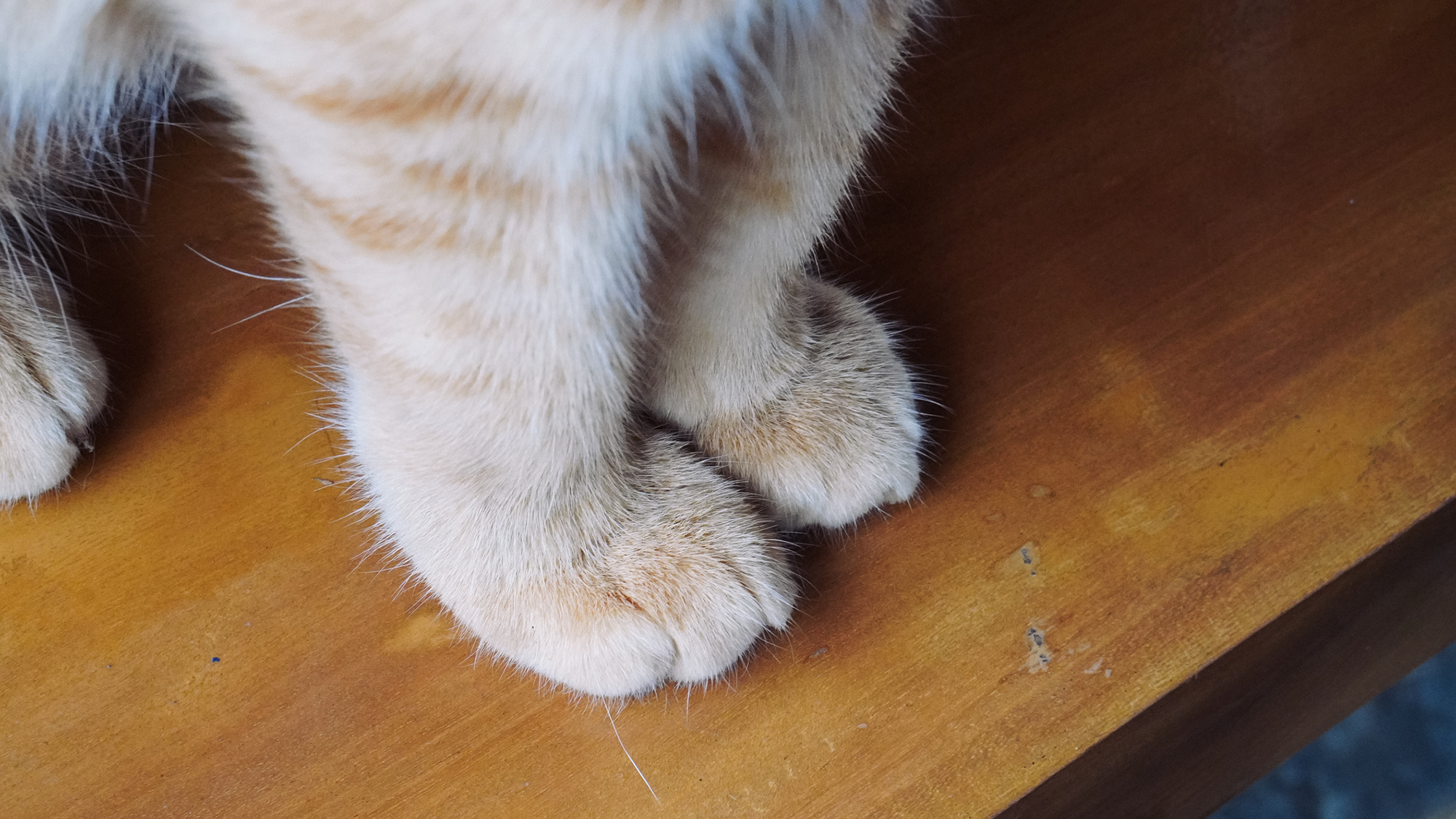
A close up of an orange cat's legs with an arrow

Cat leg whiskers, scientifically known as carpal vibrissae, are attached to their forelegs.

(Image credit: Future)

Facial whiskers help cats hunt when light is limited or when their vision is poor. Although cats are good at seeing distant objects, “cats can’t really focus on anything less than 10 inches (25 centimeters) from their eyes, so they use their whiskers to figure out where things are,” Jonathan Losos, an evolutionary biologist at Washington University in St. Louis and author of “The Cat’s Meow: How Cats Evolved from the Savanna to Your Sofa” (Viking, 2023), told Live Science.


You may like

In addition, cats have a tuft of whiskers known as superciliary vibrissae above each eye. These whiskers help protect the cat’s vision by triggering a blink when stimulated by anything that might fly into their eye, according to The Feline Patient.

Cats also have chin whiskers (mandibular vibrissae) and whiskers on each side of the head, between the ear and chin (genal vibrissae). These also help cats stay aware of the space around them.

Leg whiskers

Cats also possess a tuft of four to six whiskers on the back of each front leg, each about 0.8 to 1.2 inches (2 to 3 centimeters) long. These are known as carpal vibrissae.

“Carpal refers to the bones that, in humans, are in our wrists,” Losos said. “Carpal whiskers are attached to cat forelegs near the carpal bones.” However, in cats, the carpal bones are not located in the same place as the human wrist. Rather, they “are further up the leg, because cats essentially walk on their toes and not their palms,” he explained.

Cats are not the only animals with carpal whiskers. “Most carnivores have them, and many rodents do, as do lemurs and armadillos,” Losos said. “Dogs don’t have them, but other canine species do. Rabbits don’t have them either, nor do ungulates — that is, hooved animals, such as horses and cattle.”

The species that have carpal whiskers “tend to be the ones that either grasp things with their forelimbs or climb up trees,” Losos said. “The idea is that if it’s hard for the animals to see what they’re grasping, carpal whiskers can help supplement their vision. Perhaps cats have them and dogs don’t because cats can move their forearms laterally from side to side and put their palms together to grab things, whereas dogs can’t.”

It remains uncertain what role carpal whiskers play in cats, but they likely “guide locomotion — that is, safe forepaw placement — especially during complex locomotion, such as climbing,” Grant said. “They might guide prey handling too.”


How much of a cat fan are you? Find out by taking our cat quiz!

TOPICS

Life’s Little Mysteries

Source link

Share. Facebook Twitter Pinterest LinkedIn Tumblr Email
Previous ArticleTotal eclipse, shooting stars, and the Milky Way: Why Aug. 12 could be the greatest single day and night for skywatching for years
Editor
  • Website

Related Posts

Lifestyle

Total eclipse, shooting stars, and the Milky Way: Why Aug. 12 could be the greatest single day and night for skywatching for years

August 1, 2026
Lifestyle

Dementia prevention trial shows promising results, prompting celebration from scientists

August 1, 2026
Lifestyle

Science news this week: Secret lives of whale sharks revealed, Earth’s coldest temperature registered, and Amazonian geoglyphs show clues to lost civilization

August 1, 2026
Add A Comment

Comments are closed.

Categories
  • Entertainment
  • Lifestyle
  • News
  • Sports
  • Tech
  • Travel
Recent Posts
  • Why do cats have ‘leg whiskers’?
  • Total eclipse, shooting stars, and the Milky Way: Why Aug. 12 could be the greatest single day and night for skywatching for years
  • Dementia prevention trial shows promising results, prompting celebration from scientists
  • Science news this week: Secret lives of whale sharks revealed, Earth’s coldest temperature registered, and Amazonian geoglyphs show clues to lost civilization
  • New telescope images provide best evidence yet that the bright red star Betelgeuse is actually 2 stars in disguise
calendar
August 2026
M T W T F S S
 12
3456789
10111213141516
17181920212223
24252627282930
31  
« Jul    
Recent Posts
  • Why do cats have ‘leg whiskers’?
  • Total eclipse, shooting stars, and the Milky Way: Why Aug. 12 could be the greatest single day and night for skywatching for years
  • Dementia prevention trial shows promising results, prompting celebration from scientists
About

Welcome to Baynard Media, your trusted source for a diverse range of news and insights. We are committed to delivering timely, reliable, and thought-provoking content that keeps you informed
and inspired

Categories
  • Entertainment
  • Lifestyle
  • News
  • Sports
  • Tech
  • Travel
Facebook X (Twitter) Pinterest WhatsApp
  • Contact Us
  • About Us
  • Privacy Policy
  • Disclaimer
  • UNSUBSCRIBE
© 2026 copyrights reserved

Type above and press Enter to search. Press Esc to cancel.