
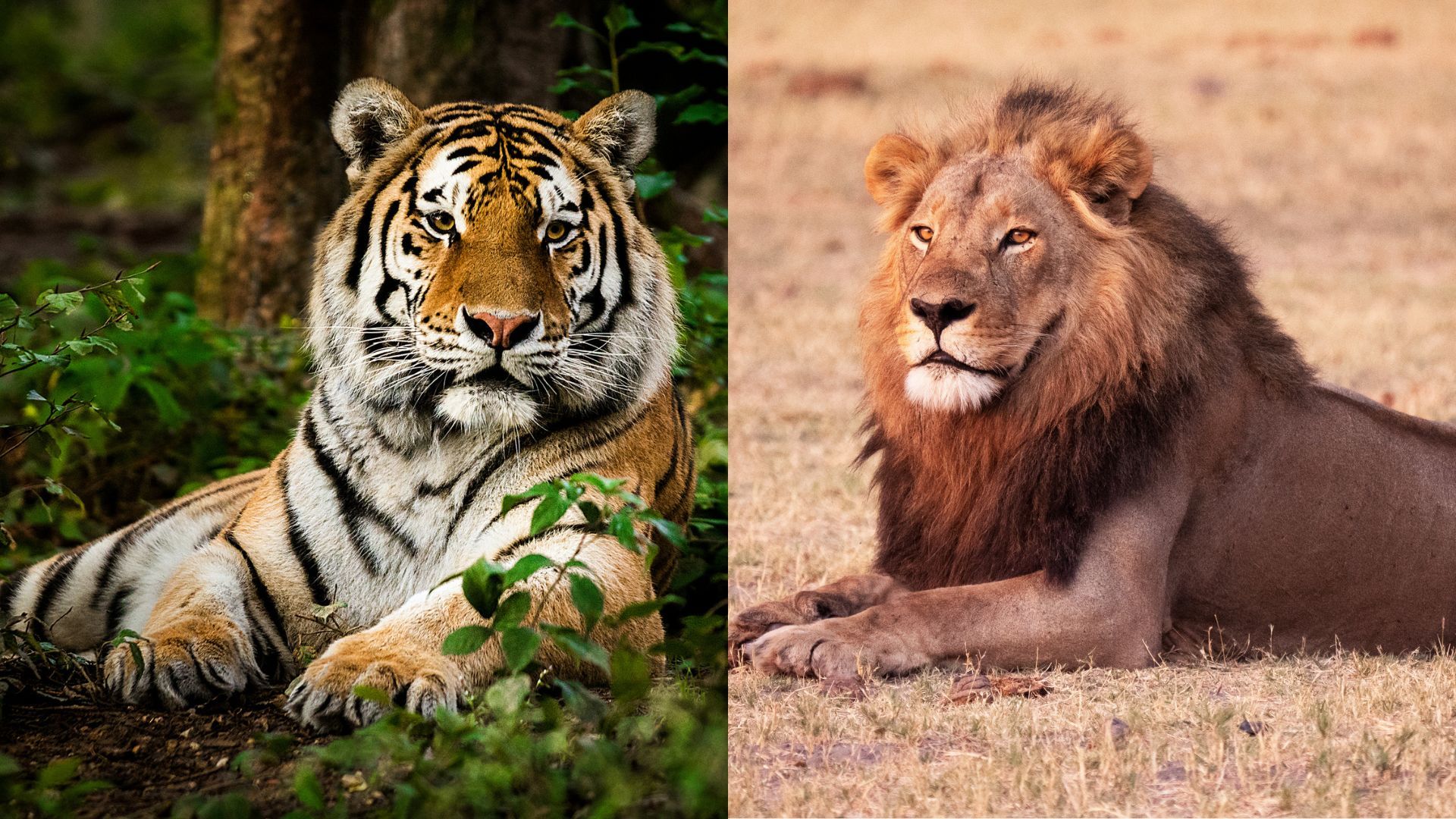
Whether it’s having the “eye of the tiger” or being lionhearted, references to lions and tigers evoke power and determination. That’s not surprising given these animals are both large, powerful felines. But they are distinct species. So what do these iconic cats have in common, and how are they different?
To answer this question, let’s consider the two species’ appearances, evolutionary histories and how they live their lives as kings of their ecosystems.
Appearance and anatomy
The most obvious difference between modern lions (Panthera leo) and tigers (Panthera tigris) is their distinct physical appearances, particularly their coats.
“Just looking at them, you can clearly tell that tigers have stripes and lions don’t,” Dell Guglielmo, a zookeeper who cares for lions and tigers at Smithsonian’s National Zoo, told Live Science. “The lion males have the large huge mane, and the females do not.” In contrast, male and female tigers look the same.
Sign up for our newsletter

(Image credit: Marilyn Perkins / Future)
Sign up for our weekly Life’s Little Mysteries newsletter to get the latest mysteries before they appear online.
A tiger’s stripes help the cat blend in among the patterns of shadows and light created by grasses and trees in the dense temperate and tropical forests of Asia where they live. The orange and brown or black stripes stand out to the human eye, but to a tiger’s colorblind prey, orange appears green and blends in. The stripes are pigmented on their skin, too. Each tiger’s stripe pattern is unique, Guglielmo said.
Lions’ tawny coloring also serves as camouflage. Lions blend in with the dry grasses of Africa’s open savannas.
On the inside, however, lions and tigers are very similar. “If you look at the skeletons, all cats essentially look the same,” Z. Jack Tseng, an associate professor of integrative biology at the University of California, Berkeley, told Live Science. There’s an unofficial saying among those who study cat fossils. If “you ask them to describe the cat family fossil record, usually people will say, ‘Well, a cat is a cat is a cat,'” Tseng said. Even your pet cat is basically identical to a lion or tiger, skeletally speaking — just proportionally a lot smaller.
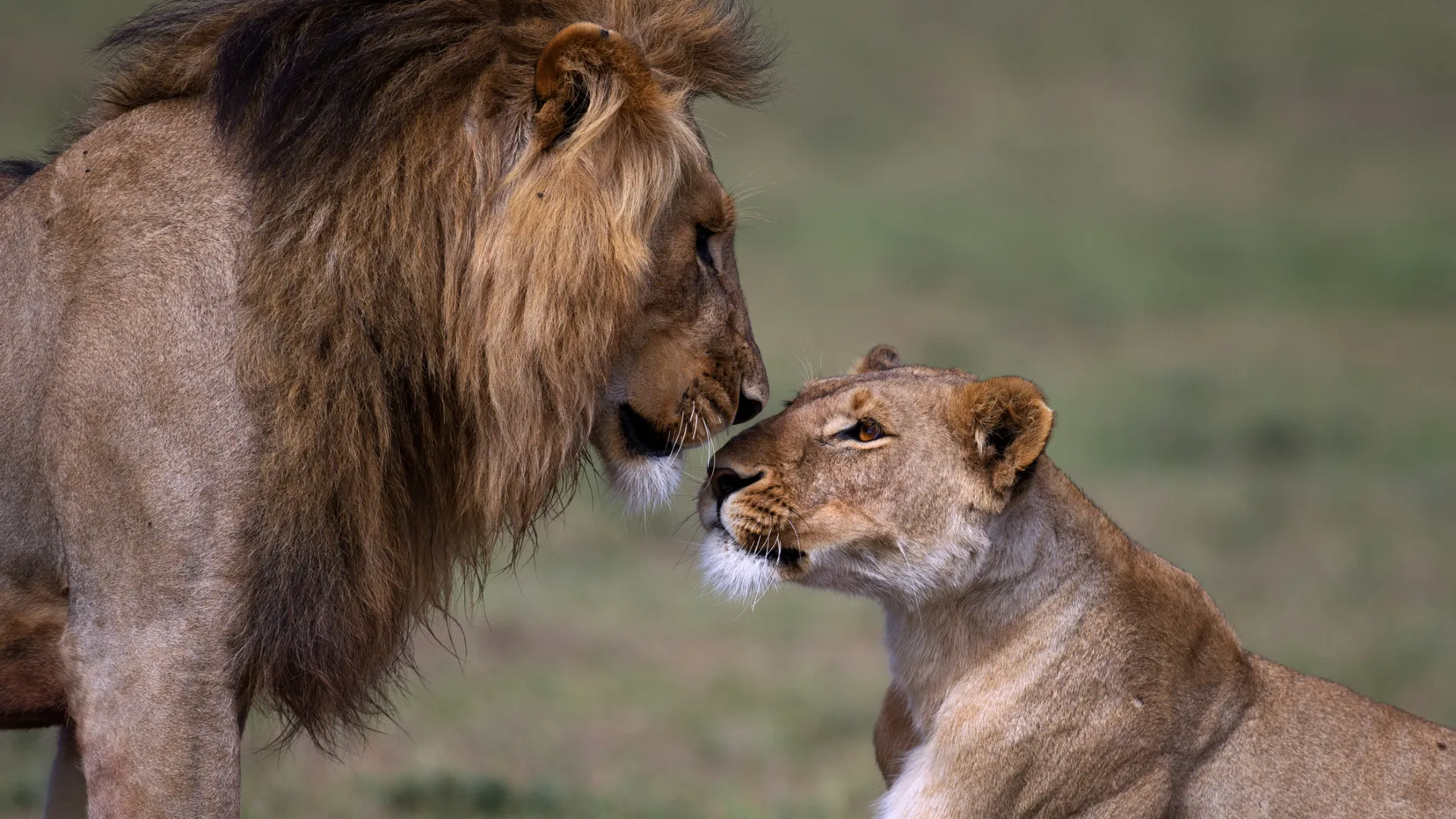
There are key differences between male and female lions, including male lions having a mane.
(Image credit: Anup Shah via Getty Images)
Evolutionary differences
Despite their similarities, “lions and tigers are not each other’s closest relatives,” Tseng said. Tigers are more closely related to snow leopards, while lions are grouped with leopards and jaguars.
Moreover, tigers emerged much earlier as a species than lions. “The oldest putative tiger fossils are around 2 million years old,” Tseng said, “whereas lion fossils are probably no more than a million years old, probably younger than that.”
When it comes to classifying cats, size matters. Lions and tigers belong to the Panthera genus, along with leopards, jaguars and snow leopards. The last common ancestor of all five species likely emerged at least 5.57 million years ago, a genetic modeling study found. Tseng and his co-authors modeled this age based on genetic sequences and anatomical data, such as characteristics of bones and teeth. No fossil has been found yet, but this ancestor was likely smaller than lions and tigers, Tseng said.
He noted that both species independently evolved to be large. Animals can grow in body size for a variety of reasons, including living in cooler climates, as this gives them a smaller surface area-to-volume ratio, which helps to reduce heat loss. “The fossil record is not detailed enough to say whether lions and tigers got large independently for the same reasons, but they probably followed one or more of these broader trends as they evolved,” Tseng said.
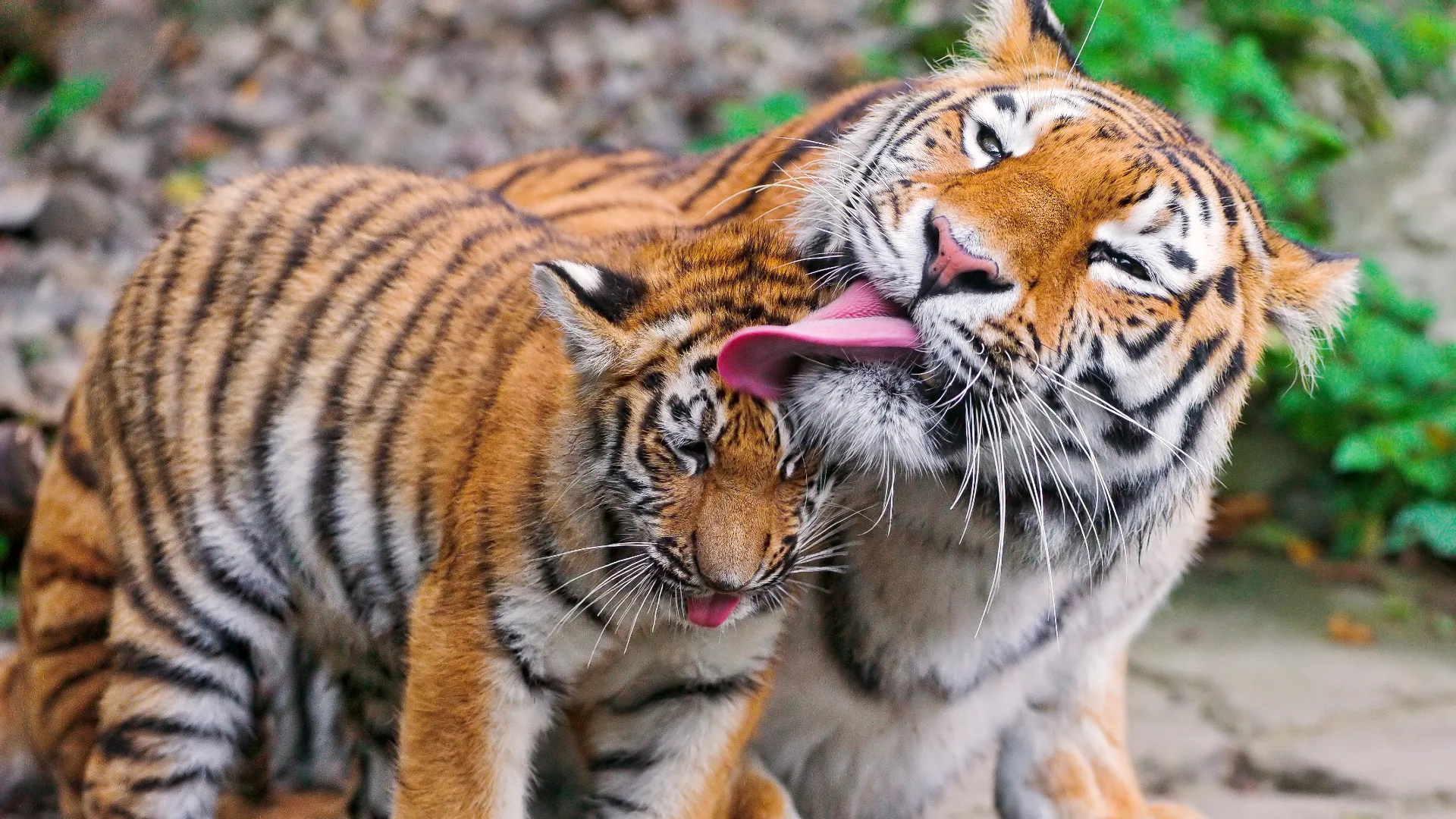
Tigers behave differently from lions in their natural habitats.
(Image credit: Picture by Tambako the Jaguar via Getty Images)
Behavior
Lions and tigers behave quite differently in the wild. Lions live in social, matriarchal groups with multiple female relatives and one or two male adult lions who may leave if challenged by another male. That’s where the mane can come in handy.
“Cats often go for the neck when they fight and when they kill their prey,” Jacob Shanks, a wildlife care manager at San Diego Zoo Wildlife Alliance, told Live Science. “Male lions being social, there’s a lot of battling for territory and access to reproduction and other resources, so the manes help protect against neck wounds.”
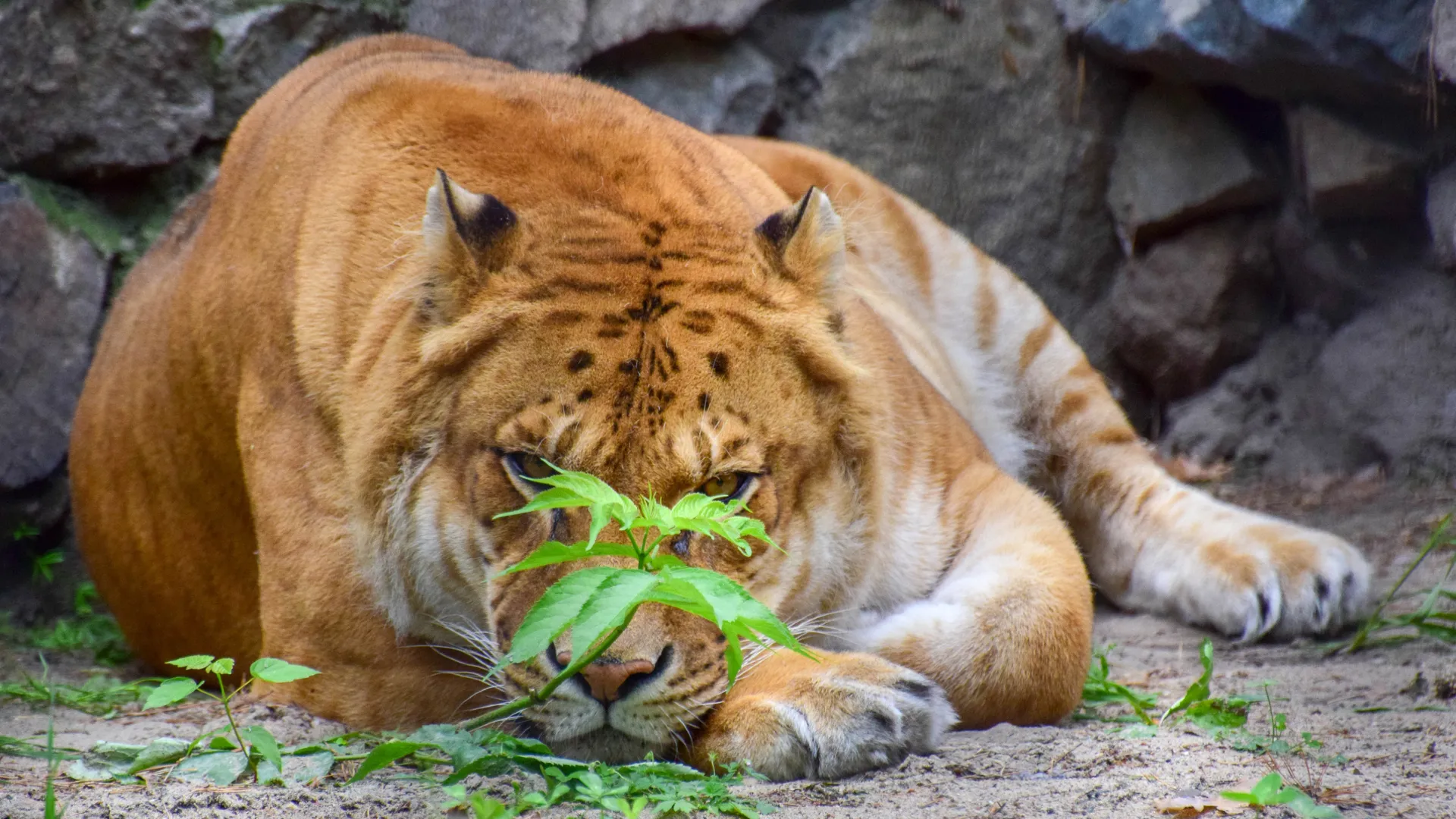
A liger is a bred cross between a lion and a tiger.
(Image credit: Matevz Gros via Getty Images)
Tigers have far less social interaction than lions do. Tiger cubs remain with their mother for two years before going their separate ways. As adults, tigers generally avoid each other, aside from breeding. When a tiger wants to approach another individual, it makes a puff-like sound, called a chuff, by pushing air through its nose. Tigers are “one of the only cat species that chuff,” Guglielmo said. If the second tiger is OK with the first tiger moving closer, it will chuff back. “Lions don’t use a chuff; they just use different body language or just walk up and see if it works,” Guglielmo said.
Would tigers and lions ever meet in the wild? That’s not likely, as they live in completely different parts of the world. Even in the fossil record, there is no overlap in their range, which prevents the two species from competing and breeding, Tseng said.
However, humans have artificially bred lions and tigers in captivity, creating a hybrid called a liger. “Hybridization doesn’t exist in the wild,” Shanks said. “I’ve never seen a case of wild lion-tiger hybridization.” Making hybrids doesn’t benefit either species, he added.
A key similarity between lions and tigers are the threats they face. Tigers are considered endangered, and lions are vulnerable, according to the International Union for Conservation of Nature. Both big cats face threats from human conflict, habitat loss and climate change. “They need active conservation to protect and to help improve if we’re going to not have them slip away,” Shanks said.
Think you know about lions and tigers? Test your smarts with our big cat quiz!
TOPICS
