Close Menu
  • Home
  • UNSUBSCRIBE
  • News
  • Lifestyle
  • Tech
  • Entertainment
  • Sports
  • Travel
Facebook X (Twitter) WhatsApp
Trending
  • How did animals survive the asteroid that killed the dinosaurs?
  • ‘We can identify these really early, before the clinical diagnosis’: Epigenetic markers may help explain why Native Hawaiians are aging faster
  • Catapult the cow: 6 medieval castles that were never conquered
  • China launches ‘human artificial embryos’ to space for the first time
  • NASA’s Psyche spacecraft beams back blue images of Mars on its way to a metal asteroid
  • Science news this week: Laotian ‘death jar’, climate change threatens rice crops, and an asthma drug treats tough cancer
  • DNA sequencing is rewriting our understanding of historic outbreaks, but it can’t tell the whole story
  • AI-generated images are making it impossible to distinguish truth from fiction. We need laws and AI watermarks to protect our shared reality.
Facebook X (Twitter) WhatsApp
Baynard Media
  • Home
  • UNSUBSCRIBE
  • News
  • Lifestyle
  • Tech
  • Entertainment
  • Sports
  • Travel
Baynard Media
Home»Lifestyle»‘This has left us scratching our heads’: Astronomers flummoxed by James Webb telescope’s view of ‘impossible’ auroras on Jupiter
Lifestyle

‘This has left us scratching our heads’: Astronomers flummoxed by James Webb telescope’s view of ‘impossible’ auroras on Jupiter

EditorBy EditorMay 14, 2025No Comments3 Mins Read
Share Facebook Twitter Pinterest LinkedIn Tumblr Reddit Telegram Email
Share
Facebook Twitter LinkedIn Pinterest Email

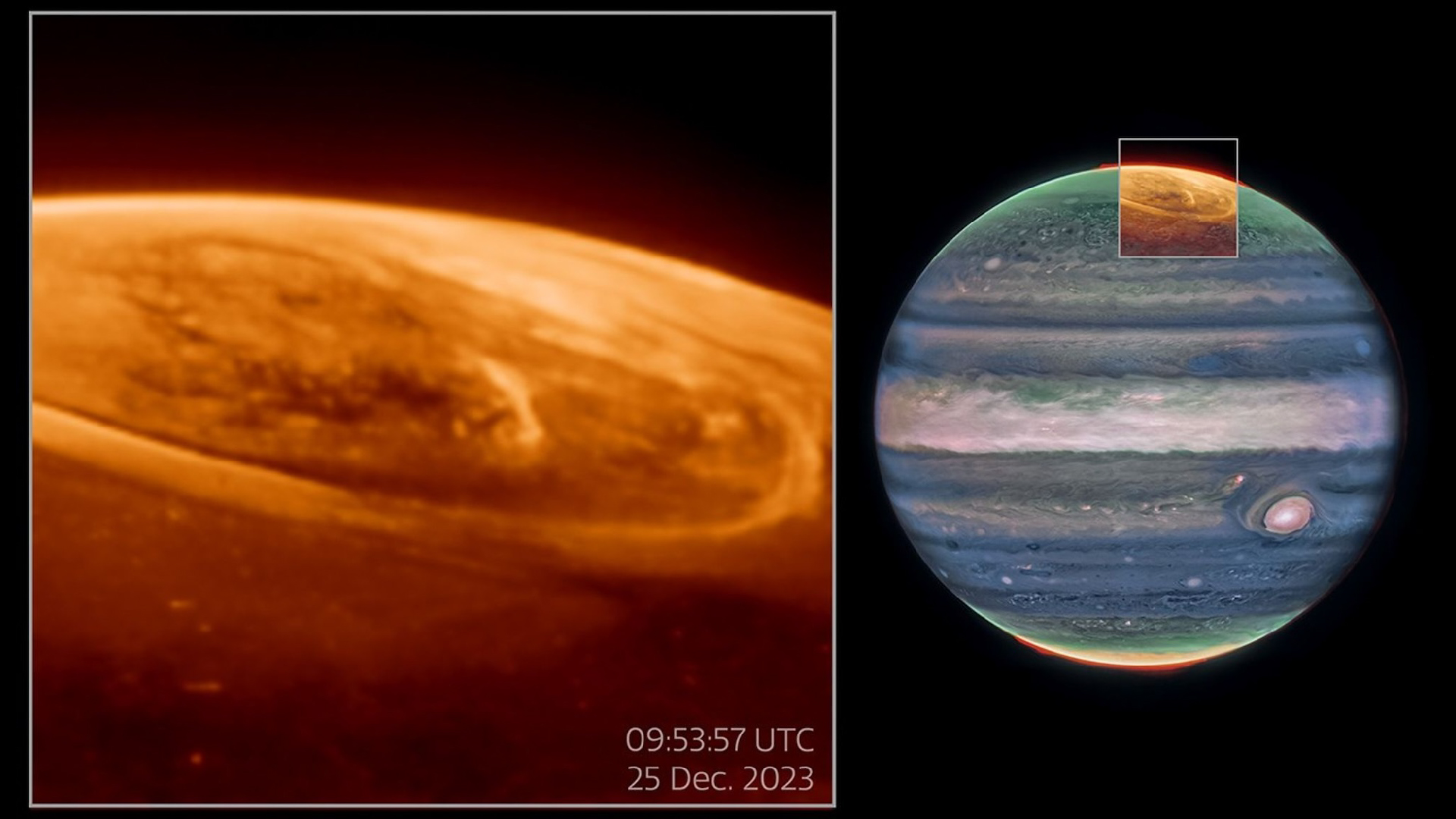
On Christmas Day in 2023, scientists trained the James Webb Space Telescope (JWST) on Jupiter’s auroras and captured a dazzling light show.

The researchers observed rapidly-changing features in Jupiter’s vast auroras using JWST’s infrared cameras. The findings could help explain how Jupiter’s atmosphere is heated and cooled, according to a study published May 12 in Nature Communications.

“What a Christmas present it was — it just blew me away!” study coauthor Jonathan Nichols, a researcher studying auroras at the University of Leicester in the UK, said in a statement. “We wanted to see how quickly the auroras change, expecting them to fade in and out ponderously, perhaps over a quarter of an hour or so. Instead, we observed the whole auroral region fizzing and popping with light, sometimes varying by the second.”


You may like

Auroras form when high-energy charged particles, often released from the sun, slam into gases in a planet’s atmosphere, causing the gas to glow. Jupiter’s strong magnetic field scoops up charged particles such as electrons from the solar wind — and from eruptions on its highly volcanic moon Io — and sends them hurtling toward the planet’s poles, where they put on a spectacle hundreds of times brighter than Earth’s Northern Lights.

Related: NASA reveals ‘glass-smooth lake of cooling lava’ on surface of Jupiter’s moon Io

In the new study, the team looked closely at infrared light emitted by the trihydrogen cation, H3+. This molecule forms in Jupiter’s auroras when energetic electrons meet hydrogen in the planet’s atmosphere. Its infrared emission sends heat out of Jupiter’s atmosphere, but the molecule can also be destroyed by fast-moving electrons. To date, no ground-based telescopes have been sensitive enough to determine exactly how long H3+ sticks around.

But by using JWST’s Near Infrared Camera, the team observed H3+ emissions that varied more than they expected. They found that H3+ lasts about two and a half minutes in Jupiter’s atmosphere before being destroyed. That could help scientists tease out how much of an effect H3+ has on cooling Jupiter’s atmosphere.

Get the world’s most fascinating discoveries delivered straight to your inbox.

But the scientists don’t have the full picture yet. They also found some puzzling data when they turned the Hubble Space Telescope toward Jupiter at the same time. Hubble captured the ultraviolet light coming from the auroras, while JWST captured infrared light.

“Bizarrely, the brightest light observed by Webb had no real counterpart in Hubble’s pictures,” Nichols said in the statement. “This has left us scratching our heads. In order to cause the combination of brightness seen by both Webb and Hubble, we need to have a combination of high quantities of very low-energy particles hitting the atmosphere, which was previously thought to be impossible. We still don’t understand how this happens.”

In future work, the researchers plan to study the source of this unexpected pattern using additional JWST data as well as observations from NASA’s Juno spacecraft, which has been observing Jupiter from orbit since 2016.

Source link

Share. Facebook Twitter Pinterest LinkedIn Tumblr Email
Previous ArticleThe universe is dying much faster than scientists thought, new study suggests
Next Article ‘Truly miraculous’: Common gut microbe shows promise as fatty liver disease treatment
Editor
  • Website

Related Posts

Lifestyle

How did animals survive the asteroid that killed the dinosaurs?

May 24, 2026
Lifestyle

‘We can identify these really early, before the clinical diagnosis’: Epigenetic markers may help explain why Native Hawaiians are aging faster

May 24, 2026
Lifestyle

Catapult the cow: 6 medieval castles that were never conquered

May 24, 2026
Add A Comment

Comments are closed.

Categories
  • Entertainment
  • Lifestyle
  • News
  • Sports
  • Tech
  • Travel
Recent Posts
  • How did animals survive the asteroid that killed the dinosaurs?
  • ‘We can identify these really early, before the clinical diagnosis’: Epigenetic markers may help explain why Native Hawaiians are aging faster
  • Catapult the cow: 6 medieval castles that were never conquered
  • China launches ‘human artificial embryos’ to space for the first time
  • NASA’s Psyche spacecraft beams back blue images of Mars on its way to a metal asteroid
calendar
May 2026
M T W T F S S
 123
45678910
11121314151617
18192021222324
25262728293031
« Apr    
Recent Posts
  • How did animals survive the asteroid that killed the dinosaurs?
  • ‘We can identify these really early, before the clinical diagnosis’: Epigenetic markers may help explain why Native Hawaiians are aging faster
  • Catapult the cow: 6 medieval castles that were never conquered
About

Welcome to Baynard Media, your trusted source for a diverse range of news and insights. We are committed to delivering timely, reliable, and thought-provoking content that keeps you informed
and inspired

Categories
  • Entertainment
  • Lifestyle
  • News
  • Sports
  • Tech
  • Travel
Facebook X (Twitter) Pinterest WhatsApp
  • Contact Us
  • About Us
  • Privacy Policy
  • Disclaimer
  • UNSUBSCRIBE
© 2026 copyrights reserved

Type above and press Enter to search. Press Esc to cancel.