
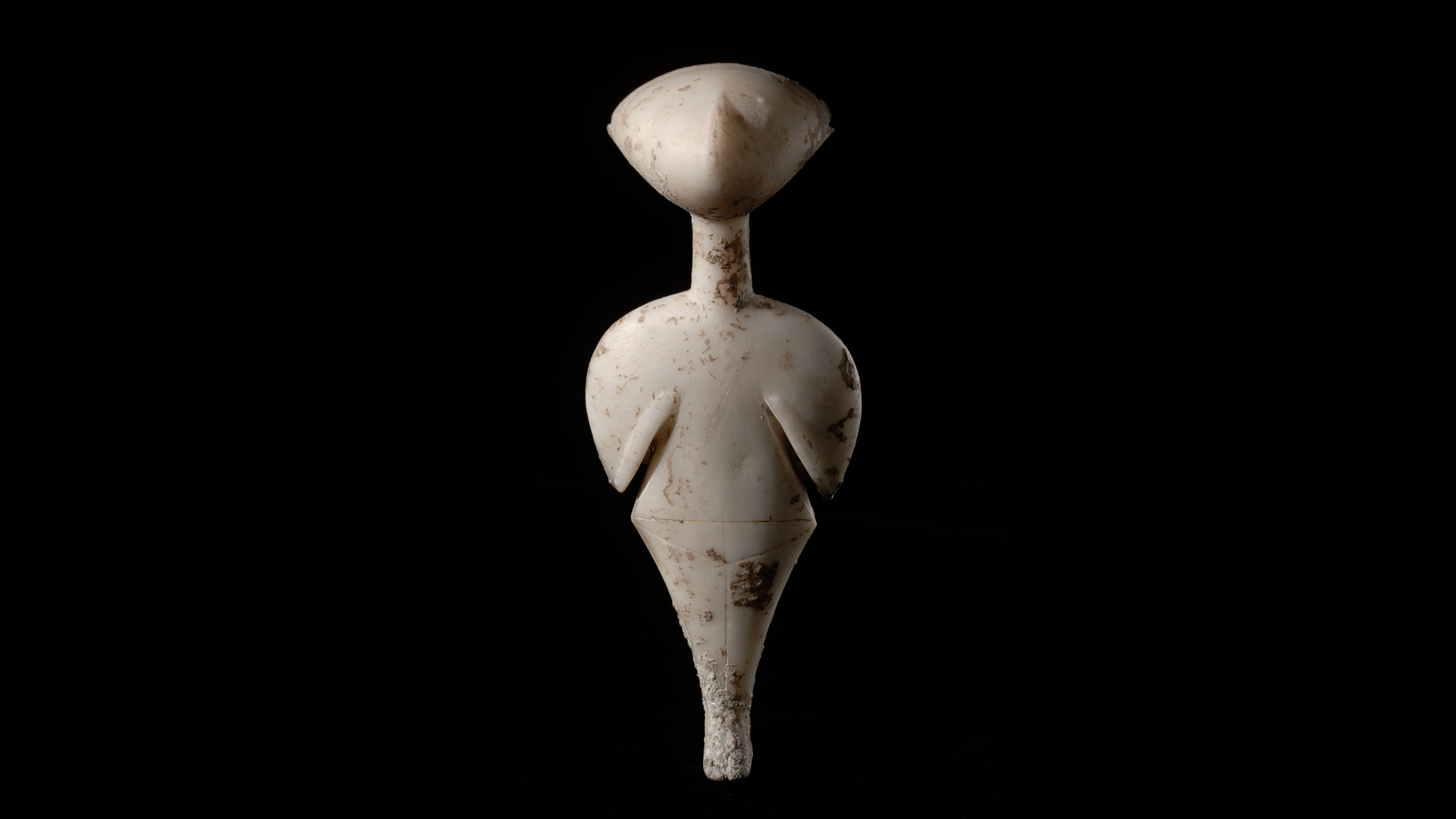

The Stargazer figurine was carved from marble around 5,000 years ago.
(Image credit: Cleveland Museum of Art / Leonard C. Hanna Jr. Fund; John L. Severance Fund 1993.165 (Public Domain))
QUICK FACTS
Name: The Stargazer
What it is: A marble figurine
Where it is from: Kırşehir, Turkey
When it was made: Circa 3000 B.C.
This small, abstract sculpture of a woman, carved from milky-white marble, is known as The Stargazer because her head is tilted back and her eyes appear to stare skyward. Only about 30 figurines of this type have ever been found; all of them date to about 3000 B.C. and were crafted by a culture that left no written records of the figurines’ meaning, according to art historian Amanda Mikolic.
This particular stargazer figurine was once owned by philanthropist Nelson Rockefeller, a member of the wealthy industrial family and vice president of the United States under Gerald Ford. It is now in the collection of the Cleveland Museum of Art (CMA).
The marble figurine is roughly 6.8 inches (17.2 centimeters) tall and weighs about 1 pound (454 grams). Clearly carved into human form but lacking a mouth, the statuette likely represents a woman, with the incised lines below the waist representing her pubic triangle. Her large, oval head is tilted back, and her tiny, dot-like eyes look upward.
Most stargazer figurines that have been discovered in western Anatolia (present-day Turkey) were broken at the neck before being buried in the ground millennia ago, making the CMA example one of the finest and most complete stargazer statuettes ever found.
But the meaning of the woman portrayed in The Stargazer figurine is unclear, since the culture that created it did not leave any written language explaining their art.
The figurine cannot stand on its own, suggesting that it was meant to be held or placed flat, according to Mikolic. “Deliberately rendered as female, she may be associated with fertility and abundance,” she wrote. The statuette may be part of a trend of simplistic female figurines in the Mediterranean area linked to female fertility and the life cycle, such as the Cycladic figurines, according to The Getty, which has a stargazer figurine in its collection.
Regardless of the woman’s specific meaning, “she must have been an important devotional object to some long-lost culture,” Arielle Kozloff, former curator of ancient art at the CMA, wrote in the CMA Members Magazine.
Get the world’s most fascinating discoveries delivered straight to your inbox.
Abstract female figurines like The Stargazer and other Neolithic examples are known to have inspired early-20th-century cubist masters, Kozloff wrote. This gives her “a sense of timelessness,” according to Mikolic, “encouraging the viewer to think of humankind’s place and role in a larger cosmos.”
For more stunning archaeological discoveries, check out our Astonishing Artifacts archives.
Can you put together last week’s Astonishing Artifact?
TOPICS
