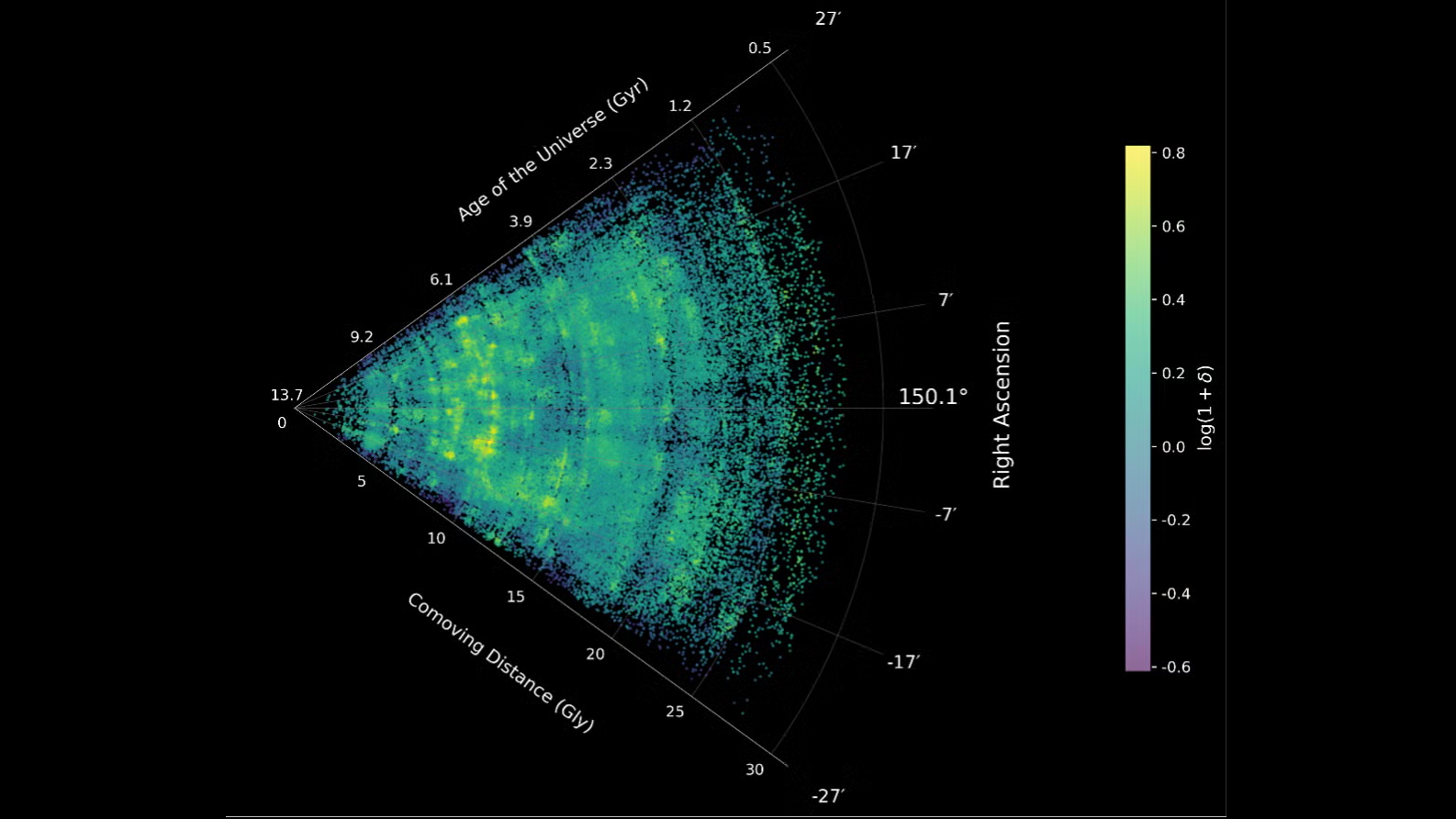
Astronomers have reconstructed the “skeleton” of the cosmos in unprecedented detail, thanks to the largest-ever survey conducted by the James Webb Space Telescope (JWST). The resulting map reveals how galaxies have evolved since the universe’s infancy around 13 billion years ago and how they fall together in a vast structure called the cosmic web.
The cosmic web is the largest known structure in existence, home to countless galaxy clusters and clusters of clusters. It is the framework of the universe, a scaffolding of gas filaments, stars, voids and sheets of dark matter that trace the entire large-scale organization of the cosmos.
In a paper published May 6 in The Astrophysical Journal, an international team of astronomers, led by researchers from the University of California, Riverside (UCR), utilized a treasure trove of JWST data to reveal how the universe has evolved.
Latest Videos From
How to sculpt a universe from scratch
The new research shows how intrinsic and extrinsic factors influence the formation and death of stars — and, therefore, galaxies and galactic clusters — throughout vast swathes of cosmic time.
“We show how the cosmic web helped shape galaxy growth before, during, and after that peak era,” study co-author and UCR astronomer Hossein Hatamnia told Live Science via email. “At earlier times, dense regions appear to be sites of rapid galaxy growth, while at later times dense environments are associated with the shutdown of star formation.”
Such revelations come courtesy of COSMOS-Web, the grandest JWST survey yet: a 255-hour program spanning a contiguous area of the sky about the size of three full moons.
Get the world’s most fascinating discoveries delivered straight to your inbox.
Compared with the previous COSMOS2020 survey, shared in 2021 and conducted by the Hubble Space Telescope and other facilities, the JWST-derived COSMOS-Web boasts better redshift precision and includes more galaxies — including fainter, lower-mass and more-distant objects. (Redshift is a measure of cosmic distance and time based on how light shifts to redder wavelengths as it crosses the universe.)
Compared with the JWST-derived image below, which shows a slice of the cosmos as it appeared 11.5 billion years ago, previous cosmic maps were sparser, more diffuse, and lacking in cosmic structures.
Data from the new COSMOS-Web survey (left) compared to the previous iteration (right). JWST’s sensitivity and depth has allowed scientists to map the cosmic web in unprecedented detail.
(Image credit: Hatamnia et al., The Astrophysical Journal, 2026)
Additionally, the older COSMOS2020 survey tended to overestimate the depth in especially dense cosmic regions, where galaxies grow earlier and larger, and underestimate the depth of the least-dense spatial regions, the researchers said.
Revealing celestial birth and death
Yet JWST’s cosmic map preserves the relative contrast across cosmic regions. It also shows that “massive galaxies in dense environments are more likely to be quiescent” — dying and quenched of their star-forming potential.
This may be because those galaxies are too massive, the team theorized. Once the dark matter halos that anchor galaxies grow to 1 trillion solar masses, they energize gas and prevent it from forming new stars. Additionally, active supermassive black holes quench star formation by energizing gas with their lethal, near-light-speed jets.
Such “mass-related” star-killing mechanisms dominated up to around 7 billion years ago — around half the age of the universe, the team found.
In the more recent universe, star formation is dominantly quenched by the environment around galaxies, which may strip them of material or prevent cold gas from accumulating and coalescing into stars.
Thanks to JWST’s capabilities, the large-scale structure and evolution of the universe have been made clearer than ever, resolving blurry blobs into dim, ancient galaxies.
“The jump in depth and resolution is truly significant, and we can now see the cosmic web at a time when the universe was only a few hundred million years old, an era that was essentially out of reach before JWST,” co-author Bahram Mobasher, a distinguished professor of physics and astronomy at UCR, concluded in a statement.
Hatamnia, H., Mobasher, B., Taamoli, S., Kartaltepe, J. S., Casey, C. M., Akins, H. B., Brinch, M., Chartab, N., Drakos, N. E., Faisst, A. L., Finkelstein, S. L., Franco, M., Giddings, F., Gozaliasl, G., Hadi, A., Haghjoo, A., Harish, S., Ilbert, O., Jablonka, P. L., . . . Yang, L. (2026). Large-scale Structure in COSMOS-Web: Tracing Galaxy Evolution in the Cosmic Web up to z ∼ 7 with the Largest JWST Survey. The Astrophysical Journal, 1002(2), 192. https://doi.org/10.3847/1538-4357/ae5bac