Close Menu
  • Home
  • UNSUBSCRIBE
  • News
  • Lifestyle
  • Tech
  • Entertainment
  • Sports
  • Travel
Facebook X (Twitter) WhatsApp
Trending
  • Toto Japan Classic: Nasa Hataoka wins a playoff hole in rain-shortened final day to claim seventh LPGA Tour title | Golf News
  • Inside Nick Lachey and Vanessa Lachey’s Epic Love Story
  • Researchers find massive spider web in cave
  • South Carolina teacher charged after allegedly trying to run over baby’s father
  • Kohl’s Black Friday ad 2025: Top deals you can shop online
  • Anthony Joshua? Francis Ngannou? Who will Jake Paul fight now after Gervonta Davis cancellation | Boxing News
  • 12 Funnel-Neck Jackets That Give Model-Off-Duty Vibes
  • Colombia’s defense minister on U.S. drug boat strikes
Facebook X (Twitter) WhatsApp
Baynard Media
  • Home
  • UNSUBSCRIBE
  • News
  • Lifestyle
  • Tech
  • Entertainment
  • Sports
  • Travel
Baynard Media
Home»Lifestyle»Strange ‘sea pigs,’ sea spiders and a spawning ‘butterfly’ discovered on Antarctic ocean floor by scientists
Lifestyle

Strange ‘sea pigs,’ sea spiders and a spawning ‘butterfly’ discovered on Antarctic ocean floor by scientists

EditorBy EditorApril 15, 2025No Comments4 Mins Read
Share Facebook Twitter Pinterest LinkedIn Tumblr Reddit Telegram Email
Share
Facebook Twitter LinkedIn Pinterest Email

Strange creatures straight out of a science-fiction movie have been captured by scientists off the coast of Antarctica.

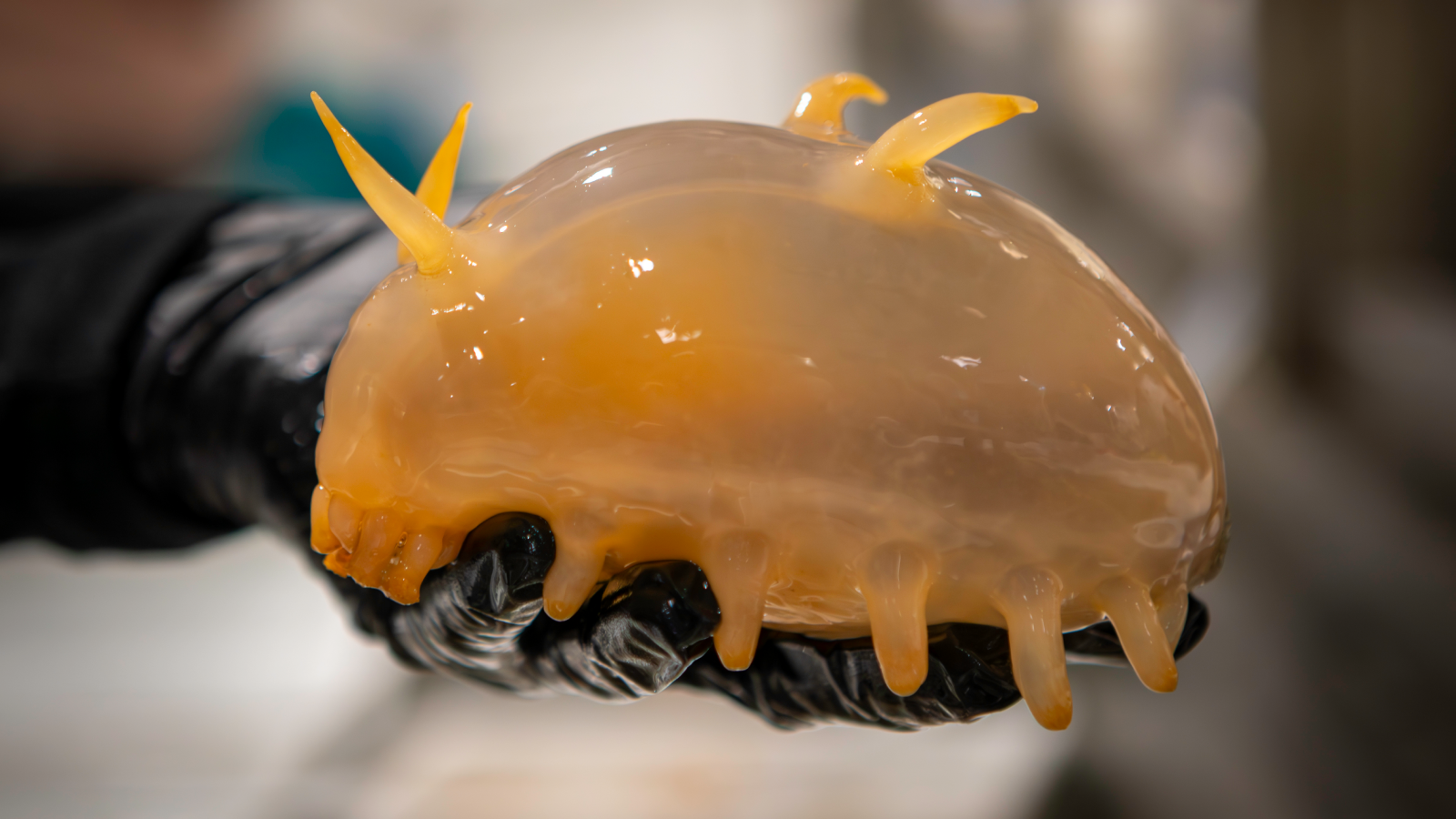
Pink and bulbous “sea pigs”, hand-sized sea spiders and delicate sea butterflies are among the bizarre animals hauled up from the ocean floor by a team of Australian researchers aboard the icebreaker ship RSV Nuyina, which is on a 60-day voyage across the Southern Ocean to the Denman Glacier.

Some of the weird wildlife may even be previously undiscovered.

“[We’ve collected] a really large diversity of a broad suite of marine life, and likely some new species to science,” Jan Strugnell, a professor of marine biology at James Cook University in Queensland, Australia, told ABC News.

The RSV Nuyina was launched for the Denman Marine Voyage to investigate the effects of warming sea temperatures on the Denman Glacier, which is located about 3,100 miles (5,000 kilometres) south of Australia and has already retreated 3.1 miles (5 km) between 1996 and 2017/2018. It is considered the fastest-melting glacier in East Antarctica.

Along the way, the ship’s researchers have been trawling the sea floor to bring up a huge variety of unusual organisms from the deep.

One of the strangest creatures was a sea pig. These bizarre animals are a type of sea cucumber and measure around 1.5 to 6 inches (4 to 15 centimeters) long. They get their name from their squishy, bloated bodies and stubby little legs, which make them vaguely resemble pigs. Sea pigs live on the sea floor, between 3,300 to 19,500 feet (1 to 6 km) below the ocean’s surface, and feed on the organic material that falls from the upper ocean layers, sometimes called “marine snow.”

Get the world’s most fascinating discoveries delivered straight to your inbox.

The scientists also fished out sea spiders “as big as your hand” and sea stars “that grow to the size of a dinner plate,” according to Strugnell.

Sea spider in white tray.

The sea spiders collected by the team were about the size of a human hand. (Image credit: Commonwealth of Australia/AAD)

Sea spiders are not true spiders, but instead belong to a separate group of arthropods, more closely related to crabs than the arachnids that live on land. They have eight long, thin legs and tiny bodies, with some species having a leg span of up to 20 inches (51 cm).

There are over 1,300 species of sea spider, which are found on the sea floor in a wide range of environments, including depths of up to 13,100 feet (4 km). Their bodies are so small that some of their organs — including parts of the gut and reproductive systems — are stuffed into their legs.

Person holds a long and thin fish.

Researchers say many of the specimens pulled up from the ocean floor could be new to science. (Image credit: Commonwealth of Australia/AAD)

The researchers on the ship were able to capture the most minuscule and fragile creatures thanks to a special “wet well,” which is a tank that holds seawater and is used to keep marine organisms alive and in good condition after they are collected from the ocean.

One organism that they were able to study was a sea butterfly, a type of sea snail that looks like it flies through the water. The sea butterfly specimen — nicknamed “Clio” by the scientists — laid eggs in one of the aquariums on the ship, allowing the researchers to study how these eggs developed for the very first time.

A sea butterfly.

A sea butterfly collected by the team started spawning after it was brought on board, allowing researchers to watch the eggs develop for the first time. (Image credit: Commonwealth of Australia/AAD)

“The team is super excited about having the little creature and observing it and looking after it, so that it tells all the secrets that have been hidden until now,” Laura Herraiz Borreguero, an oceanographer at the Commonwealth Scientific and Industrial Research Organisation (CSIRO) and the Australian Antarctic Program Partnership (AAPP), told ABC News.

Image 1 of 2

Large Antarctic ice sheet viewed from above with expedition boat in the distance.
The expedition aims to study effects of warming sea temperatures on Antarctica’s Denman Glacier.(Image credit: Commonwealth of Australia/AAD)

Stripey jade berg.
The expedition includes 60 scientists from four different research organizations in Australia. (Image credit: Commonwealth of Australia/AAD)

Along with collecting creatures from the deep, the researchers have also been taking samples of seawater near the edge of the glacier to analyze temperature, salinity, oxygen and the level of metals present at different depths.

“For us to really understand how much heat enters the ice shelf, we need to be as close as possible to understand these processes and properties of the ocean,” Herraiz Borreguero said.

“The system is changing. And it is really important that we observe the change so that we keep on challenging those climate models we rely on for our mitigation and adaptation strategies.”

Source link

Share. Facebook Twitter Pinterest LinkedIn Tumblr Email
Previous ArticleWatch creepy video of Protoclone robot with bionic muscles twitch, shrug and clench its fists
Next Article Mindy Weisberger on the skin-crawling reality of insect zombification
Editor
  • Website

Related Posts

Lifestyle

Latest science news: Comet 3I/ATLAS glows green | Roman roads | Bear attacks

November 8, 2025
Lifestyle

Watch “Kingdom” — Streaming details for David Attenborough series

November 8, 2025
Lifestyle

Some people love AI, others hate it. Here’s why.

November 8, 2025
Add A Comment

Comments are closed.

Categories
  • Entertainment
  • Lifestyle
  • News
  • Sports
  • Tech
  • Travel
Recent Posts
  • Toto Japan Classic: Nasa Hataoka wins a playoff hole in rain-shortened final day to claim seventh LPGA Tour title | Golf News
  • Inside Nick Lachey and Vanessa Lachey’s Epic Love Story
  • Researchers find massive spider web in cave
  • South Carolina teacher charged after allegedly trying to run over baby’s father
  • Kohl’s Black Friday ad 2025: Top deals you can shop online
calendar
November 2025
M T W T F S S
 12
3456789
10111213141516
17181920212223
24252627282930
« Oct    
Recent Posts
  • Toto Japan Classic: Nasa Hataoka wins a playoff hole in rain-shortened final day to claim seventh LPGA Tour title | Golf News
  • Inside Nick Lachey and Vanessa Lachey’s Epic Love Story
  • Researchers find massive spider web in cave
About

Welcome to Baynard Media, your trusted source for a diverse range of news and insights. We are committed to delivering timely, reliable, and thought-provoking content that keeps you informed
and inspired

Categories
  • Entertainment
  • Lifestyle
  • News
  • Sports
  • Tech
  • Travel
Facebook X (Twitter) Pinterest WhatsApp
  • Contact Us
  • About Us
  • Privacy Policy
  • Disclaimer
  • UNSUBSCRIBE
© 2025 copyrights reserved

Type above and press Enter to search. Press Esc to cancel.