Close Menu
  • Home
  • UNSUBSCRIBE
  • News
  • Lifestyle
  • Tech
  • Entertainment
  • Sports
  • Travel
Facebook X (Twitter) WhatsApp
Trending
  • 2 rivers merged to form the Euphrates 3.6 million years ago, eventually leading to the Fertile Crescent
  • NASA confirms fireball meteor exploded over northeastern US with force of 230 tons of TNT
  • Astronauts could use lightning-like plasma jets to kill germs on the moon and Mars, demo hints
  • First whole-genome sequence of a Greenland shark holds clues to their extreme longevity
  • Heading a soccer ball just once is enough to raise levels of proteins associated with brain damage
  • OpenAI’s internal AI model just solved an 80-year-old math problem ‪—‬ and mathematicians verified it
  • Skeletal remains of Queen Elisenda, one of the most powerful rulers in medieval Europe, unearthed in Barcelona — along with several others who bore unexplained stab wounds
  • Tests that measure ‘biological age’ aren’t helpful for tracking your health, scientists say
Facebook X (Twitter) WhatsApp
Baynard Media
  • Home
  • UNSUBSCRIBE
  • News
  • Lifestyle
  • Tech
  • Entertainment
  • Sports
  • Travel
Baynard Media
Home»Lifestyle»Space photo of the week: The tilted spiral galaxy that took Hubble 23 years to capture
Lifestyle

Space photo of the week: The tilted spiral galaxy that took Hubble 23 years to capture

EditorBy EditorJanuary 12, 2025No Comments2 Mins Read
Share Facebook Twitter Pinterest LinkedIn Tumblr Reddit Telegram Email
Share
Facebook Twitter LinkedIn Pinterest Email

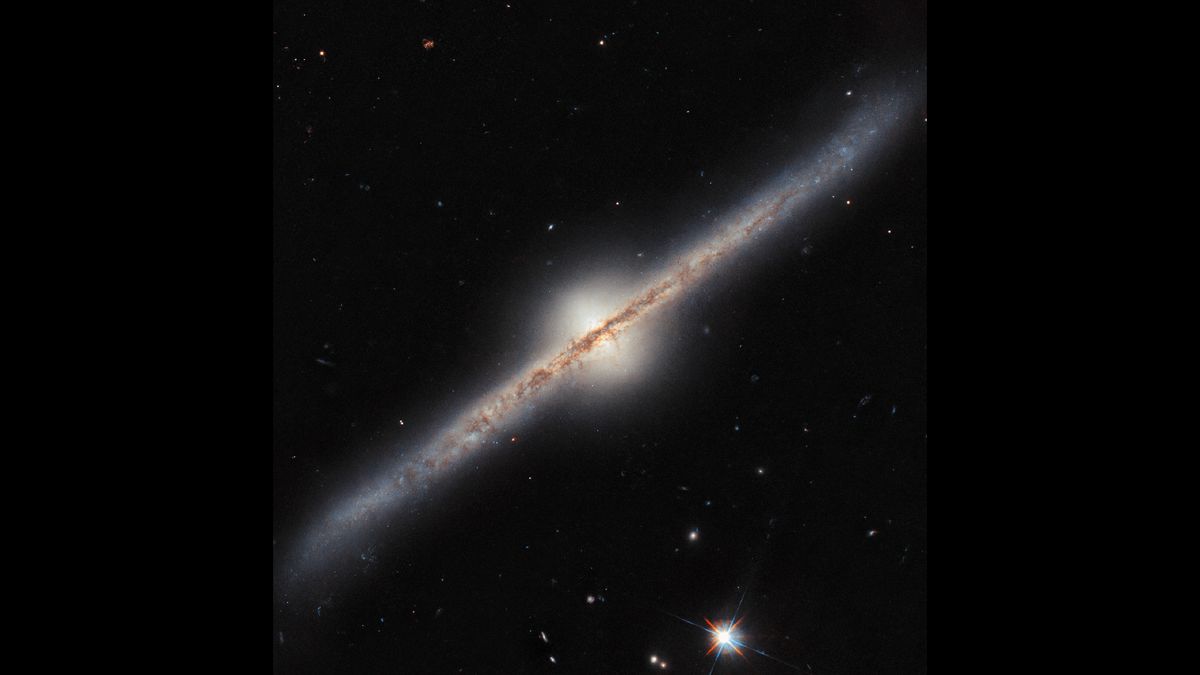
What it is: Spiral galaxy UGC 10043

Where it is: 150 million light-years away in the constellation Serpens

When it was shared: December 12, 2024

Why it’s so special: This image of a spiral galaxy taken by the Hubble Space Telescope is a portrait more than two decades in the making.

Like most full-color images of space objects, it’s a composite of images taken in different wavelengths of light. What sets this image apart, however, is that the data used to create it was collected during observation sessions in 2000 and 2023 — 23 years apart. That’s one advantage of having a space telescope in orbit for so long: Hubble was launched from the space shuttle Discovery on April 24, 1990, and its long service has enabled it to capture a huge amount of data about every corner of the cosmos.

But besides the prolonged methods used to create it, it’s also an unusual image on its face. Spiral galaxies — which account for about 60% of all galaxies in the universe, according to the European Space Agency — are, by chance, typically seen face-on when viewed from the solar system. That’s why spiral galaxies are typically associated with vivid spiral arms, which can only be seen from a face-on vantage. However, UGC 10043 is viewed edge-on, with its rings seemingly flattened into a line. This unique angle gives astronomers the chance to see how spiral galaxies are structured in 3D.

Related: Space photo of the week: Hubble celebrates 10 years of hunting giants

Get the world’s most fascinating discoveries delivered straight to your inbox.

This image of UGC 10043 reveals obvious lanes of dust, which would likely look like spiral arms if the galaxy was seen face-on. Here, they appear to block the collective glow of the stars that make up the galaxy itself. They also contain dark clouds, which are star-forming regions.

At the center of the image is a bulge of light — the galaxy’s bright core. All galaxies have one, but UGC 10043’s is unusually large. Astronomers think it may be because UGC 10043 has collided with a dwarf galaxy nearby, leaving it with extra dust and gas that has fueled it to create new stars. A collision could also explain why the galaxy’s disk is slightly warped, bending up at one end and down at the other.

For more sublime space images, check out our Space Photo of the Week archives.

Source link

Share. Facebook Twitter Pinterest LinkedIn Tumblr Email
Previous Article2TB of cloud storage for just $70.
Next Article Australian Open: Aryna Sabalenka makes winning start as Hady Habib makes history for Lebanon in Melbourne | Tennis News
Editor
  • Website

Related Posts

Lifestyle

2 rivers merged to form the Euphrates 3.6 million years ago, eventually leading to the Fertile Crescent

June 2, 2026
Lifestyle

NASA confirms fireball meteor exploded over northeastern US with force of 230 tons of TNT

June 2, 2026
Lifestyle

Astronauts could use lightning-like plasma jets to kill germs on the moon and Mars, demo hints

June 1, 2026
Add A Comment

Comments are closed.

Categories
  • Entertainment
  • Lifestyle
  • News
  • Sports
  • Tech
  • Travel
Recent Posts
  • 2 rivers merged to form the Euphrates 3.6 million years ago, eventually leading to the Fertile Crescent
  • NASA confirms fireball meteor exploded over northeastern US with force of 230 tons of TNT
  • Astronauts could use lightning-like plasma jets to kill germs on the moon and Mars, demo hints
  • First whole-genome sequence of a Greenland shark holds clues to their extreme longevity
  • Heading a soccer ball just once is enough to raise levels of proteins associated with brain damage
calendar
June 2026
M T W T F S S
1234567
891011121314
15161718192021
22232425262728
2930  
« May    
Recent Posts
  • 2 rivers merged to form the Euphrates 3.6 million years ago, eventually leading to the Fertile Crescent
  • NASA confirms fireball meteor exploded over northeastern US with force of 230 tons of TNT
  • Astronauts could use lightning-like plasma jets to kill germs on the moon and Mars, demo hints
About

Welcome to Baynard Media, your trusted source for a diverse range of news and insights. We are committed to delivering timely, reliable, and thought-provoking content that keeps you informed
and inspired

Categories
  • Entertainment
  • Lifestyle
  • News
  • Sports
  • Tech
  • Travel
Facebook X (Twitter) Pinterest WhatsApp
  • Contact Us
  • About Us
  • Privacy Policy
  • Disclaimer
  • UNSUBSCRIBE
© 2026 copyrights reserved

Type above and press Enter to search. Press Esc to cancel.