Close Menu
  • Home
  • UNSUBSCRIBE
  • News
  • Lifestyle
  • Tech
  • Entertainment
  • Sports
  • Travel
Facebook X (Twitter) WhatsApp
Trending
  • Artemis moon landing could face long delay while NASA waits for next-generation spacesuits
  • NASA’s Curiosity rover finds a surprising number of giant ‘dragon scales’ littered across Mars
  • Diagnostic dilemma: A teen’s classic diabetes symptoms didn’t improve with treatment — revealing she also had a much rarer syndrome
  • Strange mammal ancestor laid huge, leathery eggs —‬ and it was key to surviving the world’s worst mass extinction
  • Ancient process that created rare earth elements discovered — and it could help us locate desperately needed deposits
  • This humanoid robot does all your housework for you ‪—‬ and its makers say it’s ready for your home
  • ‘Nations need to prepare now’: Key Atlantic ocean current is much closer to collapse than scientists thought
  • Neanderthal toddlers grew faster than modern humans, probably because of the harsh environment they evolved in
Facebook X (Twitter) WhatsApp
Baynard Media
  • Home
  • UNSUBSCRIBE
  • News
  • Lifestyle
  • Tech
  • Entertainment
  • Sports
  • Travel
Baynard Media
Home»Lifestyle»Space photo of the week: James Webb telescope reveals hidden past of the ‘Crystal Ball Nebula’
Lifestyle

Space photo of the week: James Webb telescope reveals hidden past of the ‘Crystal Ball Nebula’

EditorBy EditorApril 20, 2025No Comments3 Mins Read
Share Facebook Twitter Pinterest LinkedIn Tumblr Reddit Telegram Email
Share
Facebook Twitter LinkedIn Pinterest Email

What it is: NGC 1514, a planetary nebula

Where it is: 1,500 light-years distant in the constellation Taurus

When it was shared: April 14, 2025


You may like

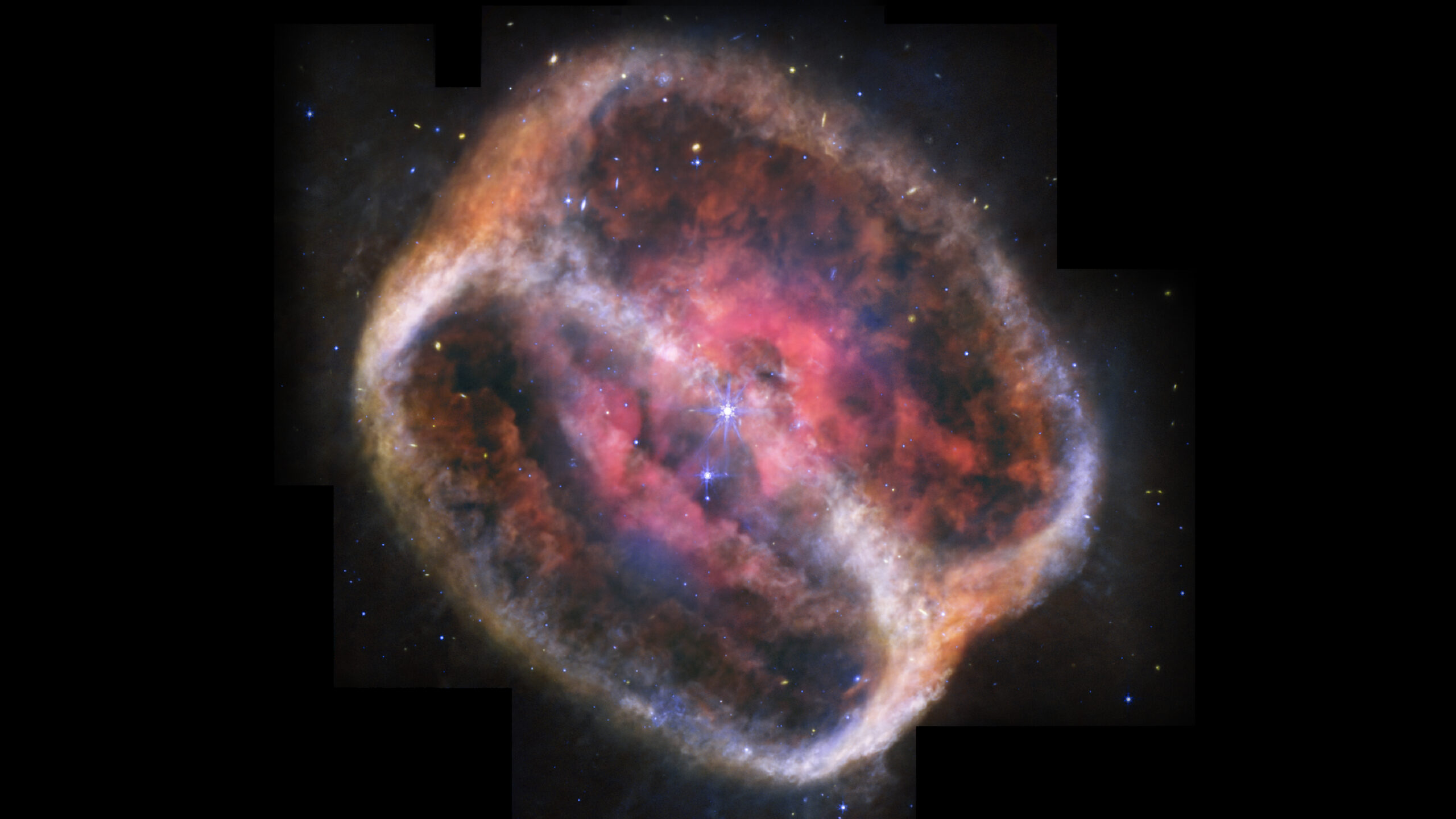
Why it’s so special: The death of a star can be the catalyst for one of the most beautiful sights in the universe. To see that, look no further than the latest images from the James Webb Space Telescope (JWST), which recently turned its gaze toward a planetary nebula called NGC 1514.

According to NASA, planetary nebulas form during the death of some stars as they expel their outer layers into space. Planetary nebulas like NGC 1514 are expanding shells of gas that form intricate shapes. NGC 1514 is sometimes called the Crystal Ball Nebula, but in this new image from Webb, it looks more like an hourglass or a ring. That’s thanks to the extra details revealed by JWST’s infrared optics, with its Mid-infrared Instrument (MIRI) in particular helping to draw out gas clouds and rings.

Related: James Webb telescope spots Milky Way’s long-lost ‘twin’ — and it is ‘fundamentally changing our view of the early universe’

In the center of the nebula is what looks like a single bright star. Appearances can be deceptive; it’s actually a binary system, with the dense cores of two dying stars locked in a shared orbit. These stars — one still expelling its outer gas layers and the other a white dwarf, the hot remnant of a star that has used up its nuclear fuel — are responsible for what JWST can see only in infrared light.

Get the world’s most fascinating discoveries delivered straight to your inbox.

The white dwarf started as a star several times more massive than the sun.

a comparison of images taken of nebula NGC 1514 by WISE and JWST. The JWST image is much crisper and more detailed.

NASA’s WISE satellite and JWST share competing views of the Crystal Ball Nebula (Image credit: NASA, ESA, CSA, STScI, NASA-JPL, Caltech, UCLA, Michael Ressler (NASA-JPL), Dave Jones (IAC))

“As it evolved, it puffed up, throwing off layers of gas and dust in a very slow, dense stellar wind,” David Jones, a senior scientist at the Institute of Astrophysics on the Canary Islands, who found the binary star system in 2017, said in a statement.

JWST offers scientists an unprecedented glimpse into the cosmos, revealing never-before-seen details even in objects that have previously been studied. “Before Webb, we weren’t able to detect most of this material, let alone observe it so clearly,” said Mike Ressler, a researcher and project scientist for Webb’s MIRI at NASA’s Jet Propulsion Laboratory in southern California. “With MIRI’s data, we can now comprehensively examine the turbulent nature of this nebula.” Ressler had noticed the rings around NGC 1514 in a much fuzzier and less detailed image taken in 2010 by NASA’s now-retired Wide-field Infrared Survey Explorer (WISE).

For more sublime space images, check out our Space Photo of the Week archives.

Source link

Share. Facebook Twitter Pinterest LinkedIn Tumblr Email
Previous ArticleHow will the latest generation of fighter jets stand out? The answer lies in stealth tech.
Next Article Venus at ‘greatest brilliancy’: How to see our neighboring planet at its best and brightest this week
Editor
  • Website

Related Posts

Lifestyle

Artemis moon landing could face long delay while NASA waits for next-generation spacesuits

April 22, 2026
Lifestyle

NASA’s Curiosity rover finds a surprising number of giant ‘dragon scales’ littered across Mars

April 22, 2026
Lifestyle

Diagnostic dilemma: A teen’s classic diabetes symptoms didn’t improve with treatment — revealing she also had a much rarer syndrome

April 22, 2026
Add A Comment

Comments are closed.

Categories
  • Entertainment
  • Lifestyle
  • News
  • Sports
  • Tech
  • Travel
Recent Posts
  • Artemis moon landing could face long delay while NASA waits for next-generation spacesuits
  • NASA’s Curiosity rover finds a surprising number of giant ‘dragon scales’ littered across Mars
  • Diagnostic dilemma: A teen’s classic diabetes symptoms didn’t improve with treatment — revealing she also had a much rarer syndrome
  • Strange mammal ancestor laid huge, leathery eggs —‬ and it was key to surviving the world’s worst mass extinction
  • Ancient process that created rare earth elements discovered — and it could help us locate desperately needed deposits
calendar
April 2026
M T W T F S S
 12345
6789101112
13141516171819
20212223242526
27282930  
« Mar    
Recent Posts
  • Artemis moon landing could face long delay while NASA waits for next-generation spacesuits
  • NASA’s Curiosity rover finds a surprising number of giant ‘dragon scales’ littered across Mars
  • Diagnostic dilemma: A teen’s classic diabetes symptoms didn’t improve with treatment — revealing she also had a much rarer syndrome
About

Welcome to Baynard Media, your trusted source for a diverse range of news and insights. We are committed to delivering timely, reliable, and thought-provoking content that keeps you informed
and inspired

Categories
  • Entertainment
  • Lifestyle
  • News
  • Sports
  • Tech
  • Travel
Facebook X (Twitter) Pinterest WhatsApp
  • Contact Us
  • About Us
  • Privacy Policy
  • Disclaimer
  • UNSUBSCRIBE
© 2026 copyrights reserved

Type above and press Enter to search. Press Esc to cancel.