Close Menu
  • Home
  • UNSUBSCRIBE
  • News
  • Lifestyle
  • Tech
  • Entertainment
  • Sports
  • Travel
Facebook X (Twitter) WhatsApp
Trending
  • Pregnancy quiz: Can you deliver on the science of growing babies?
  • Science news this week: The latest on the cruise ship hantavirus infections, a shortcut to Mars, and a fast-charging quantum battery
  • Hantavirus cruise LIVE: Cruise passengers monitored in at least 5 US states as American passengers set to receive repatriation flight
  • Mangroves clean up $8.7 billion of nitrogen pollution every year, study finds
  • Flowering plants transformed into ‘hopeful monsters’ in 9 dire bursts across evolutionary time, study finds
  • US government declassifies nearly 200 UAP files, including strange sightings from Apollo astronauts
  • Some gene therapies no longer require clinical trials, thanks to new FDA rule. Is this safe, and who will it help?
  • Live quantum network test in New York overcomes 2 key hurdles in creating an ‘unhackable’ internet
Facebook X (Twitter) WhatsApp
Baynard Media
  • Home
  • UNSUBSCRIBE
  • News
  • Lifestyle
  • Tech
  • Entertainment
  • Sports
  • Travel
Baynard Media
Home»Lifestyle»Scientists discover 2 stars orbiting our galaxy’s supermassive black hole in lockstep — and they could point to a type of planet never seen before
Lifestyle

Scientists discover 2 stars orbiting our galaxy’s supermassive black hole in lockstep — and they could point to a type of planet never seen before

EditorBy EditorDecember 20, 2024No Comments4 Mins Read
Share Facebook Twitter Pinterest LinkedIn Tumblr Reddit Telegram Email
Share
Facebook Twitter LinkedIn Pinterest Email

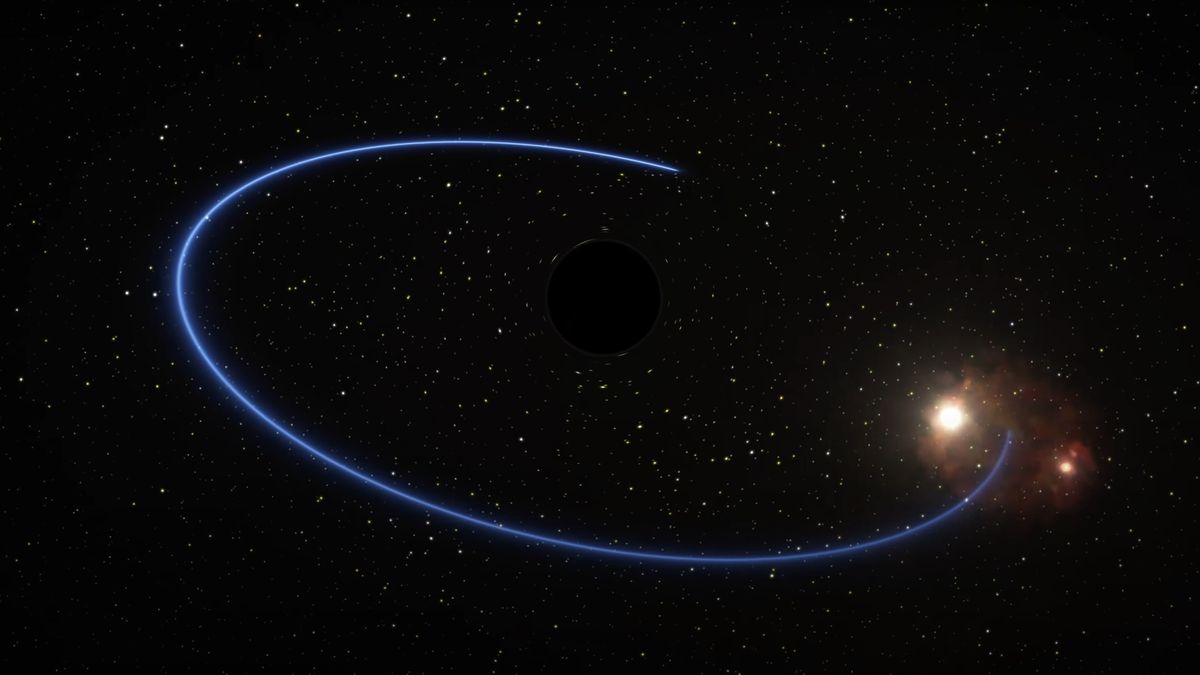
Astronomers have discovered a pair of young stars near the supermassive black hole at the heart of our galaxy. And despite living so close to the cosmic behemoth, they are likely to remain intact for a million years.

While our pocket of the universe is home to a solitary sun, that’s not the norm. More than half of all stars in the sky have one or more companions, yet until now, none have been found near a supermassive black hole. Astronomers attribute this absence to the extreme gravity black holes, which tug unevenly on nearby stars, making such multiple-star systems unstable and potentially kicking one of them out on lonely, high-speed journeys through the Milky Way.

But the newfound duo, dubbed D9, suggests that some stellar pairs can, in fact, hang on near a black hole, if only for a short while. Astronomers estimate the stars are about 2.7 million years old, with one weighing roughly 2.8 times the mass of the sun while its companion may be just t 0.7 solar masses. Locked in a gravitational dance, they skirt Sagittarius A* (Sgr A*), the supermassive black hole lurking at our galaxy’s center, as close as 0.095 light-years. Yet the fact that the two stars have not been torn apart and shredded suggests “black holes are not as destructive as we thought,” Florian Peißker, an astronomer at the University of Cologne, said in a statement.

He and his colleagues describe the D9 stars in a paper published Tuesday (Dec. 17) in the journal Nature Communications.

In the nick of time

Peißker was using the European Southern Observatory’s Very Large Telescope (VLT) in Chile, to study mysterious G objects near our galaxy’s center — apparent clumps of gas and dust that exhibit star-like behavior, whose true nature has eluded astronomers — when he noticed the orbit of one object wobbling strangely.

Related: Scientists followed a mysterious signal — and found 2 black holes gorging on something like never before

So, every night for 15 years, he used VLT to monitor changes to the wobbling object’s wavelengths of light, which revealed how much ionized hydrogen the object emitted — in turn revealing a regular 372-day pattern. This periodic fluctuation was caused by the “Doppler Effect,” in which wavelengths of light are stretched or smooshed as an object passes by them. This 372-day pattern was evidence that the “object” is actually two stars caught in a gravitational dance around our galaxy’s center, the researchers said.

Get the world’s most fascinating discoveries delivered straight to your inbox.

The researchers estimate the newfound stars ignited just 2.7 million years ago and will eventually succumb to the black hole’s gravity, merging into a single star within a million years.

“This provides only a brief window on cosmic timescales to observe such a binary system — and we succeeded!” study co-author Emma Bordier of the University of Cologne said in the statement.

a labelled photo showing the location of D9 next to Sagittarius A

D9 is the first star pair ever found near Sagittarius A*, the supermassive black hole at the centre of the Milky Way. This image shows an emission line of hydrogen mapped by the SINFONI instrument on ESO’s Very Large Telescope. (Image credit: ESO/F. Peißker et al.)

A sneak peek of hidden stars and planets

Beyond being a technological feat, this discovery could help explain why similar binary pairs haven’t been detected near our galaxy’s center. There, the mysterious G objects that appear to be clouds of gas and dust may instead be binary stars about to merge, like the D9 pair, or remnant material from past mergers, researchers say.

As the clouds of dust and gas around these binary stars dissipate, the stellar duos would be reborn as single, youthful stars that have been observed zipping around the Milky Way’s center at hypervelocities, the new study suggests.

Moreover, because young stars are often accompanied by planets, this discovery also raises the possibility of finding orbiting worlds near black holes, Peißker said in the statement.

“It seems plausible that the detection of planets in the galactic center is just a matter of time.”

Source link

Share. Facebook Twitter Pinterest LinkedIn Tumblr Email
Previous ArticleBest Amazon deals of the day: Sony WH-1000XM5, Apple AirTags 4-pack, Fire HD 10 tablet, Roku Streambar SE, UE Wonderboom Play
Next Article MasterClass memberships are 50% off through December 25
Editor
  • Website

Related Posts

Lifestyle

Pregnancy quiz: Can you deliver on the science of growing babies?

May 9, 2026
Lifestyle

Science news this week: The latest on the cruise ship hantavirus infections, a shortcut to Mars, and a fast-charging quantum battery

May 9, 2026
Lifestyle

Hantavirus cruise LIVE: Cruise passengers monitored in at least 5 US states as American passengers set to receive repatriation flight

May 9, 2026
Add A Comment

Comments are closed.

Categories
  • Entertainment
  • Lifestyle
  • News
  • Sports
  • Tech
  • Travel
Recent Posts
  • Pregnancy quiz: Can you deliver on the science of growing babies?
  • Science news this week: The latest on the cruise ship hantavirus infections, a shortcut to Mars, and a fast-charging quantum battery
  • Hantavirus cruise LIVE: Cruise passengers monitored in at least 5 US states as American passengers set to receive repatriation flight
  • Mangroves clean up $8.7 billion of nitrogen pollution every year, study finds
  • Flowering plants transformed into ‘hopeful monsters’ in 9 dire bursts across evolutionary time, study finds
calendar
May 2026
M T W T F S S
 123
45678910
11121314151617
18192021222324
25262728293031
« Apr    
Recent Posts
  • Pregnancy quiz: Can you deliver on the science of growing babies?
  • Science news this week: The latest on the cruise ship hantavirus infections, a shortcut to Mars, and a fast-charging quantum battery
  • Hantavirus cruise LIVE: Cruise passengers monitored in at least 5 US states as American passengers set to receive repatriation flight
About

Welcome to Baynard Media, your trusted source for a diverse range of news and insights. We are committed to delivering timely, reliable, and thought-provoking content that keeps you informed
and inspired

Categories
  • Entertainment
  • Lifestyle
  • News
  • Sports
  • Tech
  • Travel
Facebook X (Twitter) Pinterest WhatsApp
  • Contact Us
  • About Us
  • Privacy Policy
  • Disclaimer
  • UNSUBSCRIBE
© 2026 copyrights reserved

Type above and press Enter to search. Press Esc to cancel.