
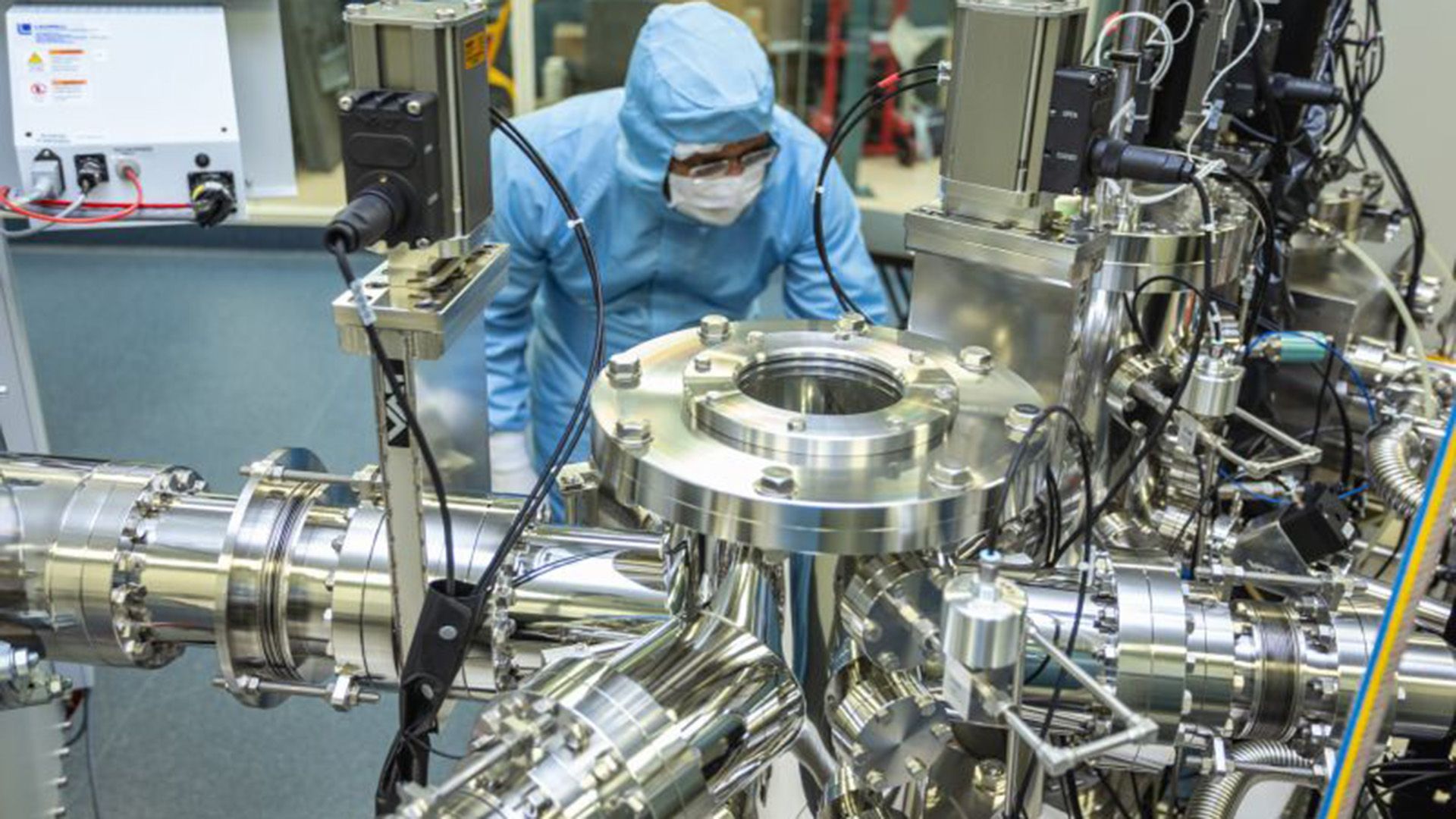
Researchers have created the world’s first miniature, proof-of-concept quantum battery. If the technology can be replicated, it could transform the field of energy storage forever and open up new possibilities for lightweight, remote electrification, experts say.
The research team outlined their design for the quantum battery in a study published March 13 in the journal Light: Science & Applications. They say it can be used for long-term battery storage, as well as high-density battery applications such as heavy electric vehicles.
In a standard lithium-ion (Li-ion) battery, ions move between the cathode and the anode through an electrolyte. But inside a quantum battery, energy is stored as electromagnetic excitation among coherent molecules — molecules that share non-random internal states such as their vibrational energy or electron states. This allows them to maintain a fixed relationship with one another.
Quantum batteries rely on the weird laws of quantum mechanics. In this case, the researchers relied on quantum coherence — an effect in which a mass of local particles exists in multiple states at once. These particles, though in a “superposition” of states, act in predictable ways relative to one another. Collected in the battery, the coherent particles undergo quantum entanglement, which means they are not simply aligned with one another but functionally the same, forming one larger system.
This allows all molecules within the battery to charge at a constant speed, no matter its size. The more molecules involved, the more efficiently energy is absorbed throughout the system, meaning charging times actually decrease in real terms as the battery size increases.
“Similar to conventional batteries, quantum batteries charge, store and discharge energy,”, explained Hutchinson in the statement. “But while everyday batteries rely on chemical reactions, quantum batteries leverage properties of quantum mechanics. The advantage of quantum is that the system absorbs light in a single, giant ‘super absorption’ event and this charges the battery faster.”
Composition of the quantum battery
To build the battery, the researchers relied on the Dicke model in quantum optics, which states that when light and matter are coupled beyond a set value, they can become superradiant — where a group of emitters emit light collectively in a short, intense pulse.
In practical terms, the battery is made up of a series of organic semiconductor layers (where the coupling occurs) sandwiched between silver mirrors, creating a microcavity — a microscopic structure that confines light to a small volume, allowing it to reflect multiple times.
This allows the coherent group of molecules or atoms to emit light in a unified pulse — a necessary function for the discharging of the quantum battery — as well as to absorb light at a rate equal to the number of coherent molecules squared. This is known as superabsorption. The microcavity is essential for coupling and superabsorption, as it provides the right confined environment to achieve the set ratio between light and matter set out in the Dicke model.
Beneath and above the organic semiconductors, hole blocking and electron transport layers ensure electrons can flow toward the cathode and electrodes when necessary so the system can actually function as a battery.
In tests at the University of Melbourne’s Ultrafast and Microspectroscopy Laboratories, the researchers fired a laser pulse with a bandwidth of 31 nanometers for a femtosecond (one-quadrillionth of a second), which prompted an excited state in the molecules for tens of nanoseconds (several hundred millionths of a second).
This means the battery is capable of holding a charge for 1 million times longer than the time it takes to charge it.
On this scale, a battery that took one minute to charge could remain charged for “a couple of years,” first researcher James Quach, science leader at CSIRO, Australia’s national science agency, told The Guardian.
Going forward, the researchers aim to scale up the battery in such a manner while retaining its charge. This is a key hurdle, as the energy stored in quantum batteries is susceptible to environmental noise, which can disrupt or eliminate quantum behavior in a process known as decoherence.
If this obstacle can be overcome, the implications of a practical quantum battery could be profound. For instance, remote charging via lasers could open up more opportunities for batteries in drones or aircraft because they could be charged in midair.
Andrew White, who leads the Quantum Technology Laboratory at the University of Queensland, told The Guardian that an initial application could be to power quantum computers at a very low energy cost.
Hymas, K., Muir, J. B., Tibben, D., Van Embden, J., Hirai, T., Dunn, C. J., Gómez, D. E., Hutchison, J. A., Smith, T. A., & Quach, J. Q. (2026). Superextensive electrical power from a quantum battery. Light Science & Applications, 15(1). https://doi.org/10.1038/s41377-026-02240-6
