Close Menu
  • Home
  • UNSUBSCRIBE
  • News
  • Lifestyle
  • Tech
  • Entertainment
  • Sports
  • Travel
Facebook X (Twitter) WhatsApp
Trending
  • Archaeologists find 2,800-year-old burial of person clutching sea turtle vessel in El Salvador
  • New robotic heart mimics common, mysterious condition to help researchers study it
  • Canon EOS R6 III review: A wildlife wonder
  • Medieval babies and adults buried together in Sweden were not related, archaeologists discover — raising big questions about early Christian burial practices
  • NASA is creating a fifth state of matter on the ISS, thanks to an upgrade to a mini-fridge-sized quantum lab
  • New sodium metal battery design charges in just 4 minutes and retains its capacity for years
  • Quantum computing wielded to create extremely rare material critical to nuclear fusion
  • Scientists build tiny ‘diving suit’ for cockroaches, turning them into search-and-rescue cyborgs
Facebook X (Twitter) WhatsApp
Baynard Media
  • Home
  • UNSUBSCRIBE
  • News
  • Lifestyle
  • Tech
  • Entertainment
  • Sports
  • Travel
Baynard Media
Home»Lifestyle»Paralvinella hessleri: The yellow worm that lives in acid and fights poison with poison
Lifestyle

Paralvinella hessleri: The yellow worm that lives in acid and fights poison with poison

EditorBy EditorSeptember 20, 2025No Comments2 Mins Read
Share Facebook Twitter Pinterest LinkedIn Tumblr Reddit Telegram Email
Share
Facebook Twitter LinkedIn Pinterest Email

QUICK FACTS

Name: Paralvinella hessleri

Where it lives: Pacific Ocean

What it eats: Bacteria and organic debris around hydrothermal vents

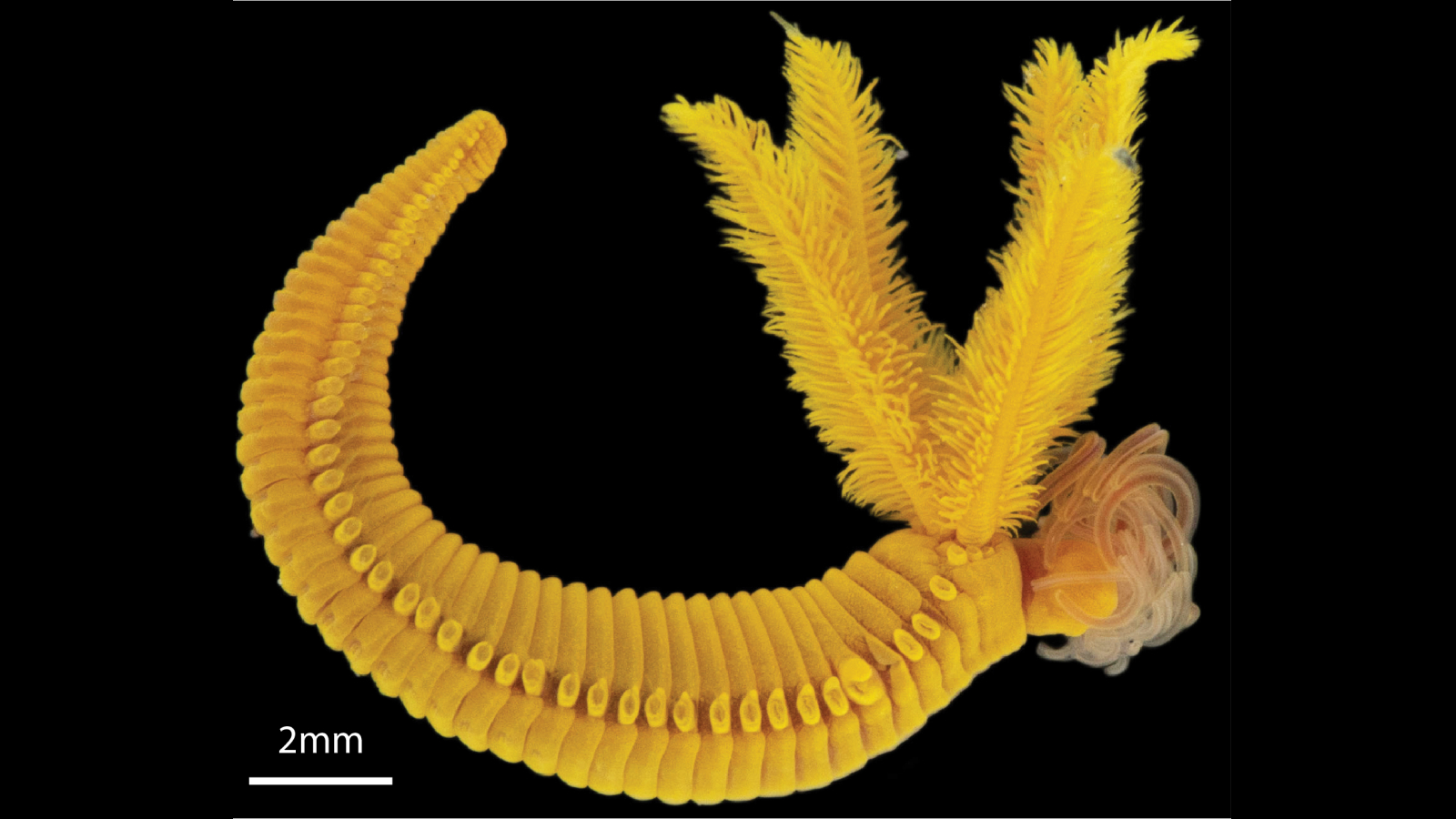
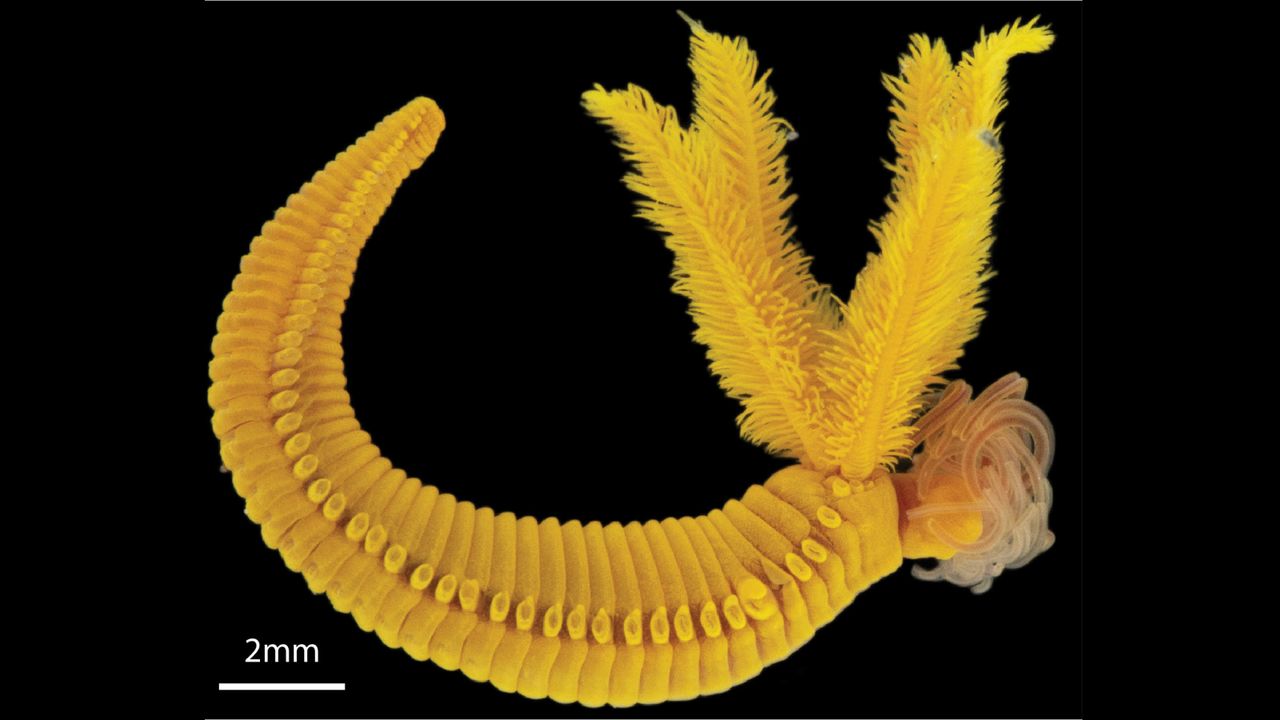
Deep-sea creatures are uniquely adapted to living in extreme environments, and the worm Paralvinella hessleri is no exception. In fact, it survives high levels of toxic chemicals like arsenic by creating its own poison.

P. hessleri is a member of the family Alvinellidae, a group of small tube worms adapted to some of the most extreme environments on Earth.

Found only at the hottest hydrothermal vents in the western Pacific, including the Okinawa Trough and Mariana Back-Arc Basin, these worms grow up to about 0.8 inches (22 millimeters) in length and live in protective tubes attached to vent chimneys. Remarkably, P. hessleri is the only known animal able to colonize and thrive in the acidic, metal-rich zones of these vents, where temperatures can reach around 608 degrees Fahrenheit (320 degrees Celsius).


You may like

These worms have an unusual survival trick that lets them withstand the high levels of toxic arsenic and sulfide found at hydrothermal vents. In humans, arsenic exposure is linked to serious health problems, including cancer and neurological disorders. P. hessleri, however, turns this danger into a defense: it stores arsenic in its skin cells, where the toxin reacts with sulfide from vent fluids to form orpiment — a less harmful, though still poisonous, mineral.

This bright yellow-orange substance, once known as “King’s Yellow,” was historically used by artists as a pigment until its toxicity became clear. P. hessleri, which has a yellow-orange tint due to the orpiment crystals, can accumulate so much arsenic that it makes up nearly 1% of the worm’s body weight.

In a 2025 paper published in the journal PLOS Biology, the researchers who discovered the worms’ survival strategy described the process as “fighting poison with poison.”

Commenting on the discovery, study co-author Hao Wang, a researcher at the Chinese Academy of Sciences’ Institute of Oceanology, said he was “stunned” when he first saw the worms with a remotely operated vehicle.

Get the world’s most fascinating discoveries delivered straight to your inbox.

“The bright yellow Paralvinella hessleri worms were unlike anything I had ever seen, standing out vividly against the white biofilm and dark hydrothermal vent landscape,” he said in a statement. “It was hard to believe that any animal could survive, let alone thrive, in such an extreme and toxic environment.”

Source link

Share. Facebook Twitter Pinterest LinkedIn Tumblr Email
Previous ArticleCountry star Luke Bryan brings music and support to rural America’s farms
Next Article Arrest made after shots fired at ABC-affiliate station
Editor
  • Website

Related Posts

Lifestyle

Archaeologists find 2,800-year-old burial of person clutching sea turtle vessel in El Salvador

July 26, 2026
Lifestyle

New robotic heart mimics common, mysterious condition to help researchers study it

July 11, 2026
Lifestyle

Canon EOS R6 III review: A wildlife wonder

July 10, 2026
Add A Comment

Comments are closed.

Categories
  • Entertainment
  • Lifestyle
  • News
  • Sports
  • Tech
  • Travel
Recent Posts
  • Archaeologists find 2,800-year-old burial of person clutching sea turtle vessel in El Salvador
  • New robotic heart mimics common, mysterious condition to help researchers study it
  • Canon EOS R6 III review: A wildlife wonder
  • Medieval babies and adults buried together in Sweden were not related, archaeologists discover — raising big questions about early Christian burial practices
  • NASA is creating a fifth state of matter on the ISS, thanks to an upgrade to a mini-fridge-sized quantum lab
calendar
July 2026
M T W T F S S
 12345
6789101112
13141516171819
20212223242526
2728293031  
« Jun    
Recent Posts
  • Archaeologists find 2,800-year-old burial of person clutching sea turtle vessel in El Salvador
  • New robotic heart mimics common, mysterious condition to help researchers study it
  • Canon EOS R6 III review: A wildlife wonder
About

Welcome to Baynard Media, your trusted source for a diverse range of news and insights. We are committed to delivering timely, reliable, and thought-provoking content that keeps you informed
and inspired

Categories
  • Entertainment
  • Lifestyle
  • News
  • Sports
  • Tech
  • Travel
Facebook X (Twitter) Pinterest WhatsApp
  • Contact Us
  • About Us
  • Privacy Policy
  • Disclaimer
  • UNSUBSCRIBE
© 2026 copyrights reserved

Type above and press Enter to search. Press Esc to cancel.