Close Menu
  • Home
  • UNSUBSCRIBE
  • News
  • Lifestyle
  • Tech
  • Entertainment
  • Sports
  • Travel
Facebook X (Twitter) WhatsApp
Trending
  • New robotic heart mimics common, mysterious condition to help researchers study it
  • Canon EOS R6 III review: A wildlife wonder
  • Medieval babies and adults buried together in Sweden were not related, archaeologists discover — raising big questions about early Christian burial practices
  • NASA is creating a fifth state of matter on the ISS, thanks to an upgrade to a mini-fridge-sized quantum lab
  • New sodium metal battery design charges in just 4 minutes and retains its capacity for years
  • Quantum computing wielded to create extremely rare material critical to nuclear fusion
  • Scientists build tiny ‘diving suit’ for cockroaches, turning them into search-and-rescue cyborgs
  • Physicists develop the first working model of quantum mechanics using only ‘real’ numbers
Facebook X (Twitter) WhatsApp
Baynard Media
  • Home
  • UNSUBSCRIBE
  • News
  • Lifestyle
  • Tech
  • Entertainment
  • Sports
  • Travel
Baynard Media
Home»Lifestyle»Artemis II crew captures rare double auroras on the dark side of Earth as they zoom toward the moon — Space photo of the week
Lifestyle

Artemis II crew captures rare double auroras on the dark side of Earth as they zoom toward the moon — Space photo of the week

EditorBy EditorJune 14, 2026No Comments3 Mins Read
Share Facebook Twitter Pinterest LinkedIn Tumblr Reddit Telegram Email
Share
Facebook Twitter LinkedIn Pinterest Email

Quick Facts

What it is: A moonlit Earth.

Where it is: Image taken from Earth orbit.

When it was shared: June 4, 2026.

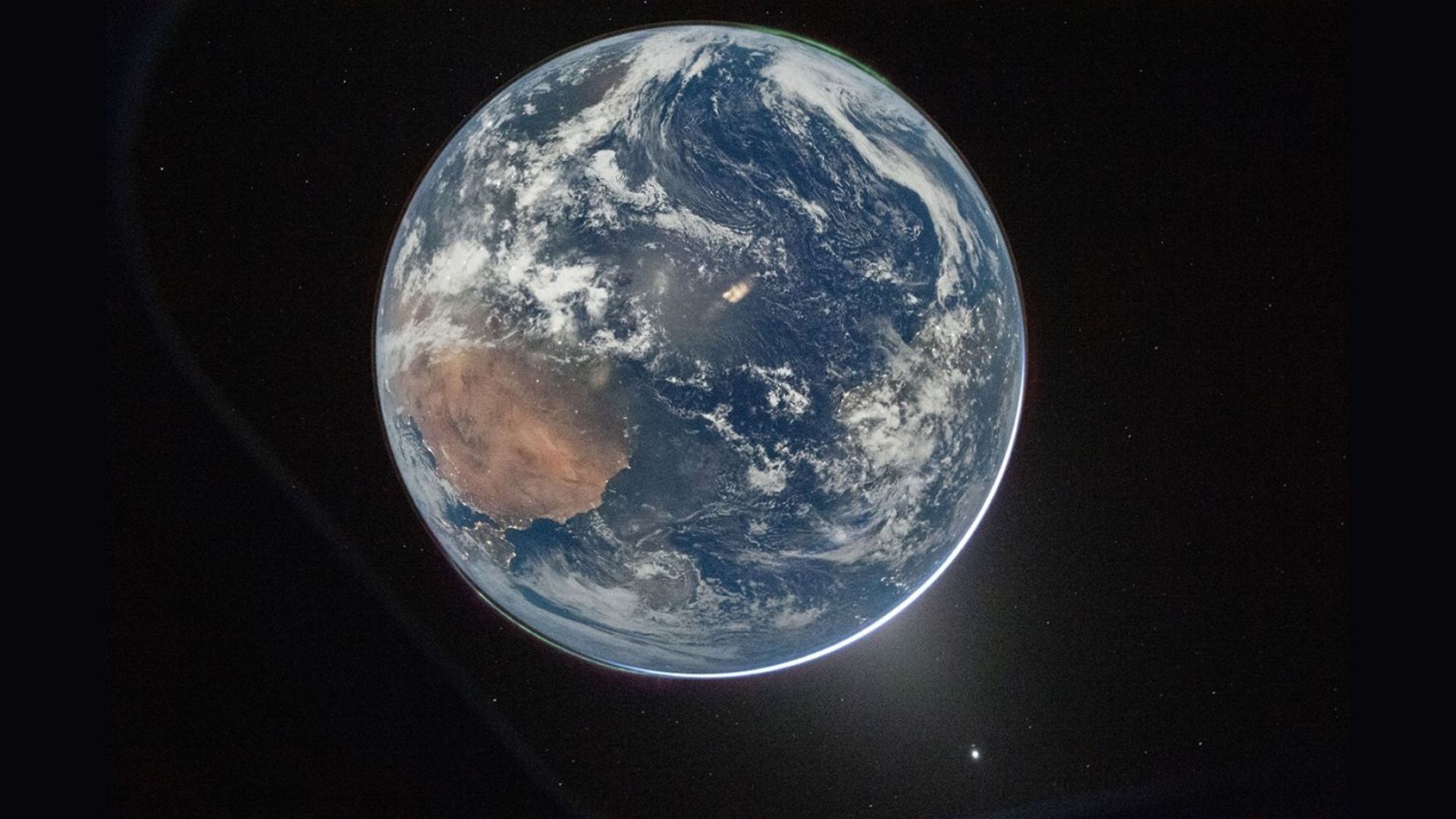
When NASA astronaut Reid Wiseman pointed his camera back at Earth — just as the Artemis II crew’s Orion spacecraft departed for the moon on April 2 — he captured what looks, to the untrained eye, like a regular “Blue Marble” image. But look closer, and you will see a series of hidden details that make this one of the mission’s most unique and poignant images.

When Wiseman took this photograph (with a Nikon D5 camera), he and his record-breaking crew were on the night side of Earth. Yet it looks very much like daytime, because the globe was lit by bright light from the Pink Moon, which had turned full on April 1 — the day before Artemis II launched from Florida’s Kennedy Space Center.

What Wiseman’s camera captured was sunlight reflected by the moon onto Earth, a subtle light he could only capture by maximizing his camera’s sensitivity. Look at the originals, archived on the Gateway to Astronaut Photography of Earth, and you can see what this view looked like to the naked eye.

Being illuminated largely by moonlight allowed nighttime features to stand out in unusual detail. Look carefully, and you’ll see city lights. From the astronauts’ position above the mid-Atlantic, urban lights can be seen in parts of Spain, Portugal, northern Africa, sub-Saharan Africa and Brazil.

But it’s not just the cities that are aglow. Because this global image includes both the North and South Poles, Wiseman managed to capture an extremely rare display of simultaneous auroras on opposite sides of the Earth. Look at the top left and bottom right segments of the planet, and you’ll spot rival bands of green — the northern and southern lights, generated as charged particles of solar wind race along magnetic field lines and collide with molecules in Earth’s atmosphere.


You may like

You can also see a sliver of sunlight shining through Earth’s atmosphere on the bottom-right limb of our planet; evidence that it’s one day past full moon. In another, otherwise identical image taken with a faster shutter speed, the illuminated atmosphere appears only as a slim blue crescent.

A photo of Earth from space with annotations on it labeling auroras and sunlight

An annotated version of Wiseman’s image, showing the cavalcade of cosmic phenomena at play.

(Image credit: Reid Wiseman/NASA)

Beyond that crescent is a bright fuzzy patch of zodiacal light, a faint glow caused by sunlight scattering off interplanetary dust. It’s sometimes called “false dawn” and “false dusk” when it’s seen near the horizon in very dark locations on Earth (typically during twilight close to the equinoxes). Beyond that bright patch, in the bottom-right corner, shines the planet Venus.

Get the world’s most fascinating discoveries delivered straight to your inbox.

The image of Earth in the foreground, auroras at the poles, sunlight bending through the atmosphere, glowing cosmic dust and Venus make this shot feel like a family portrait of the inner solar system.

In a single frame, Wiseman turns Earth from a familiar “Blue Marble” into something rarer: a moonlit, solar-charged, living planet seen in its true cosmic setting.


TOPICS


Artemis 2

space photo of the week

Source link

Share. Facebook Twitter Pinterest LinkedIn Tumblr Email
Previous ArticleHas all the water on Earth been peed before?
Next Article Famous child mummies in Andes may belong to kids who were sacrificed to ‘ritually anchor’ the Inca’s presence as their empire expanded
Editor
  • Website

Related Posts

Lifestyle

New robotic heart mimics common, mysterious condition to help researchers study it

July 11, 2026
Lifestyle

Canon EOS R6 III review: A wildlife wonder

July 10, 2026
Lifestyle

Medieval babies and adults buried together in Sweden were not related, archaeologists discover — raising big questions about early Christian burial practices

July 10, 2026
Add A Comment

Comments are closed.

Categories
  • Entertainment
  • Lifestyle
  • News
  • Sports
  • Tech
  • Travel
Recent Posts
  • New robotic heart mimics common, mysterious condition to help researchers study it
  • Canon EOS R6 III review: A wildlife wonder
  • Medieval babies and adults buried together in Sweden were not related, archaeologists discover — raising big questions about early Christian burial practices
  • NASA is creating a fifth state of matter on the ISS, thanks to an upgrade to a mini-fridge-sized quantum lab
  • New sodium metal battery design charges in just 4 minutes and retains its capacity for years
calendar
July 2026
M T W T F S S
 12345
6789101112
13141516171819
20212223242526
2728293031  
« Jun    
Recent Posts
  • New robotic heart mimics common, mysterious condition to help researchers study it
  • Canon EOS R6 III review: A wildlife wonder
  • Medieval babies and adults buried together in Sweden were not related, archaeologists discover — raising big questions about early Christian burial practices
About

Welcome to Baynard Media, your trusted source for a diverse range of news and insights. We are committed to delivering timely, reliable, and thought-provoking content that keeps you informed
and inspired

Categories
  • Entertainment
  • Lifestyle
  • News
  • Sports
  • Tech
  • Travel
Facebook X (Twitter) Pinterest WhatsApp
  • Contact Us
  • About Us
  • Privacy Policy
  • Disclaimer
  • UNSUBSCRIBE
© 2026 copyrights reserved

Type above and press Enter to search. Press Esc to cancel.