Close Menu
  • Home
  • UNSUBSCRIBE
  • News
  • Lifestyle
  • Tech
  • Entertainment
  • Sports
  • Travel
Facebook X (Twitter) WhatsApp
Trending
  • May’s Flower ‘micromoon’ will look extra small tonight, with a rare Blue Moon following
  • ‘If astrological compatibility exists, its effects should be observable’: TL;DR — it’s not
  • Humanoid robots have outpaced human runners in the half-marathon, beating the world record ‪—‬ here are the secrets to this astonishing feat
  • Google AI breakthrough means chatbots use six times less memory during conversations without compromising performance
  • ZWO Seestar S30 Pro smart telescope review
  • Doctors partially delivered a baby at 25 weeks to perform a lifesaving surgery and then returned him to the womb
  • Poop-encrusted chamber pots from the Roman Empire reveal oldest known human cases of Crypto parasite
  • Weapons of the world quiz: Can you identify these historical objects of war?
Facebook X (Twitter) WhatsApp
Baynard Media
  • Home
  • UNSUBSCRIBE
  • News
  • Lifestyle
  • Tech
  • Entertainment
  • Sports
  • Travel
Baynard Media
Home»Lifestyle»Paleolithic humans invented an ‘early predecessor to writing’ at least 40,000 years ago, carved signs suggest
Lifestyle

Paleolithic humans invented an ‘early predecessor to writing’ at least 40,000 years ago, carved signs suggest

EditorBy EditorFebruary 28, 2026No Comments4 Mins Read
Share Facebook Twitter Pinterest LinkedIn Tumblr Reddit Telegram Email
Share
Facebook Twitter LinkedIn Pinterest Email

Humans first developed complex and information-dense writing around 3000 B.C., when the Sumerians of southern Mesopotamia (modern-day Iraq) invented cuneiform scripts. But new research suggests the precursors to writing can be found on sculptures and tools made by Paleolithic hunter-gatherers in Central Europe tens of thousands of years earlier.

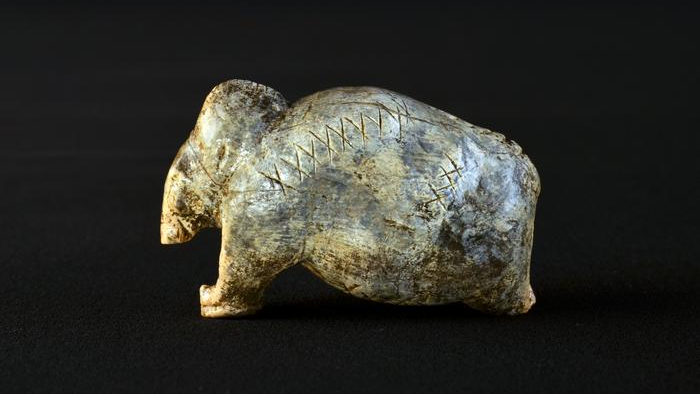
When modern humans (Homo sapiens) first arrived in Europe around 55,000 years ago, they brought with them a sophisticated tool culture that included projectile points and drilling implements. Humans began decorating cave walls with geometric shapes, hand stencils and representations of animals, and they adorned their tools and sculptures with geometric signs whose meaning has baffled archaeologists for decades.

In a study published Feb. 23 in the journal PNAS, linguist Christian Bentz of Saarland University in Germany and archaeologist Ewa Dutkiewicz of the Museum of Prehistory and Early History in Berlin statistically analyzed more than 3,000 mysterious markings on 260 ancient objects and determined that they constitute “sign sequences” that encoded Paleolithic people’s thoughts.


You may like

“Our research is helping us uncover the unique statistical properties — or statistical fingerprint — of these sign systems, which are an early predecessor to writing,” Bentz said in a statement.

The researchers cataloged intentional symbols — lines, points, crosses, stars, grids and zigzags — carved into a variety of tools and figurines, most of which were discovered in previous archaeological excavations in cave sites in the Swabian Jura, a mountain range in southern Germany. Then, they used computational techniques to look at the statistical properties of the signs, discovering that the Paleolithic sequences were comparable to proto-cuneiform in their potential to encode information.

Bentz’s research deals with frequency trends and measurable aspects of signs. (In linguistics, a sign is a physical representation of a concept or meaning.) By statistically investigating two series of signs — in this case, the Paleolithic system and proto-cuneiform — Bentz compared the sign systems to discover similarities and differences.

“Our analyses demonstrate that these sign sequences have nothing to do with the writing systems of today,” Bentz said. “The signs on the archaeological objects are frequently repeated – cross, cross, cross, line, line, line. This type of repetition is not a feature found in spoken language.”

Get the world’s most fascinating discoveries delivered straight to your inbox.

The Paleolithic hunter-gatherers instead developed a system of symbols comparable to early proto-cuneiform, a system created tens of thousands of years later. “In terms of complexity, the sign sequences are comparable,” Bentz said.

But while cuneiform evolved rapidly in Mesopotamia over the course of a millennium, the Paleolithic sign system the researchers discovered stayed consistent for nearly 10,000 years.

two sides of a carved piece of ivory featuring a human figure on one side and a linear series of notches on another

The roughly 38,000-year-old Adorant figurine from Geißenklösterle Cave consists of a small ivory plate bearing an anthropomorphic figure and multiple sequences of notches and dots. (Image credit: Landesmuseum Württemberg / Hendrik Zwietasch, CC BY 4.0)

“The human ability to encode information in signs and symbols was developed over many thousands of years,” Bentz said. “Writing is only one specific form in a long series of sign systems.”


You may like

The statistical analysis did not reveal what the carved signs meant, although the researchers did discover that figurines had a higher “information density” than tools did.

This is not the first research to propose that the origin of human writing systems dates to the Paleolithic. In a 2023 study, researchers investigated dots and lines in 20,000-year-old cave paintings of animals and concluded that they constituted an early calendar. And paleoanthropologist Genevieve von Petzinger has argued that three dozen symbols found in caves throughout the world show humans developed an early form of writing at least 40,000 years ago.

The new study includes “two excellent approaches for at least trying to confirm that these marks were meaningful beyond being decorative doodles,” von Petzinger, who was not involved in the study, told Scientific American. “The more we can learn about the selection of ‘writing’ surfaces and choices about specific images and signs, the more we will be able to learn about this period.”

The researchers continue to look for objects with intentionally made signs to add to their understanding of early human communication.

“Countless tools and sculptures from the Paleolithic, or the Old Stone Age, bear intentional sign sequences,” Dutkiewicz said in the statement. “There are many sign sequences to be found on artefacts. We’ve only just scratched the surface.”

Bentz, C., & Dutkiewicz, E. (2026). Humans 40,000 y ago developed a system of conventional signs. Proceedings of the National Academy of Sciences, 123(9), e2520385123. https://doi.org/10.1073/pnas.2520385123


Stone Age quiz: What do you know about the Paleolithic, Mesolithic and Neolithic?

Source link

Share. Facebook Twitter Pinterest LinkedIn Tumblr Email
Previous ArticleReview: RayNeo Air 4 Pro AR glasses, an OLED TV for my face
Next Article Herbicide Could be Making Its Way to South OC Beaches
Editor
  • Website

Related Posts

Lifestyle

May’s Flower ‘micromoon’ will look extra small tonight, with a rare Blue Moon following

May 1, 2026
Lifestyle

‘If astrological compatibility exists, its effects should be observable’: TL;DR — it’s not

May 1, 2026
Lifestyle

Humanoid robots have outpaced human runners in the half-marathon, beating the world record ‪—‬ here are the secrets to this astonishing feat

May 1, 2026
Add A Comment

Comments are closed.

Categories
  • Entertainment
  • Lifestyle
  • News
  • Sports
  • Tech
  • Travel
Recent Posts
  • May’s Flower ‘micromoon’ will look extra small tonight, with a rare Blue Moon following
  • ‘If astrological compatibility exists, its effects should be observable’: TL;DR — it’s not
  • Humanoid robots have outpaced human runners in the half-marathon, beating the world record ‪—‬ here are the secrets to this astonishing feat
  • Google AI breakthrough means chatbots use six times less memory during conversations without compromising performance
  • ZWO Seestar S30 Pro smart telescope review
calendar
May 2026
M T W T F S S
 123
45678910
11121314151617
18192021222324
25262728293031
« Apr    
Recent Posts
  • May’s Flower ‘micromoon’ will look extra small tonight, with a rare Blue Moon following
  • ‘If astrological compatibility exists, its effects should be observable’: TL;DR — it’s not
  • Humanoid robots have outpaced human runners in the half-marathon, beating the world record ‪—‬ here are the secrets to this astonishing feat
About

Welcome to Baynard Media, your trusted source for a diverse range of news and insights. We are committed to delivering timely, reliable, and thought-provoking content that keeps you informed
and inspired

Categories
  • Entertainment
  • Lifestyle
  • News
  • Sports
  • Tech
  • Travel
Facebook X (Twitter) Pinterest WhatsApp
  • Contact Us
  • About Us
  • Privacy Policy
  • Disclaimer
  • UNSUBSCRIBE
© 2026 copyrights reserved

Type above and press Enter to search. Press Esc to cancel.