Close Menu
  • Home
  • UNSUBSCRIBE
  • News
  • Lifestyle
  • Tech
  • Entertainment
  • Sports
  • Travel
Facebook X (Twitter) WhatsApp
Trending
  • NASA’s Curiosity rover finds a surprising number of giant ‘dragon scales’ littered across Mars
  • Diagnostic dilemma: A teen’s classic diabetes symptoms didn’t improve with treatment — revealing she also had a much rarer syndrome
  • Strange mammal ancestor laid huge, leathery eggs —‬ and it was key to surviving the world’s worst mass extinction
  • Ancient process that created rare earth elements discovered — and it could help us locate desperately needed deposits
  • This humanoid robot does all your housework for you ‪—‬ and its makers say it’s ready for your home
  • ‘Nations need to prepare now’: Key Atlantic ocean current is much closer to collapse than scientists thought
  • Neanderthal toddlers grew faster than modern humans, probably because of the harsh environment they evolved in
  • NASA shuts off another Voyager 1 instrument as humanity’s most distant spacecraft prepares for risky ‘Big Bang’ maneuver to save power
Facebook X (Twitter) WhatsApp
Baynard Media
  • Home
  • UNSUBSCRIBE
  • News
  • Lifestyle
  • Tech
  • Entertainment
  • Sports
  • Travel
Baynard Media
Home»Lifestyle»Northern lights forecast: Double solar eruption lights up night sky with auroras
Lifestyle

Northern lights forecast: Double solar eruption lights up night sky with auroras

EditorBy EditorApril 16, 2025No Comments3 Mins Read
Share Facebook Twitter Pinterest LinkedIn Tumblr Reddit Telegram Email
Share
Facebook Twitter LinkedIn Pinterest Email

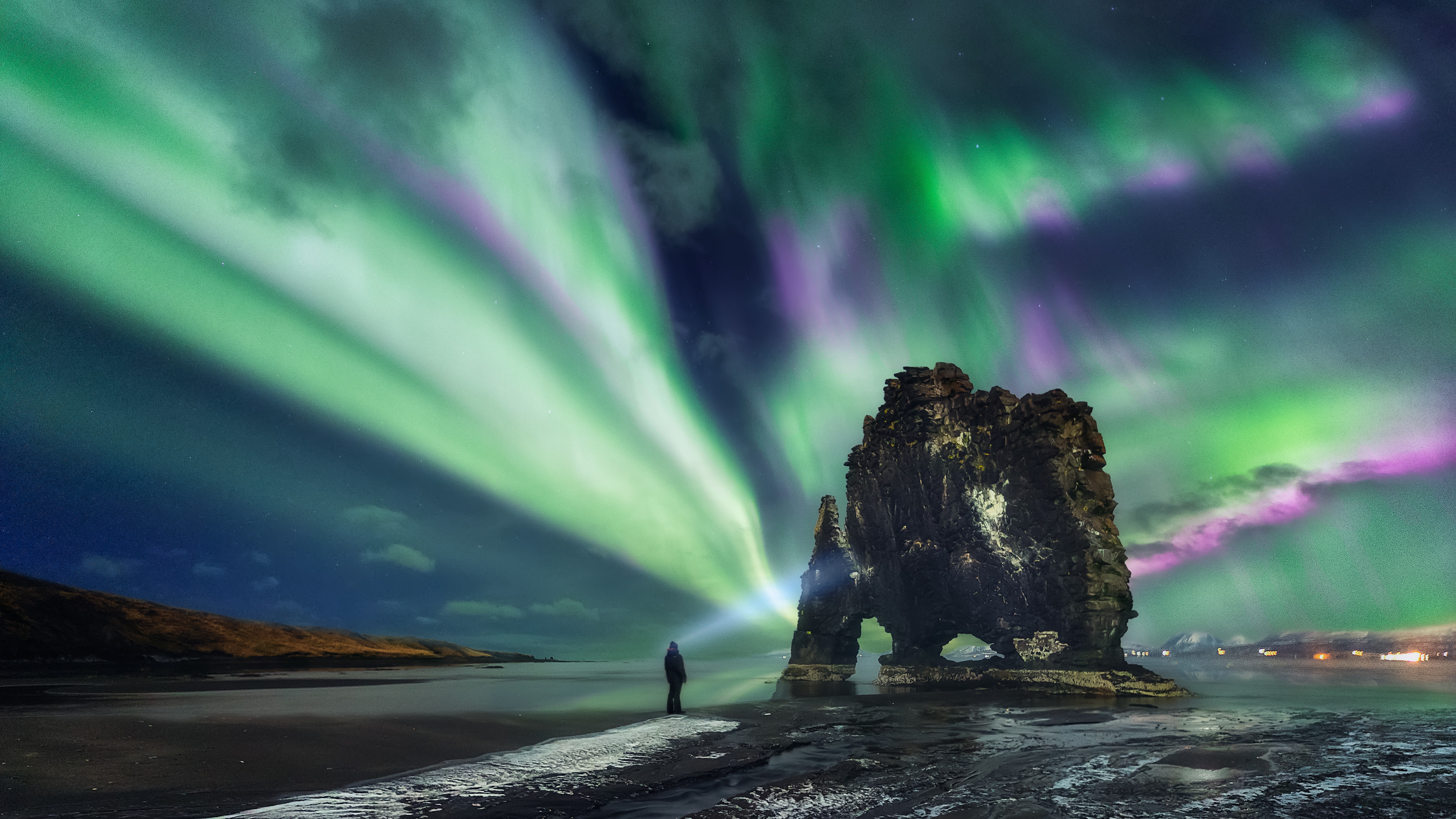
A rare double solar eruption fueled a spectacular display of the northern lights overnight — and more auroras could be on the way.

Last weekend, two separate solar eruptions sent a pair of coronal mass ejections (CMEs) — clouds of solar plasma and radiation — hurtling towards Earth. At least one of the CMEs hit our planet’s magnetic field at around 1 p.m. EDT on Tuesday (April 15), creating geomagnetic storms and northern lights at high altitudes.

I seriously just captured a meteor in front of Aurora. Incredible. #Revontulet #NorthernLights pic.twitter.com/XR1HKCkSbsApril 15, 2025

Skywatchers from across the Northern Hemisphere have shared images of last night’s display. Spaceweather.com’s real-time image gallery revealed that parts of Iceland, Sweden, Finland and the U.K. were treated to spectacular auroras. Northern lights were also expected across the northern U.S. and Canada, with the gallery confirming a display in Minnesota.

The storms could intensify if a second CME hits today (April 16). However, there’s a good chance that the prime storm window has already closed. The CME that hit yesterday likely absorbed the second CME, so we probably won’t get two blasts, the U.K.’s Met Office reported.

The National Oceanic and Atmospheric Administration’s (NOAA) Space Weather Prediction Center still has a strong, G3 geomagnetic storm watch in place for today. However, the Center’s latest three-day forecast suggests that the most severe G3 conditions occurred overnight — the geomagnetic storm scale ranges from G1 to G5, with G5 being the most severe.

Northern Lights over Stornoway. Worth freezing for!!! 😳 pic.twitter.com/oOCKLHY6yvApril 15, 2025

The Space Weather Prediction Center still expects the aurora borealis to be visible over North America again tonight. The most intense auroras will be over Alaska and Canada, but states in the north of the contiguous U.S. may see auroras on the northern horizon.

Related: 32 stunning photos of auroras seen from space

Get the world’s most fascinating discoveries delivered straight to your inbox.

This week’s increased geomagnetic activity began with two eruptions on the sun. Solar eruptions stem from magnetic filaments — tubes of dense plasma. The filaments are normally held above the sun’s surface by magnetic forces, but the structures can erupt if the magnetic forces become unstable. On April 12 and 13, there was a rare double eruption, with two filaments becoming unstable in quick succession, Spaceweather.com reported.

For those that know me on here, you’ll know I has two things on my bucket list: see a murmuration and the Northern Lights. Achieved one last year a few miles down the road, and tonight I’ve achieved the other from my back garden. I’m overwhelmed…. pic.twitter.com/FlqpUpN4ETMay 10, 2024

These eruptions sent streams of charged particles, carried on solar wind, out into space — and toward our planet. If they reach Earth’s magnetic field, they can cause solar storms. Solar storms are major disturbances in Earth’s magnetosphere, which is the region around our planet where Earth’s magnetic field is the dominant magnetic field, as opposed to the magnetic field of interplanetary space, according to the Space Weather Prediction Center.

The auroras form when the sun’s charged particles travel through Earth’s magnetosphere and hit the high atmosphere, smashing into particles of oxygen and nitrogen. These particles then glow different colors as they shed energy from the collision, according to NASA’s Jet Propulsion Laboratory.

The exact timing of CMEs hitting Earth — and the resulting geomagnetic storms — is difficult to predict, with yesterday’s CME arriving earlier than expected, Live Science’s sister site Space.com reported. The Met Office noted that its own G3 watch is valid until 2 p.m. EDT today, with the potential for minor G1 storms to continue through Thursday (April 17).


Source link

Share. Facebook Twitter Pinterest LinkedIn Tumblr Email
Previous ArticleRussia and China are threatening SpaceX’s Starlink satellite constellation, new report finds
Next Article Some people are ‘wired to connect with music on a deeper level,’ study of 9,000 twins finds
Editor
  • Website

Related Posts

Lifestyle

NASA’s Curiosity rover finds a surprising number of giant ‘dragon scales’ littered across Mars

April 22, 2026
Lifestyle

Diagnostic dilemma: A teen’s classic diabetes symptoms didn’t improve with treatment — revealing she also had a much rarer syndrome

April 22, 2026
Lifestyle

Strange mammal ancestor laid huge, leathery eggs —‬ and it was key to surviving the world’s worst mass extinction

April 22, 2026
Add A Comment

Comments are closed.

Categories
  • Entertainment
  • Lifestyle
  • News
  • Sports
  • Tech
  • Travel
Recent Posts
  • NASA’s Curiosity rover finds a surprising number of giant ‘dragon scales’ littered across Mars
  • Diagnostic dilemma: A teen’s classic diabetes symptoms didn’t improve with treatment — revealing she also had a much rarer syndrome
  • Strange mammal ancestor laid huge, leathery eggs —‬ and it was key to surviving the world’s worst mass extinction
  • Ancient process that created rare earth elements discovered — and it could help us locate desperately needed deposits
  • This humanoid robot does all your housework for you ‪—‬ and its makers say it’s ready for your home
calendar
April 2026
M T W T F S S
 12345
6789101112
13141516171819
20212223242526
27282930  
« Mar    
Recent Posts
  • NASA’s Curiosity rover finds a surprising number of giant ‘dragon scales’ littered across Mars
  • Diagnostic dilemma: A teen’s classic diabetes symptoms didn’t improve with treatment — revealing she also had a much rarer syndrome
  • Strange mammal ancestor laid huge, leathery eggs —‬ and it was key to surviving the world’s worst mass extinction
About

Welcome to Baynard Media, your trusted source for a diverse range of news and insights. We are committed to delivering timely, reliable, and thought-provoking content that keeps you informed
and inspired

Categories
  • Entertainment
  • Lifestyle
  • News
  • Sports
  • Tech
  • Travel
Facebook X (Twitter) Pinterest WhatsApp
  • Contact Us
  • About Us
  • Privacy Policy
  • Disclaimer
  • UNSUBSCRIBE
© 2026 copyrights reserved

Type above and press Enter to search. Press Esc to cancel.