Close Menu
  • Home
  • UNSUBSCRIBE
  • News
  • Lifestyle
  • Tech
  • Entertainment
  • Sports
  • Travel
Facebook X (Twitter) WhatsApp
Trending
  • Relief fragment with vanquished enemies: A 3,400-year-old depiction of an Egyptian pharaoh crushing western Asian soldiers under his royal chariot
  • Military’s testosterone screening program could lead to overtreatment and side effects, including impaired T production
  • ‘We were forced to say, Feynman and followers, you guys are off’: Physicists disprove decades-old Richard Feynman theory on ‘silly’ sprinklers
  • 7 ways to photograph the 2026 total solar eclipse — from smartphone to telescope
  • Science word of the day: Pando
  • Science word of the day: Lithics
  • Are quasiparticles real? | Live Science
  • How to watch ‘Shark Week’ 2026 — schedule, dates & episodes
Facebook X (Twitter) WhatsApp
Baynard Media
  • Home
  • UNSUBSCRIBE
  • News
  • Lifestyle
  • Tech
  • Entertainment
  • Sports
  • Travel
Baynard Media
Home»Lifestyle»‘New’ island emerges from melting ice in Alaska
Lifestyle

‘New’ island emerges from melting ice in Alaska

EditorBy EditorSeptember 11, 2025No Comments3 Mins Read
Share Facebook Twitter Pinterest LinkedIn Tumblr Reddit Telegram Email
Share
Facebook Twitter LinkedIn Pinterest Email

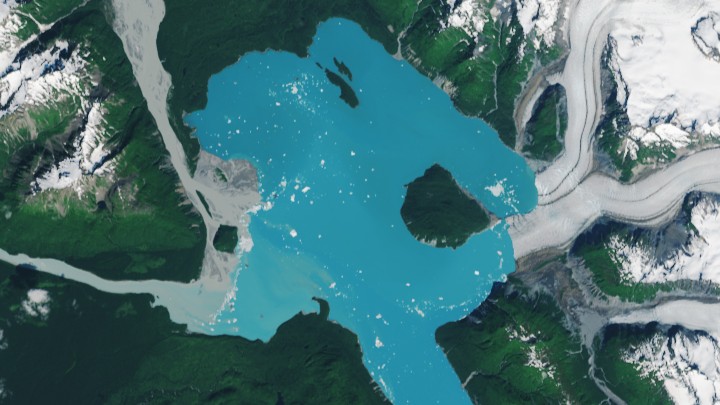
A ‘new’ island has appeared in the middle of a lake in southeastern Alaska after the landmass lost contact with a melting glacier, NASA satellite images reveal.

The landmass, named Prow Knob, is a small mountain that was formerly surrounded by the Alsek Glacier in Glacier Bay National Park. However, Alsek Glacier has been retreating for decades, slowly separating itself from Prow Knob and leaving a growing freshwater lake in its wake.

A recent satellite image, taken by Landsat 9 in August, reveals that the glacier has now lost all connection to Prow Knob, according to a statement released by NASA’s Earth Observatory. Prow Knob provides a clear visual example of how glaciers are thinning and retreating in southeastern Alaska.


You may like

Image 1 of 2

An annotated satellite image of Prow Knob surrounded by ice in 1984.
Alsek on July 5, 1984. (Image credit: NASA Earth Observatory images by Michala Garrison, using Landsat data from the U.S. Geological Survey.)

An annotated satellite image of Prow Knob completely separated from Alsek Glacier.
Alsek on August 6, 2025.(Image credit: NASA Earth Observatory images by Michala Garrison, using Landsat data from the U.S. Geological Survey.)

“Along the coastal plain of southeastern Alaska, water is rapidly replacing ice,” Lindsey Doermann, a science writer at the NASA Earth Observatory, wrote in the statement. “Glaciers in this area are thinning and retreating, with meltwater forming proglacial lakes off their fronts. In one of these growing watery expanses, a new island has emerged.”

Related: Glaciers across North America and Europe have lost an ‘unprecedented’ amount of ice in the past 4 years

Alsek Glacier used to split into two channels to wind its way around Prow Knob, which has a landmass of about 2 square miles (5 square kilometers). In the early 20th century, the glacier extended across the now-exposed Alsek Lake and as far as Gateway Knob, about 3 miles (5 kilometers) west of Prow Knob.

The late glaciologist Austin Post, who captured aerial photographs of Alsek in 1960, named Prow Knob after its resemblance to the prow (pointed front end) of a ship. Post and fellow glaciologist Mauri Pelto, a professor of environmental science at Nichols College in Massachusetts, previously predicted that Alsek Glacier would release Prow Knob in 2020, based on the rate it was retreating between 1960 and 1990, according to the statement. The glacier has therefore clung on to its mountain for slightly longer than initially predicted.

Get the world’s most fascinating discoveries delivered straight to your inbox.

Prow Knob completely separated from Alsek Glacier between July 13 and Aug. 6, according to the statement.

Many of Earth’s glaciers are retreating as the planet gets warmer due to climate change. Last year was the hottest year for global average temperatures since records began, while 2025 has been marked by a string of record-breaking and near-record-breaking hot months.

Source link

Share. Facebook Twitter Pinterest LinkedIn Tumblr Email
Previous ArticleTavia Hunt mourns Charlie Kirk after Utah Valley University killing
Next Article Tom Llamas reflects on political violence in the U.S.
Editor
  • Website

Related Posts

Lifestyle

Relief fragment with vanquished enemies: A 3,400-year-old depiction of an Egyptian pharaoh crushing western Asian soldiers under his royal chariot

July 27, 2026
Lifestyle

Military’s testosterone screening program could lead to overtreatment and side effects, including impaired T production

July 27, 2026
Lifestyle

‘We were forced to say, Feynman and followers, you guys are off’: Physicists disprove decades-old Richard Feynman theory on ‘silly’ sprinklers

July 27, 2026
Add A Comment

Comments are closed.

Categories
  • Entertainment
  • Lifestyle
  • News
  • Sports
  • Tech
  • Travel
Recent Posts
  • Relief fragment with vanquished enemies: A 3,400-year-old depiction of an Egyptian pharaoh crushing western Asian soldiers under his royal chariot
  • Military’s testosterone screening program could lead to overtreatment and side effects, including impaired T production
  • ‘We were forced to say, Feynman and followers, you guys are off’: Physicists disprove decades-old Richard Feynman theory on ‘silly’ sprinklers
  • 7 ways to photograph the 2026 total solar eclipse — from smartphone to telescope
  • Science word of the day: Pando
calendar
July 2026
M T W T F S S
 12345
6789101112
13141516171819
20212223242526
2728293031  
« Jun    
Recent Posts
  • Relief fragment with vanquished enemies: A 3,400-year-old depiction of an Egyptian pharaoh crushing western Asian soldiers under his royal chariot
  • Military’s testosterone screening program could lead to overtreatment and side effects, including impaired T production
  • ‘We were forced to say, Feynman and followers, you guys are off’: Physicists disprove decades-old Richard Feynman theory on ‘silly’ sprinklers
About

Welcome to Baynard Media, your trusted source for a diverse range of news and insights. We are committed to delivering timely, reliable, and thought-provoking content that keeps you informed
and inspired

Categories
  • Entertainment
  • Lifestyle
  • News
  • Sports
  • Tech
  • Travel
Facebook X (Twitter) Pinterest WhatsApp
  • Contact Us
  • About Us
  • Privacy Policy
  • Disclaimer
  • UNSUBSCRIBE
© 2026 copyrights reserved

Type above and press Enter to search. Press Esc to cancel.