Close Menu
  • Home
  • UNSUBSCRIBE
  • News
  • Lifestyle
  • Tech
  • Entertainment
  • Sports
  • Travel
Facebook X (Twitter) WhatsApp
Trending
  • Ancient squirrel poop from Arctic permafrost contains DNA from mammoths, bison, horses and big cats
  • The Milky Way returns: How to take breathtaking photos of our galaxy this summer
  • Intestinal parasite transformed into antitoxin factory that can live in the body in early study
  • Complete skin of an adult horse found with 10th-century woman and newborn in rare Siberian burial
  • ‘Geminid Symphony’ and ‘Galactic Gandalf’: See the breathtaking views of our home galaxy from the 2026 Milky Way Photographer of the Year contest
  • Japan’s ‘crawling’ moon robot LEV-2 passed its historic first lunar mission with flying colors
  • Artificial turf contains 400 chemicals tied to cancer and hormone disruption. But is it unsafe?
  • ‘Just defies belief’: 5 million-year-old whale graveyard stretches for 750 miles in the Indian Ocean
Facebook X (Twitter) WhatsApp
Baynard Media
  • Home
  • UNSUBSCRIBE
  • News
  • Lifestyle
  • Tech
  • Entertainment
  • Sports
  • Travel
Baynard Media
Home»Lifestyle»1,900-year-old souvenir cup featuring Hadrian’s Wall and Roman forts discovered in Spain
Lifestyle

1,900-year-old souvenir cup featuring Hadrian’s Wall and Roman forts discovered in Spain

EditorBy EditorApril 29, 2026No Comments4 Mins Read
Share Facebook Twitter Pinterest LinkedIn Tumblr Reddit Telegram Email
Share
Facebook Twitter LinkedIn Pinterest Email

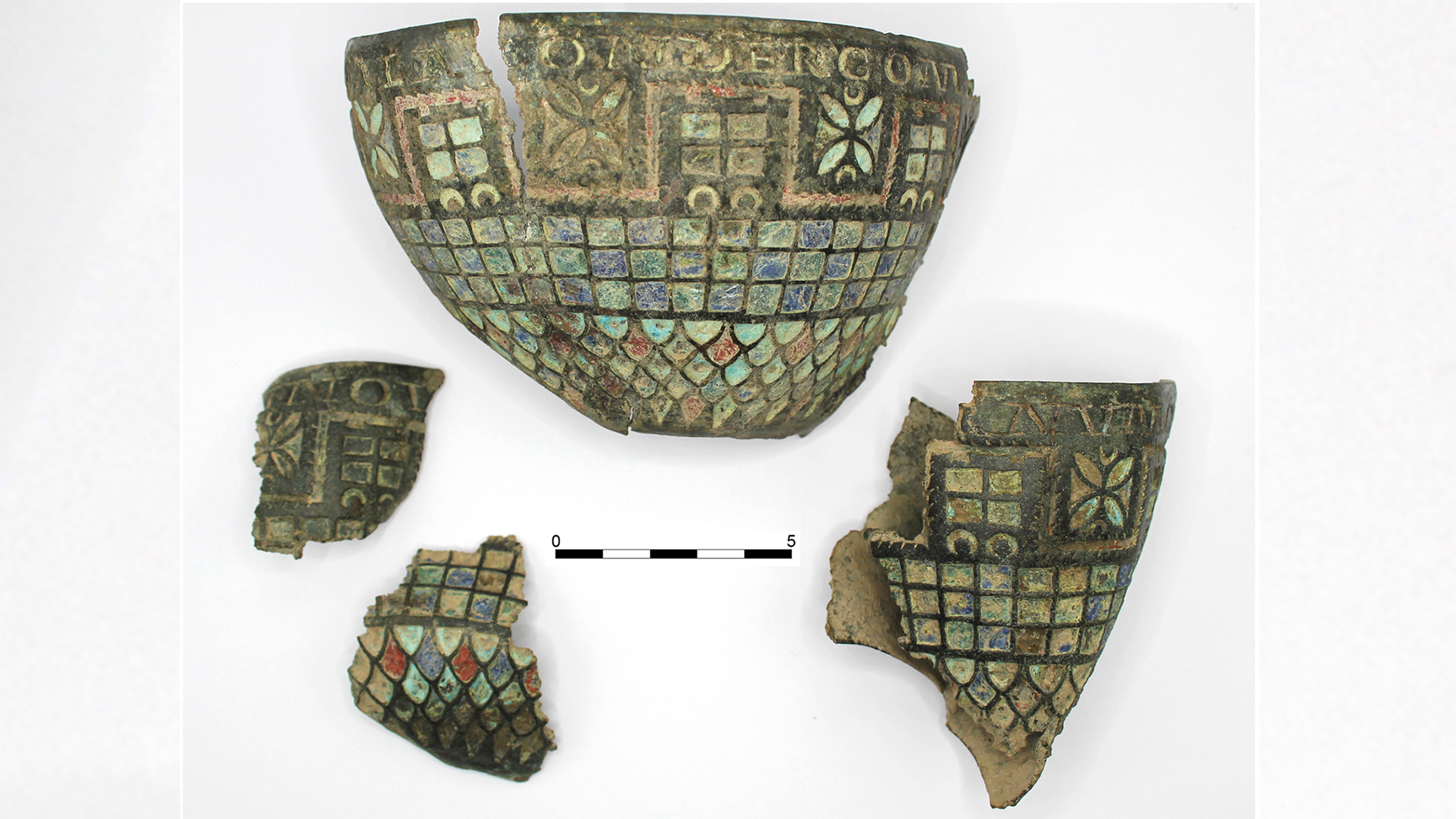
A chance discovery of a broken bronze cup in Spain has revealed a 1,900-year-old depiction of Hadrian’s Wall and forts in England, a new study reports. The multicolored vessel was likely crafted as a memento of a soldier’s time defending the frontiers of the Roman Empire, the study authors said.

The cup was discovered in Berlanga de Duero, a municipality in central Spain, nearly 1,200 miles (2,000 kilometers) from the storied Roman defensive wall that protected the northern frontier of the empire in the second century. The hemispheric “Berlanga Cup” is about 4.5 inches (11.4 centimeters) wide and around 3.2 inches (8.1 cm) tall. It features colorful enameled designs and a Latin inscription that mentions four forts.

“The cup is a small representation of a functional vessel called a Roman trulla — a bronze or clay cup with a handle used to drink water,” Jesús García Sánchez, an archaeologist at the Archaeological Institute of Mérida in Spain and co-author of the new study, told Live Science in an email. “It is not only crafted with metals, but also expensive enamels, and later on customized. It is definitely not an industrial product.”


You may like

In the study, published April 23 in the journal Britannia, García Sánchez and colleagues wrote that, while similar cups have been discovered in the past, the Berlanga Cup is the only one that refers to forts on the eastern side of Hadrian’s Wall. The four forts mentioned in the inscription are Cilurnum (now called Chesters), Onno (now called Halton Chesters), Vindobala (now called Rudchester), and Condercom (now called Benwell). Each fort is depicted on the cup as a series of four squares and two half-moons that represent either turrets or the fort’s gateway. Below the schematic forts are two bands of designs inset with red, green, turquoise and navy-blue enamel.

An analysis of the cup revealed it was bronze — largely copper and tin — with a substantial addition of lead that likely came from mines in northernEngland. These findings strongly suggest the cup was made by a local artisan near Hadrian’s Wall between A.D. 124 and 199, the researchers said. But how the cup ended up in Spain is a bit of a mystery.
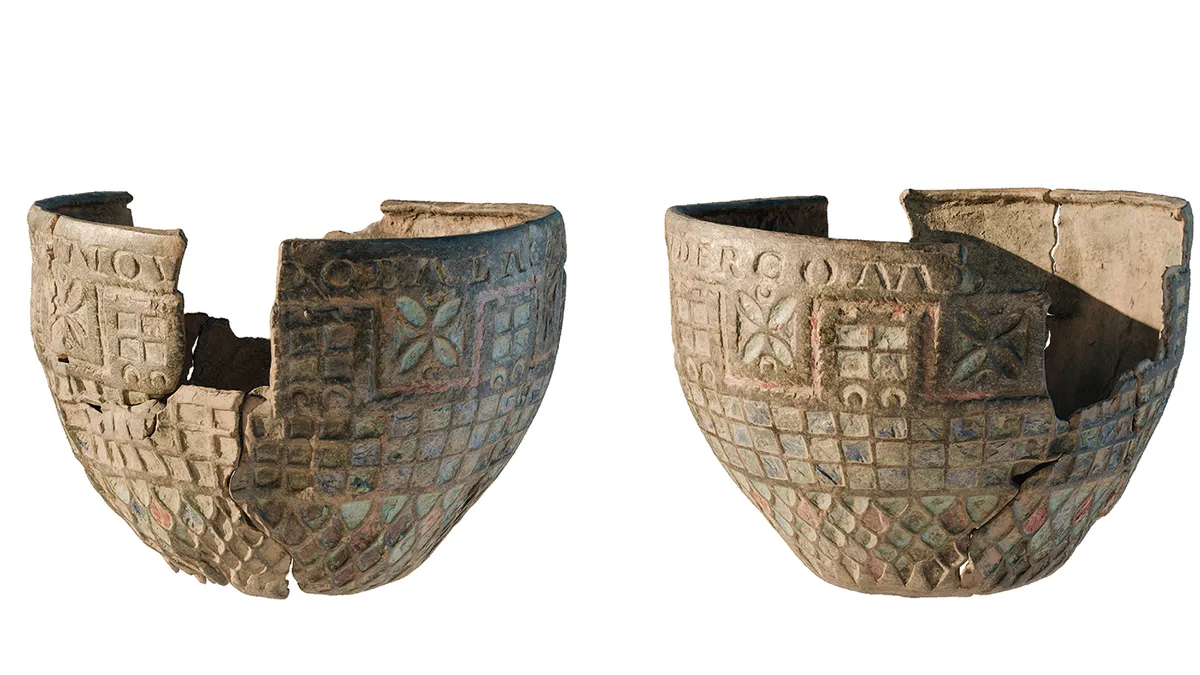
two views of a reconstructed bronze cup from Roman times

Archaeologists created a reconstruction of the Berlanga Cup by 3D scanning and virtually mending the fragments. (Image credit: 3D Stoa – Archaeology and Heritage)

The modern municipality of Berlanga de Duero was likely the ancient settlement of Valeranica in Roman times. Archaeological excavation in the area revealed fragments of Roman pottery and masonry walls, which were potentially part of a rural villa used between the first and fourth centuries. The Berlanga Cup may have been acquired by someone who lived in Valeranica and was a soldier in a Roman auxiliary unit of Hispanic origin known in historical records as the Cohors I Celtiberorum.

“This contingent was made up of troops from Celtiberia, precisely the area where the piece in question was found,” the researchers wrote in the study, and “was stationed near Hadrian’s Wall during the reign of Emperor Trajan” (who ruled from A.D. 98 to 117). After soldiers served in the Roman military, many returned to their original homes and brought back mementos of their time in service.

Get the world’s most fascinating discoveries delivered straight to your inbox.

The Berlanga Cup “could have been a souvenir acquired by a veteran before his return home, purchased with the aim of remembering his time and service at one of the monumental forts of the Empire,” the researchers wrote. Alternatively, the cup may have been bestowed on a soldier as recognition of distinguished service or a particularly brave act.

Either way, the fact that the memento was shaped like a simple trulla — an object soldiers used every day for eating and drinking — and not like a weapon suggests it was meant to remind veterans of the camaraderie they experienced while living along Hadrian’s Wall, the researchers wrote.

De Pablo Martínez, R., De Luis Mariño, S., Garcia Sanchez, J., Montero Ruiz, I., Aparicio Resco, P. (2026). The Berlanga Cup. New evidence of Hadrian’s Wall pans found in Hispania Citerior (Spain). Britannia. https://doi.org/10.1017/S0068113X26100701


What do you know about the Empire’s conquest of the British Isles? Find out with our Roman Britain quiz!

Source link

Share. Facebook Twitter Pinterest LinkedIn Tumblr Email
Previous ArticleFirst-of-its-kind map of the mouse nose reveals surprises about the sense of smell
Next Article ‘It cuts both ways’: Positive tipping points can restore wreaked ecosystems — we just need to trigger them, Earth system scientist Tim Lenton says
Editor
  • Website

Related Posts

Lifestyle

Ancient squirrel poop from Arctic permafrost contains DNA from mammoths, bison, horses and big cats

June 11, 2026
Lifestyle

The Milky Way returns: How to take breathtaking photos of our galaxy this summer

June 11, 2026
Lifestyle

Intestinal parasite transformed into antitoxin factory that can live in the body in early study

June 11, 2026
Add A Comment

Comments are closed.

Categories
  • Entertainment
  • Lifestyle
  • News
  • Sports
  • Tech
  • Travel
Recent Posts
  • Ancient squirrel poop from Arctic permafrost contains DNA from mammoths, bison, horses and big cats
  • The Milky Way returns: How to take breathtaking photos of our galaxy this summer
  • Intestinal parasite transformed into antitoxin factory that can live in the body in early study
  • Complete skin of an adult horse found with 10th-century woman and newborn in rare Siberian burial
  • ‘Geminid Symphony’ and ‘Galactic Gandalf’: See the breathtaking views of our home galaxy from the 2026 Milky Way Photographer of the Year contest
calendar
June 2026
M T W T F S S
1234567
891011121314
15161718192021
22232425262728
2930  
« May    
Recent Posts
  • Ancient squirrel poop from Arctic permafrost contains DNA from mammoths, bison, horses and big cats
  • The Milky Way returns: How to take breathtaking photos of our galaxy this summer
  • Intestinal parasite transformed into antitoxin factory that can live in the body in early study
About

Welcome to Baynard Media, your trusted source for a diverse range of news and insights. We are committed to delivering timely, reliable, and thought-provoking content that keeps you informed
and inspired

Categories
  • Entertainment
  • Lifestyle
  • News
  • Sports
  • Tech
  • Travel
Facebook X (Twitter) Pinterest WhatsApp
  • Contact Us
  • About Us
  • Privacy Policy
  • Disclaimer
  • UNSUBSCRIBE
© 2026 copyrights reserved

Type above and press Enter to search. Press Esc to cancel.