Close Menu
  • Home
  • UNSUBSCRIBE
  • News
  • Lifestyle
  • Tech
  • Entertainment
  • Sports
  • Travel
Facebook X (Twitter) WhatsApp
Trending
  • Science news this week: Laotian ‘death jar’, climate change threatens rice crops, and an asthma drug treats tough cancer
  • DNA sequencing is rewriting our understanding of historic outbreaks, but it can’t tell the whole story
  • AI-generated images are making it impossible to distinguish truth from fiction. We need laws and AI watermarks to protect our shared reality.
  • Levoit Sprout Evaporative Humidifier review: A child-safe solution to dry air
  • How hot is Earth’s core?
  • Scientists claimed the world’s oldest rock art is 67,800 years old. But is the science behind that estimate flawed?
  • Ebola outbreak in Central Africa will be hard to contain, experts say
  • Landmark finding that showed brains of kids with ADHD mature later was actually a mirage in the data, new research finds
Facebook X (Twitter) WhatsApp
Baynard Media
  • Home
  • UNSUBSCRIBE
  • News
  • Lifestyle
  • Tech
  • Entertainment
  • Sports
  • Travel
Baynard Media
Home»Lifestyle»Microscopic baby sea urchin crawling with tubed feet is among video winners of Nikon Small World in Motion competition
Lifestyle

Microscopic baby sea urchin crawling with tubed feet is among video winners of Nikon Small World in Motion competition

EditorBy EditorSeptember 24, 2025No Comments2 Mins Read
Share Facebook Twitter Pinterest LinkedIn Tumblr Reddit Telegram Email
Share
Facebook Twitter LinkedIn Pinterest Email

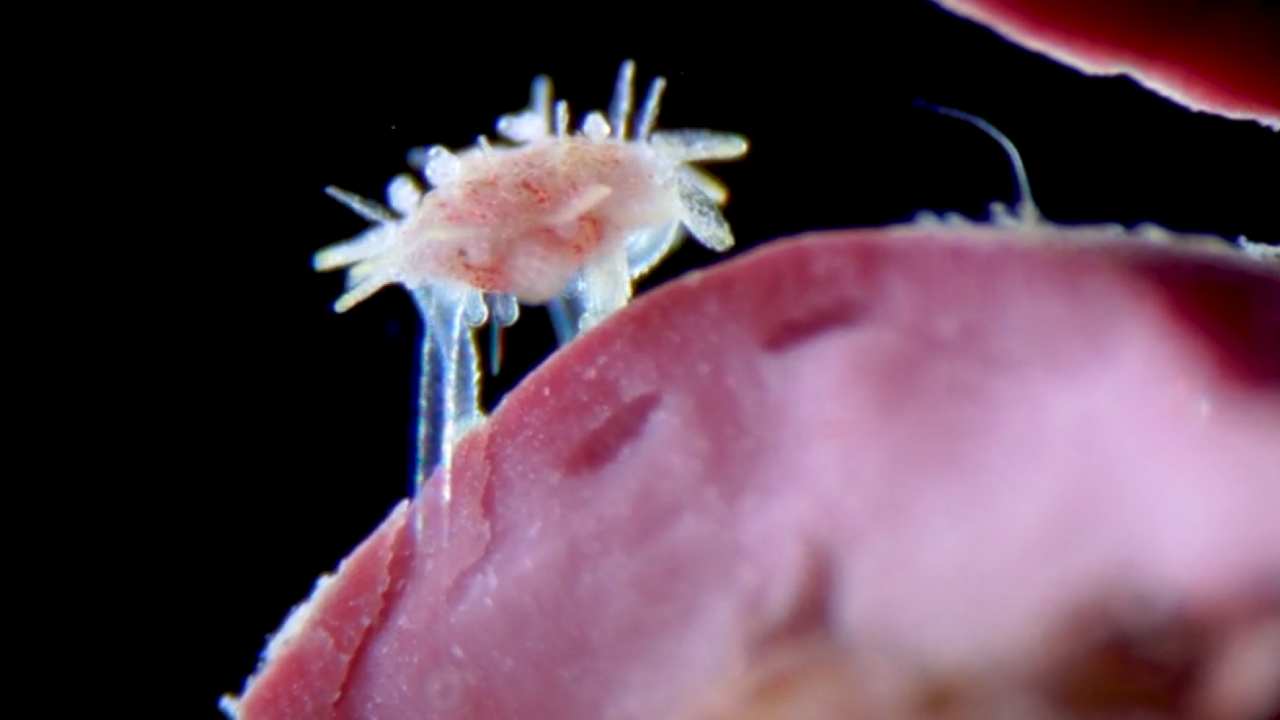
Stunning microscopic footage has captured the moment a translucent baby sea urchin crawled across a bed of red algae. The video earned fifth place in the annual Nikon Small World in Motion competition.

Alvaro Migotto, a zoologist at the University of São Paulo in Brazil, captured the mesmerizing video of the juvenile sea urchin as it moved across its habitat and identified the species as Arbacia lixula — a black sea urchin that is commonly found along the Brazilian coast and throughout the Mediterranean. Migotto discovered the tiny creature while examining debris that had washed ashore near the Center for Marine Biology where he works.

“It was simply by chance. While I was examining various materials — such as algae, pebbles, and seashells washed ashore — under the stereomicroscope in search of other organisms, I unexpectedly came across this tiny sea urchin calmly walking on a piece of red calcareous algae,” Migotto told Live Science in an email.


You may like

“The scene struck me as perfect — not only was the animal moving naturally over a substrate it typically inhabits in the wild, but the combination of these two elements also created excellent contrast and pleasing colors,” he added.

Related link: How to photograph your microscope specimens

Sea urchins are marine invertebrates in the group Echinodermata and are found in oceans around the world and in nearly every climate. They have round, spiny bodies and hundreds of tiny tubed feet.

Nikon announced the winners and honorable mentions of the competition on Sept. 24.

Get the world’s most fascinating discoveries delivered straight to your inbox.

The top prize went to microscopist Jay McClellan for his time-lapse video capturing the self-pollination of a thyme-leaved speedwell (Veronica serpyllifolia). Photographer Benedikt Pleyer was awarded second place for a swarm of Volvox algae in the central hole of a Japanese 50-yen coin.

Other noteworthy mentions include an 18-hour timelapse capturing the growth of a chick’s sensory neurons, a 3D composite of a male dung beetle (Sulcophanaeus imperator) built from more than 7,000 images and a recording of mitochondria and calcium waves in the muscle cells of a contracting human heart.

Source link

Share. Facebook Twitter Pinterest LinkedIn Tumblr Email
Previous ArticleHouse Republicans push to honor Charlie Kirk with new US currency
Next Article Four people shot at Dallas ICE facility, officials say
Editor
  • Website

Related Posts

Lifestyle

Science news this week: Laotian ‘death jar’, climate change threatens rice crops, and an asthma drug treats tough cancer

May 23, 2026
Lifestyle

DNA sequencing is rewriting our understanding of historic outbreaks, but it can’t tell the whole story

May 23, 2026
Lifestyle

AI-generated images are making it impossible to distinguish truth from fiction. We need laws and AI watermarks to protect our shared reality.

May 23, 2026
Add A Comment

Comments are closed.

Categories
  • Entertainment
  • Lifestyle
  • News
  • Sports
  • Tech
  • Travel
Recent Posts
  • Science news this week: Laotian ‘death jar’, climate change threatens rice crops, and an asthma drug treats tough cancer
  • DNA sequencing is rewriting our understanding of historic outbreaks, but it can’t tell the whole story
  • AI-generated images are making it impossible to distinguish truth from fiction. We need laws and AI watermarks to protect our shared reality.
  • Levoit Sprout Evaporative Humidifier review: A child-safe solution to dry air
  • How hot is Earth’s core?
calendar
May 2026
M T W T F S S
 123
45678910
11121314151617
18192021222324
25262728293031
« Apr    
Recent Posts
  • Science news this week: Laotian ‘death jar’, climate change threatens rice crops, and an asthma drug treats tough cancer
  • DNA sequencing is rewriting our understanding of historic outbreaks, but it can’t tell the whole story
  • AI-generated images are making it impossible to distinguish truth from fiction. We need laws and AI watermarks to protect our shared reality.
About

Welcome to Baynard Media, your trusted source for a diverse range of news and insights. We are committed to delivering timely, reliable, and thought-provoking content that keeps you informed
and inspired

Categories
  • Entertainment
  • Lifestyle
  • News
  • Sports
  • Tech
  • Travel
Facebook X (Twitter) Pinterest WhatsApp
  • Contact Us
  • About Us
  • Privacy Policy
  • Disclaimer
  • UNSUBSCRIBE
© 2026 copyrights reserved

Type above and press Enter to search. Press Esc to cancel.