
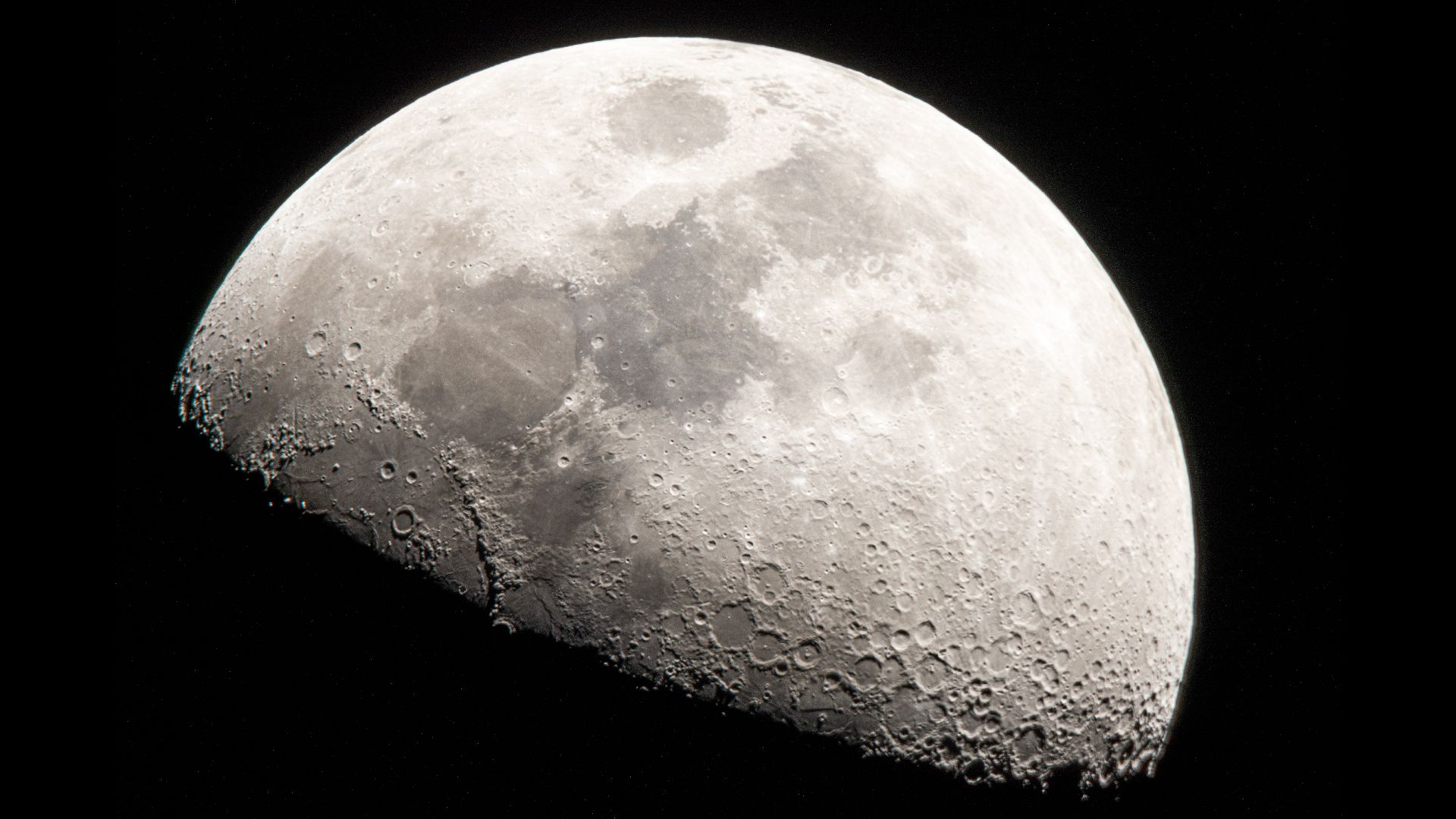
A strange, lopsided dust cloud shrouds Earth’s moon, ever skewed toward whichever side is facing the sun. Now, a new study may finally explain how the asymmetrical cloud got its shape.
Most of the moon’s surface is covered by a layer of gray dust and loose rocks. This layer, called regolith, arises because the lunar surface is constantly bombarded by micrometeoroids — tiny space rocks created by asteroid collisions and comets. Without a protective atmosphere — which, in Earth‘s case, causes micrometeoroids to burn up as “shooting stars” — the moon is struck by several tons of micrometeoroids daily. These impacts, in turn, grind the regolith’s rocks to dust.
The micrometeoroids also lift lunar dust. In 2015, researchers found that this rising dust creates a massive cloud that extends several hundred miles above the lunar surface. The cloud isn’t very thick, and it’s not visible to the naked eye, Sébastien Verkercke, a postdoctoral researcher at the Centre National D’Etudes Spatiales (France’s national space agency) in Paris and the new study’s first author, told Live Science in an email.
“The maximum density measured was only 0.004 particles per cubic meter (the equivalent to 4 dust grains in a grain silo),” he said. However, the cloud is unusual in being asymmetric, with more dust present over the moon’s daytime side (the side facing the sun at any given moment) than its nighttime side. In fact, the cloud is “densest close to the surface near the dawn terminator,” Verkercke added, referring to the stark line that separates sunlight from darkness on the moon’s surface.
The cloud’s discoverers had attributed this lopsidedness to specific meteoroid groups with trajectories that cause the meteoroids to strike the daytime surface more frequently. But the obvious difference between the daytime and nighttime sides of the moon — the temperature — stuck out to Verkercke.
Whereas the moon’s surface is often broiling during the day, with temperatures soaring far above that of the hottest place on Earth, the lunar night is four times colder than Antarctica’s average temperature. This ginormous temperature swing of up to 545 degrees Fahrenheit (285 degrees Celsius) led Verkercke and his co-authors to wonder if it could be responsible for the cloud’s skewed appearance.
To test this hypothesis, Verkercke and his colleagues (researchers from U.S. and European universities) turned to computer models. The team simulated tiny meteoroids — each the width of a human hair — slamming into the lunar dust at two temperatures, 233 degrees Fahrenheit (112 degrees Celsius) and minus 297 degrees Fahrenheit (minus 183 degrees Celsius), corresponding to the moon’s average daytime and pre-dawn temperatures, respectively.

“The ejected dust grains are then individually tracked to monitor their distribution in space,” Verkercke said. The researchers also repeated the simulations while varying how compactly it was packed.
They found that meteoroids that hit “fluffier” surfaces throw up smaller amounts of dust, because the fluffiness of the surface cushions the impacts. In contrast, meteoroids that strike more compact surfaces yield larger amounts of low-speed dust particles. The researchers think this difference means that the dust clouds can be a marker of how compact the lunar surface is.
Moreover, daytime meteoroids raise 6% to 8% more dust than nighttime ones do. And a larger fraction of those dust particles at high temperatures (relative to those formed at lower temperatures) have enough energy to reach the height of orbiting satellites that can detect them. Both the larger amounts of lofted dust and the bigger fractions of dust reaching the satellites could explain the daytime dust excess, the researchers explained in the study, published Oct. 15 in the Journal of Geophysical Research: Planets.
The team plans to extend their analysis to other bodies in the solar system that are impacted by small meteoroids. Verkercke noted that one particularly interesting case is Mercury, which has a much hotter temperature than the moon’s daytime surface and thus, a larger day-night temperature difference. This, in turn, should create an even more asymmetrical dust cloud.
The researchers hope to virtually replicate this hypothesized observation, which the BepiColombo mission to Mercury will also investigate, Verkercke added.
