
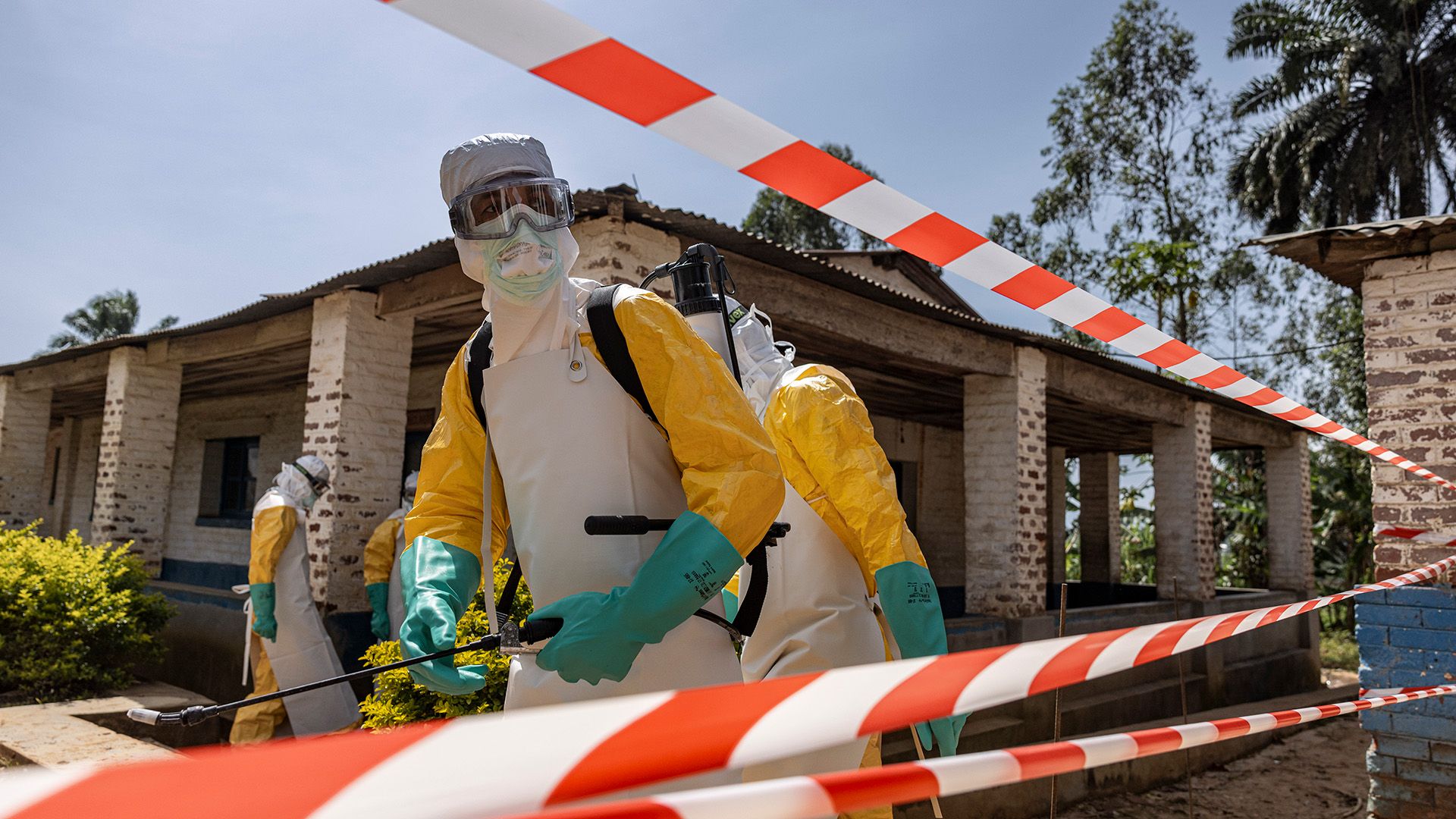
The Ebola outbreak in Central Africa was declared a public health emergency of international concern in May, and since then, over 900 suspected cases and 200 deaths have been reported in the Democratic Republic of the Congo (DRC) and Uganda.
With the majority of cases impacting the DRC, this marks the country’s 17th Ebola outbreak since the discovery of the virus on the Ebola River in 1976. Most of these outbreaks were caused by the highly lethal Zaire virus, a species of Ebola virus that now has approved treatments and vaccines.
This newest outbreak, however, is being caused by the Bundibugyo virus, a more recently discovered species that is less lethal than Zaire but has no approved vaccines or treatments.
According to modeling published in the Morbidity and Mortality Weekly Report, this epidemic has the potential to become one of the largest Ebola outbreaks on record. It could exceed 20,000 cases in the next three months if effective intervention measures are not taken. Such efforts are underway, but they’re complicated by conflict in the region and a dearth of international aid and health infrastructure.
Vaccines can help control Ebola outbreaks, as well as prevent future ones, by enabling health officials to inoculate the close contacts and potential contacts of confirmed and probable cases. Alternatively, all individuals in a given neighborhood or village might be vaccinated, if an outbreak is fairly concentrated. So now, a major effort is underway to craft brand-new vaccines for the Bundibugyo virus.
“The goal is to get a safe and effective Bundibugyo vaccine developed as quickly as possible,” Dr. Richard Hatchett, CEO of the Coalition for Epidemic Preparedness Innovations (CEPI), told Live Science in an email.
Different virus, different challenge
Since the 2014-2016 Zaire virus epidemic — the largest Ebola outbreak ever recorded — scientists have learned a lot about how to control these epidemics. Tools such as rapid diagnostics, contact tracing, isolation, infection prevention, safe burials and prompt clinical care are key to reducing transmission and saving lives.
Get the world’s most fascinating discoveries delivered straight to your inbox.
However, according to Dr. Anne Rimoin, chair of infectious diseases and public health at UCLA, there’s much less field experience for this particular outbreak, as there have been only two recorded Bundibugyo outbreaks to date.
In addition, the Bundibugyo virus may have had a big head start before it was detected. Experts suspect that, although the outbreak was declared in mid-May, it likely began in February.
If new vaccines are approved, they could help to curb the outbreak using strategies like “ring vaccination.” Through a combination of surveillance, contact tracing and rapid vaccination, health officials can vaccinate the close contacts of a person with a confirmed infection, thereby creating a “ring of protection.” Potential contacts, and contacts of people with probable cases, can also be vaccinated under this strategy.
Other strategies include the targeted vaccination of populations with the highest transmission rates or phased rollouts of the vaccine that prioritize those at greatest risk of exposure. Even vaccination after exposure, if done quickly, can reduce the risk of severe illness and death.
Global efforts accelerate vaccine development
Scientists and vaccine manufacturers are now racing to design, test, manufacture and deploy vaccines that could help prevent this outbreak from persisting for several years, as previous outbreaks have.
CEPI, a global partnership to accelerate the development of vaccines and treatments against epidemic and pandemic threats, recently announced its support for the development of three vaccine candidates from three institutions: the International AIDS Vaccine Initiative (IAVI), the pharmaceutical company Moderna, and the University of Oxford. The vaccines will be manufactured by the Serum Institute of India.

There are three candidate vaccines being developed for the Bundibugyo virus.
(Image credit: Andrew Brookes via Getty Images)
“We are supporting three different vaccine platform technologies,” Hatchett said. “All of these technologies have also been used to develop early-stage candidate vaccines targeting viruses that are closely related to Bundibugyo, so we have a lot of information about how they perform against other Ebolaviruses.”
The IAVI vaccine employs rVSV vaccine technology, similar to what is used in the vaccine against the Zaire virus. rVSV stands for “recombinant vesicular stomatitis virus,” and rVSV-based vaccines contain a weakened flu-like virus normally found in animals. This virus is tweaked so it makes proteins belonging to the target, in this case, Bundibugyo virus.
Previous Zaire vaccines made with this technology showed 95% to 100% effectiveness in preventing Ebola disease after just one dose — a feature that can be essential in controlling an outbreak.
Oxford’s vaccine is using the same technology that forms the basis of the Oxford-AstraZeneca COVID-19 vaccine. Called the ChAdOx1 platform, it uses a harmless version of a common cold virus that infects chimpanzees as its base. This platform is easier to adapt to new strains than rVSV technology, and while rVSV vaccines need to be frozen, it can be transported at refrigerated temperatures.
Moderna — whose mRNA vaccine against COVID-19 was the first to enter human trials — is now using the same technology to design a Bundibugyo virus vaccine. This platform uses mRNA, a molecular cousin of DNA, which gives cells instructions to make small pieces of an inactive viral protein. Because of their production speed and design flexibility, mRNA vaccines have become the best way to rapidly design vaccines against specific viral species.
Preparing the vaccines
Once designed and tested in the lab, the vaccines will move quickly to early-stage clinical trials, in which they will be tested on a small group of healthy volunteers, according to a CEPI statement. These vaccine platforms have already been safely used against similar viruses in both trials and real-world scenarios.
If the safety trials are successful, late-stage trials will begin, with the goals of testing more volunteers and generating enough data for emergency use authorization and production.
According to the World Health Organization (WHO), this could take seven to nine months. The CEPI coordination effort aims to accelerate this timeline by providing funding for the late-state clinical trials. In previous outbreak scenarios, vaccine production often happens at the same time as safety testing to ensure quick deployment.
It is unclear which vaccine might be the most effective or deployed first, although the WHO thinks the IAVI vaccine is likely the most promising. In the meantime, coordinated efforts on the ground will likely make the biggest impact on how the outbreak progresses in the immediate future, experts told Live Science.
Deploying vaccines in an outbreak zone like the DRC presents many challenges. The DRC generally relies on the import of vaccines, but many regions don’t have the refrigerated storage facilities required for certain vaccines. If they do, unreliable electricity grids and poor road networks still make it difficult to keep vaccines cold during transport. Vaccine hesitancy can also be high in certain areas.
“We have better tools and better knowledge than we had a decade ago, but all these tools only matter if they reach the front lines quickly, and if communities trust the response,” Rimoin said. “So far, we’ve got a lot of issues with trust in this area.”
While vaccines are great tools, researchers and responders must be realistic about timing, Rimoin added.
“These are certainly not going to be tools that are ready to change the course of the outbreak tomorrow,” Rimoin said. “The response is going to be depending on the basics: finding cases and isolation, contact tracing, protecting healthcare workers and building community trust.”
This article is for informational purposes only and is not meant to offer medical advice.
