Close Menu
  • Home
  • UNSUBSCRIBE
  • News
  • Lifestyle
  • Tech
  • Entertainment
  • Sports
  • Travel
Facebook X (Twitter) WhatsApp
Trending
  • OpenAI’s internal AI model just solved an 80-year-old math problem ‪—‬ and mathematicians verified it
  • Skeletal remains of Queen Elisenda, one of the most powerful rulers in medieval Europe, unearthed in Barcelona — along with several others who bore unexplained stab wounds
  • Tests that measure ‘biological age’ aren’t helpful for tracking your health, scientists say
  • Japan hits 6G key milestone with high-frequency speeds topping 100 Gbps
  • War has brought Iran’s water crisis to a breaking point: ‘Things will collapse unless there is meaningful structural change’
  • Fingal’s Cave: Scotland’s ‘cave of melody’ where eerie echoes bounce off pillars of solidified lava
  • Controversial ‘JuMBO’ planets discovered by James Webb telescope may not be an illusion after all
  • Scientists found the optimal robot body, and it has 20 legs ‪—‬ watch it scale walls and move through trees
Facebook X (Twitter) WhatsApp
Baynard Media
  • Home
  • UNSUBSCRIBE
  • News
  • Lifestyle
  • Tech
  • Entertainment
  • Sports
  • Travel
Baynard Media
Home»Lifestyle»Largest-ever 3D map of the universe shows 47 million galaxies, from the Milky Way to ‘cosmic noon’ — Space photo of the week
Lifestyle

Largest-ever 3D map of the universe shows 47 million galaxies, from the Milky Way to ‘cosmic noon’ — Space photo of the week

EditorBy EditorApril 19, 2026No Comments3 Mins Read
Share Facebook Twitter Pinterest LinkedIn Tumblr Reddit Telegram Email
Share
Facebook Twitter LinkedIn Pinterest Email

Quick facts

What it is: The largest 3D map of the universe ever created

Where it is: The universe, as seen from Earth

When it was shared: April 17, 2026

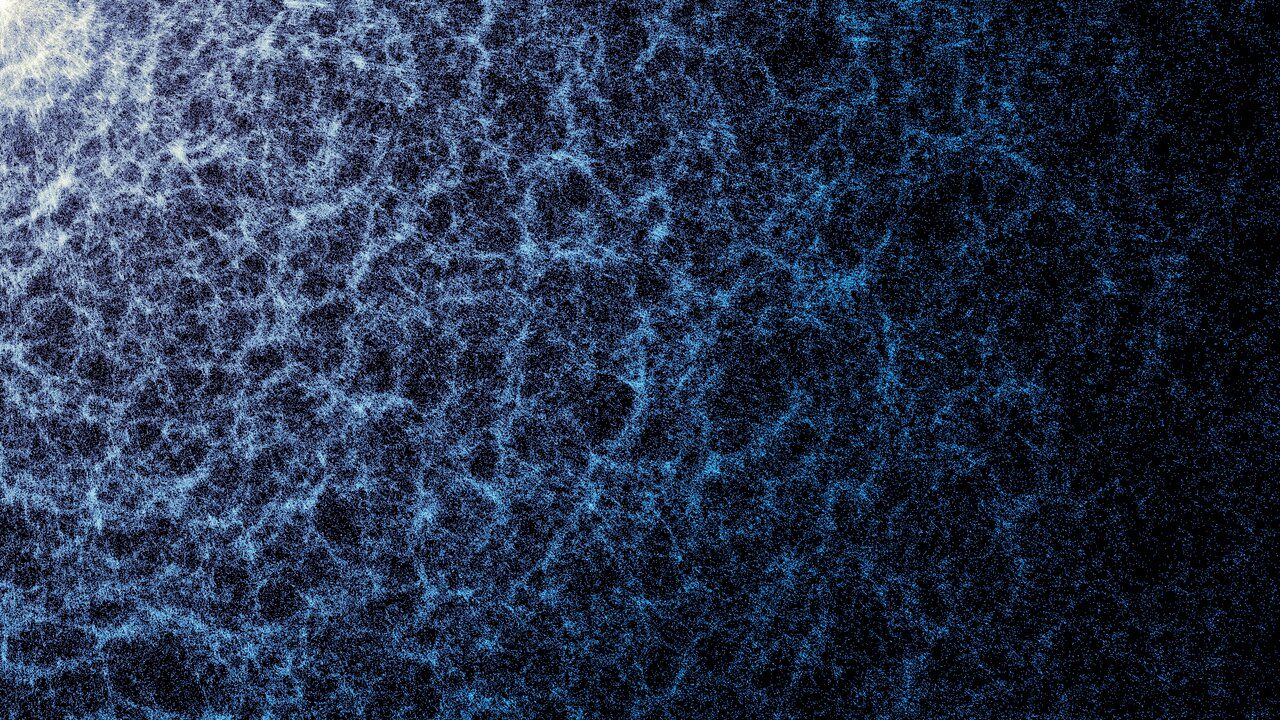
This snapshot is just a small part of one of the most comprehensive and spectacular views yet of the universe — a web-like structure formed by millions of galaxies, stretching back to near the dawn of time.

Each tiny point in the image represents a galaxy mapped by the Dark Energy Spectroscopic Instrument (DESI). The galaxies aren’t randomly distributed; instead, they form in filaments and clusters known as the cosmic web. Between these luminous strands of galaxies are vast empty regions known as voids, where few stars or galaxies exist.

The image is from the largest high-resolution 3D map of the universe ever created. DESI, which is mounted on the Nicholas U. Mayall 4-meter Telescope at Kitt Peak National Observatory in Arizona, uses 5,000 robotic fiber-optic sensors to capture light from distant celestial objects.


You may like

An hourglass shaped image of blue and white light against a black background

The full DESI map of the cosmic web, showing roughly 47 million galaxies. (Image credit: DESI Collaboration and DESI Member Institutions/ DOE/ KPNO/ NOIRLab/ NSF/ AURA/ R. Proctor)

The five-year survey was supposed to gather data on 34 million galaxies and quasars (the bright cores of distant young galaxies). In practice, it detected over 47 million, along with more than 20 million nearby stars in the Milky Way. A visualization published alongside DESI’s map shows how it has grown over those five years.

Some of the light captured in this image took billions of years to reach Kitt Peak, so it allows scientists to look back in time to reconstruct how the universe evolved. The result is a three-dimensional view that not only shows where galaxies are but also how they have moved and clustered over time.

Beyond its visual impact, the image plays a crucial role in probing mysterious dark energy, the name physicists have given to a force that appears to be driving the universe’s accelerated expansion. It makes up roughly 70% of the universe, and its nature and distribution are among the biggest questions in physics.

By comparing the distribution of galaxies across different epochs, researchers can track how dark energy has influenced the structure of the universe over the past 11 billion years. Early DESI data has already hinted that dark energy may evolve through cosmic history ‪—‬ a breakthrough that would fundamentally reshape scientists’ understanding of the universe and its ultimate fate.

Get the world’s most fascinating discoveries delivered straight to your inbox.

The image is the result of a massive international collaboration. More than 900 researchers from over 70 institutions contributed to the project, which was led by Lawrence Berkeley National Laboratory and funded by the U.S. Department of Energy Office of Science.

DESI will continue observing the sky through 2028, expanding its map by about 20%. Future observations will target fainter and more distant galaxies, as well as harder-to-observe regions near the Milky Way (where stars get in the way) and in the southern sky (which requires the telescope to peer through more of Earth’s atmosphere). The first results from the full dataset are anticipated in 2027.


Source link

Share. Facebook Twitter Pinterest LinkedIn Tumblr Email
Previous ArticleWWE star Trick Williams ready for WrestleMania debut vs Sami Zayn
Next Article Hungary’s new leader takes on the authoritarian state
Editor
  • Website

Related Posts

Lifestyle

OpenAI’s internal AI model just solved an 80-year-old math problem ‪—‬ and mathematicians verified it

May 30, 2026
Lifestyle

Skeletal remains of Queen Elisenda, one of the most powerful rulers in medieval Europe, unearthed in Barcelona — along with several others who bore unexplained stab wounds

May 29, 2026
Lifestyle

Tests that measure ‘biological age’ aren’t helpful for tracking your health, scientists say

May 29, 2026
Add A Comment

Comments are closed.

Categories
  • Entertainment
  • Lifestyle
  • News
  • Sports
  • Tech
  • Travel
Recent Posts
  • OpenAI’s internal AI model just solved an 80-year-old math problem ‪—‬ and mathematicians verified it
  • Skeletal remains of Queen Elisenda, one of the most powerful rulers in medieval Europe, unearthed in Barcelona — along with several others who bore unexplained stab wounds
  • Tests that measure ‘biological age’ aren’t helpful for tracking your health, scientists say
  • Japan hits 6G key milestone with high-frequency speeds topping 100 Gbps
  • War has brought Iran’s water crisis to a breaking point: ‘Things will collapse unless there is meaningful structural change’
calendar
June 2026
M T W T F S S
1234567
891011121314
15161718192021
22232425262728
2930  
« May    
Recent Posts
  • OpenAI’s internal AI model just solved an 80-year-old math problem ‪—‬ and mathematicians verified it
  • Skeletal remains of Queen Elisenda, one of the most powerful rulers in medieval Europe, unearthed in Barcelona — along with several others who bore unexplained stab wounds
  • Tests that measure ‘biological age’ aren’t helpful for tracking your health, scientists say
About

Welcome to Baynard Media, your trusted source for a diverse range of news and insights. We are committed to delivering timely, reliable, and thought-provoking content that keeps you informed
and inspired

Categories
  • Entertainment
  • Lifestyle
  • News
  • Sports
  • Tech
  • Travel
Facebook X (Twitter) Pinterest WhatsApp
  • Contact Us
  • About Us
  • Privacy Policy
  • Disclaimer
  • UNSUBSCRIBE
© 2026 copyrights reserved

Type above and press Enter to search. Press Esc to cancel.