Close Menu
  • Home
  • UNSUBSCRIBE
  • News
  • Lifestyle
  • Tech
  • Entertainment
  • Sports
  • Travel
Facebook X (Twitter) WhatsApp
Trending
  • Miniature camelid effigy: A silver llama with a wry smile that the Inca crafted 600 years ago
  • Antarctica’s sea ice suddenly started shrinking a decade ago — and deep-diving robots are revealing why
  • Why do cats and dogs shake their heads?
  • How likely are you to find a message in a bottle?
  • Astronomers just mapped one of the largest structures in the universe, long hidden behind the Milky Way’s ‘Zone of Avoidance’
  • Hubble revisits stunning Trifid Nebula after 30 years, and spots a growing jet of energy — Space photo of the week
  • What you’ll need to see May 2026’s night sky
  • Indigenous Americans’ DNA reveals how natural selection affected people who moved into Earth’s ‘final frontier’
Facebook X (Twitter) WhatsApp
Baynard Media
  • Home
  • UNSUBSCRIBE
  • News
  • Lifestyle
  • Tech
  • Entertainment
  • Sports
  • Travel
Baynard Media
Home»Lifestyle»Iconic ‘Apollo Earthrise’ crater just helped a spaceship get better at hunting aliens
Lifestyle

Iconic ‘Apollo Earthrise’ crater just helped a spaceship get better at hunting aliens

EditorBy EditorJuly 23, 2025No Comments4 Mins Read
Share Facebook Twitter Pinterest LinkedIn Tumblr Reddit Telegram Email
Share
Facebook Twitter LinkedIn Pinterest Email

A lunar crater immortalized in one of the most famous photographs ever taken has just played a key role in the hunt for alien life in our solar system.

Stretching nearly 25 miles (40 kilometers) across the far side of the moon, the lunar impact crater formerly known as “Pasteur T” may be the most-viewed lunar crater in history. Countless Earthlings have seen it spreading prominently through the foreground of the iconic “Earthrise” photo snapped by American astronaut William Anders on Dec. 24, 1968, during the Apollo 8 mission. The majestic photo, which shows a half-lit Earth rising majestically above the lunar horizon, became so famous that the crater was renamed “Anders’ Earthrise” in 2018.

Now, nearly 60 years after Anders’ flyby put his eponymous crater on the map, another spacecraft has glimpsed it from orbit — this time, with extraterrestrial science in mind.


You may like

The Jupiter Icy Moons Explorer (JUICE) spacecraft, which launched from Earth in April 2023 and is expected to reach Jupiter’s orbit in 2031, flew past the moon nearly a year ago. Mission scientists used this encounter to test the spacecraft’s 10 science instruments, which will eventually be used to hunt for signs of habitability on the many moons of Jupiter.

This lunar flyby presented the first opportunity to test the performance of JUICE’s instruments on a solid surface in space, representatives from the European Space Agency (ESA) said in a statement. Of particular importance was the Radar for Icy Moon Exploration (RIME) instrument, which uses radio wave echoes to measure elevation on rocky bodies.

“RIME’s task at Jupiter is to peer below the icy surfaces of moons Europa, Ganymede and Callisto to map the invisible rocky layers below,” ESA representatives wrote in the statement.

Related: 32 strange places scientists are looking for aliens

Get the world’s most fascinating discoveries delivered straight to your inbox.

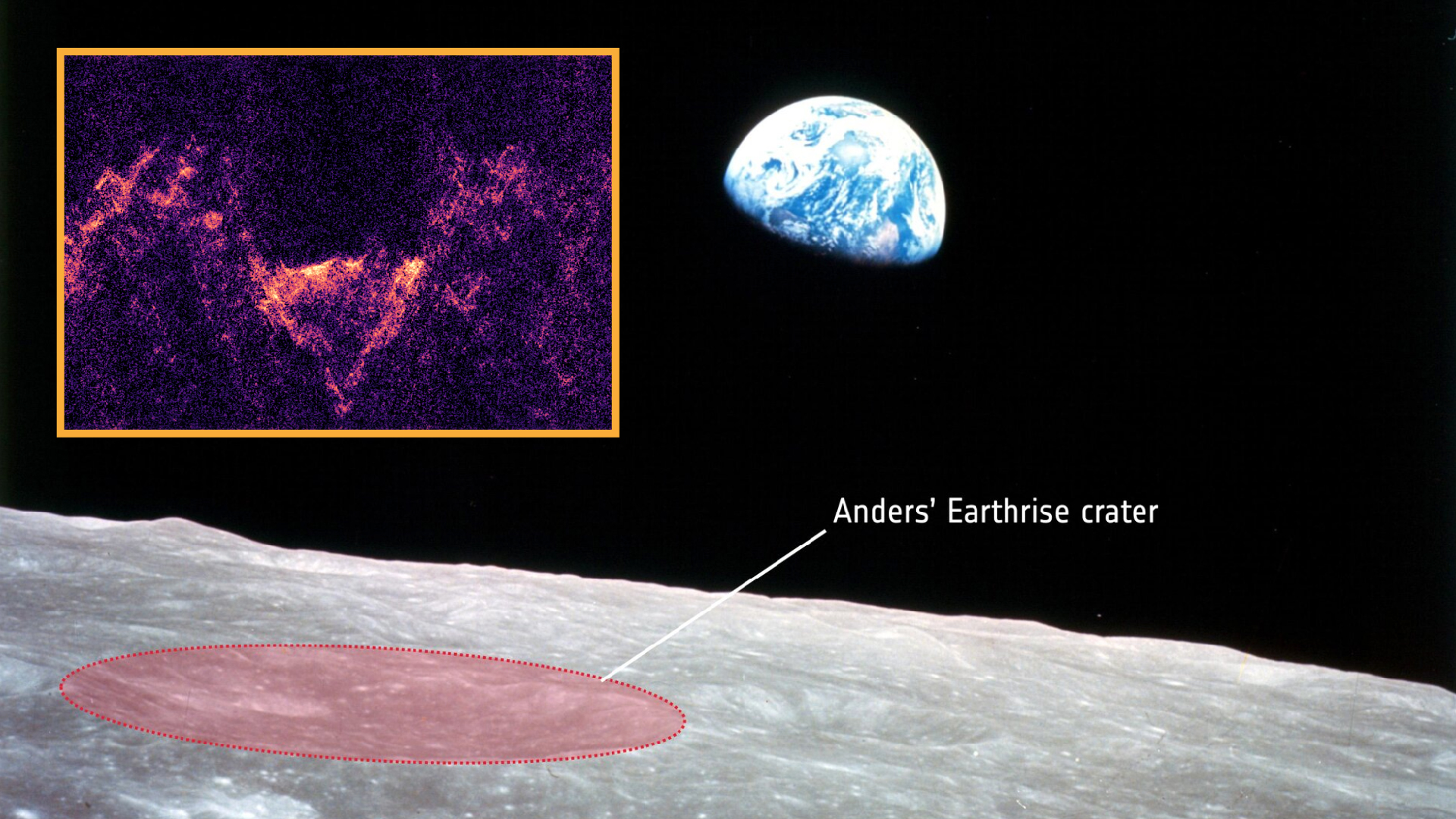
An elevation map showing the height of a crater in purple and orange lines

RIME’s elevation model shows the height of the moon in and around the iconic “Earthrise” crater, with the bright pink-to-yellow line showing the elevation. The crater itself is represented by the big dip on the right side of the image. (Image credit: ESA/Juice/RIME)

Because RIME needs to “listen” for precise changes in radio waves, the instrument requires as much silence as possible to get the best readings. That’s where Anders’ Earthrise crater comes into play. While JUICE sailed past the famous crater, ESA scientists silenced all of the probe’s other instruments to let RIME observe it in peace for eight uninterrupted minutes.

RIME’s radar mapped the moon’s elevation in and around the crater, which researchers compared to earlier measurements taken by other spacecraft, such as NASA’s Lunar Orbiter Laser Altimeter (LOLA). The team found that electronic noise within JUICE was throwing off RIME’s measurements — kicking off a months-long project to correct the issue with a new algorithm.

ESA now reports that this project was a success. The new elevation map of Anders’ Earthrise crater (above) shows peaks and valleys that perfectly match the elevations captured by LOLA during earlier lunar flybys. The data prove that RIME is ready for its big job: charting the subsurface depths of the largest moons in the solar system — and, hopefully, aiding in the search for extraterrestrial life.

With a long journey still ahead, JUICE is now headed toward Venus, where our neighboring planet’s gravity will give the spacecraft a boost on the path to Jupiter. Ultimately, JUICE will complete 35 flybys of Jupiter’s most massive moons, before settling into orbit around Ganymede from December 2034 to September 2035, according to ESA. Studying Jupiter and its moons will not only provide new insights about the formation of gas giants and planetary systems at large but also help to tease out signs of life and habitability beneath the icy shells of the enormous moons.

Source link

Share. Facebook Twitter Pinterest LinkedIn Tumblr Email
Previous ArticleTeamsters boss Sean O’Brien defends tariffs at Senate committee hearing
Next Article The deadliest extreme weather event is not what you think it is
Editor
  • Website

Related Posts

Lifestyle

Miniature camelid effigy: A silver llama with a wry smile that the Inca crafted 600 years ago

April 27, 2026
Lifestyle

Antarctica’s sea ice suddenly started shrinking a decade ago — and deep-diving robots are revealing why

April 26, 2026
Lifestyle

Why do cats and dogs shake their heads?

April 26, 2026
Add A Comment

Comments are closed.

Categories
  • Entertainment
  • Lifestyle
  • News
  • Sports
  • Tech
  • Travel
Recent Posts
  • Miniature camelid effigy: A silver llama with a wry smile that the Inca crafted 600 years ago
  • Antarctica’s sea ice suddenly started shrinking a decade ago — and deep-diving robots are revealing why
  • Why do cats and dogs shake their heads?
  • How likely are you to find a message in a bottle?
  • Astronomers just mapped one of the largest structures in the universe, long hidden behind the Milky Way’s ‘Zone of Avoidance’
calendar
April 2026
M T W T F S S
 12345
6789101112
13141516171819
20212223242526
27282930  
« Mar    
Recent Posts
  • Miniature camelid effigy: A silver llama with a wry smile that the Inca crafted 600 years ago
  • Antarctica’s sea ice suddenly started shrinking a decade ago — and deep-diving robots are revealing why
  • Why do cats and dogs shake their heads?
About

Welcome to Baynard Media, your trusted source for a diverse range of news and insights. We are committed to delivering timely, reliable, and thought-provoking content that keeps you informed
and inspired

Categories
  • Entertainment
  • Lifestyle
  • News
  • Sports
  • Tech
  • Travel
Facebook X (Twitter) Pinterest WhatsApp
  • Contact Us
  • About Us
  • Privacy Policy
  • Disclaimer
  • UNSUBSCRIBE
© 2026 copyrights reserved

Type above and press Enter to search. Press Esc to cancel.