Close Menu
  • Home
  • UNSUBSCRIBE
  • News
  • Lifestyle
  • Tech
  • Entertainment
  • Sports
  • Travel
Facebook X (Twitter) WhatsApp
Trending
  • El Niño is officially here, and will be among the strongest ever recorded, NOAA announces
  • Century-old tuberculosis vaccine could help treat diabetes, trials hint. How?
  • Earth’s underground fungal network is so massive, it would span 10% of the Milky Way, map reveals
  • Ancient squirrel poop from Arctic permafrost contains DNA from mammoths, bison, horses and big cats
  • The Milky Way returns: How to take breathtaking photos of our galaxy this summer
  • Intestinal parasite transformed into antitoxin factory that can live in the body in early study
  • Complete skin of an adult horse found with 10th-century woman and newborn in rare Siberian burial
  • ‘Geminid Symphony’ and ‘Galactic Gandalf’: See the breathtaking views of our home galaxy from the 2026 Milky Way Photographer of the Year contest
Facebook X (Twitter) WhatsApp
Baynard Media
  • Home
  • UNSUBSCRIBE
  • News
  • Lifestyle
  • Tech
  • Entertainment
  • Sports
  • Travel
Baynard Media
Home»Lifestyle»High-school student accidentally discovers black hole ‘light echo’ twice as wide as the Milky Way
Lifestyle

High-school student accidentally discovers black hole ‘light echo’ twice as wide as the Milky Way

EditorBy EditorMarch 22, 2025No Comments3 Mins Read
Share Facebook Twitter Pinterest LinkedIn Tumblr Reddit Telegram Email
Share
Facebook Twitter LinkedIn Pinterest Email

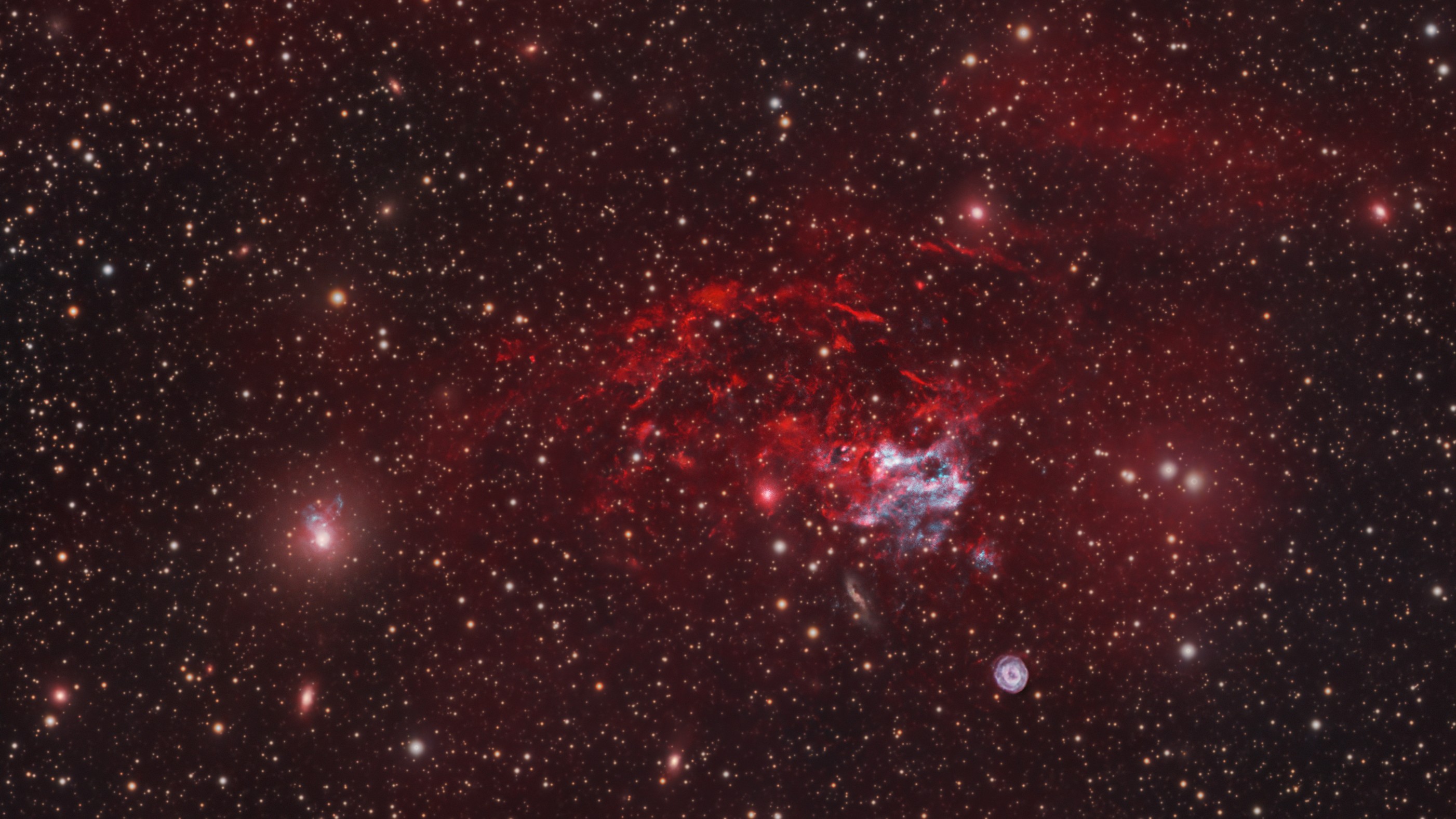
ANAHEIM, Calif. — Long after the black hole in the center of a galaxy sputters out, you can still see its ghost lingering in surrounding gas clouds aglow with leftover radiation, like wisps of smoke emanating from an already extinguished flame. Astronomers call these cosmic ghosts “light echoes” — and that’s what high-school junior Julian Shapiro found while scanning the cosmos for supernova remnants.

“There are these outer regions of gas being ionized by a supermassive black hole, which results in this echo,” Shapiro said at a March 20 presentation here at the 2025 American Physical Society (APS) Global Physics Summit.

Shapiro, 17, is a student at The Dalton School in New York City. But in between classes and scoping out potential colleges, he’s also an independent astronomer who presents at global conferences like this week’s APS meeting.

Originally, Shapiro began sifting through the DECaPS2 survey — an inventory of the southern galactic plane from the Dark Energy Camera at the Cerro Tololo Inter-American Observatory in Chile — to find the debris of exploding stars in supernova remnants and planetary nebulas.

But after zeroing in on one such object, he found its structure didn’t match the wispy filaments characteristic of a supernova remnant, nor did it show evidence of a supernova at its center. “It was a real surprise to stumble upon this,” Shapiro told Live Science.

Related: High school students who came up with ‘impossible’ proof of Pythagorean theorem discover 9 more solutions to the problem

The object, which he believes to be a light echo, stands in a field of potential supermassive black holes. Using measurements from the Southern African Large Telescope, he found high contents of oxygen and ionized sulfur sprinkled into the region — both indicators of shocked material. All of these signs suggest that the object is the afterglow of a now-dormant black hole, which once spewed radiation that ionized the surrounding gas, causing it to emit light even after the black hole quieted down.

Get the world’s most fascinating discoveries delivered straight to your inbox.

An epic echo

Shapiro currently pegs the light echo at about 150,000 to 250,000 light-years in diameter — about 1.5 to two times the width of the entire Milky Way galaxy. And if his estimates hold up, he thinks it could be a viable candidate for the largest light echo ever discovered.

“This object covers a large area in the sky, which makes it a bit easier to get in-depth images of,” Shapiro said.

According to Sasha Plavin, a black hole researcher at Harvard University who was not involved in the research, echoes like the one Shapiro discovered can help us learn more about how black holes behave in the hearts of galaxies.

“I really like how carefully [Shapiro] looked into these images,” Plavin told Live Science. “These galactic events are always of interest, and I think these echoes are a great way of studying them.”

Plavin is also interested in seeing how this new light echo measures up to others — whether it occurred faster or slower than existing examples. “Putting this discovery in a wider context could be useful in the future,” he said.

As Shapiro continues studying the light echo, he hopes to learn more about its composition with measurements of its different regions. But in the meantime, he’s excited to continue contributing to black hole science — even if he came across it by accident.

“My involvement in this area of research came as a bit of a surprise to me,” he said. “But I hope this object, in particular, helps expand the knowledge of galaxy activities that we don’t have too great of an understanding of.”

Source link

Share. Facebook Twitter Pinterest LinkedIn Tumblr Email
Previous ArticleGreat potoo: The ‘tree stump’ bird with a haunting growl and can see with its eyes closed
Next Article 1 dead and 3 missing after boat capsizes in Jacksonville, Florida
Editor
  • Website

Related Posts

Lifestyle

El Niño is officially here, and will be among the strongest ever recorded, NOAA announces

June 12, 2026
Lifestyle

Century-old tuberculosis vaccine could help treat diabetes, trials hint. How?

June 12, 2026
Lifestyle

Earth’s underground fungal network is so massive, it would span 10% of the Milky Way, map reveals

June 12, 2026
Add A Comment

Comments are closed.

Categories
  • Entertainment
  • Lifestyle
  • News
  • Sports
  • Tech
  • Travel
Recent Posts
  • El Niño is officially here, and will be among the strongest ever recorded, NOAA announces
  • Century-old tuberculosis vaccine could help treat diabetes, trials hint. How?
  • Earth’s underground fungal network is so massive, it would span 10% of the Milky Way, map reveals
  • Ancient squirrel poop from Arctic permafrost contains DNA from mammoths, bison, horses and big cats
  • The Milky Way returns: How to take breathtaking photos of our galaxy this summer
calendar
June 2026
M T W T F S S
1234567
891011121314
15161718192021
22232425262728
2930  
« May    
Recent Posts
  • El Niño is officially here, and will be among the strongest ever recorded, NOAA announces
  • Century-old tuberculosis vaccine could help treat diabetes, trials hint. How?
  • Earth’s underground fungal network is so massive, it would span 10% of the Milky Way, map reveals
About

Welcome to Baynard Media, your trusted source for a diverse range of news and insights. We are committed to delivering timely, reliable, and thought-provoking content that keeps you informed
and inspired

Categories
  • Entertainment
  • Lifestyle
  • News
  • Sports
  • Tech
  • Travel
Facebook X (Twitter) Pinterest WhatsApp
  • Contact Us
  • About Us
  • Privacy Policy
  • Disclaimer
  • UNSUBSCRIBE
© 2026 copyrights reserved

Type above and press Enter to search. Press Esc to cancel.