

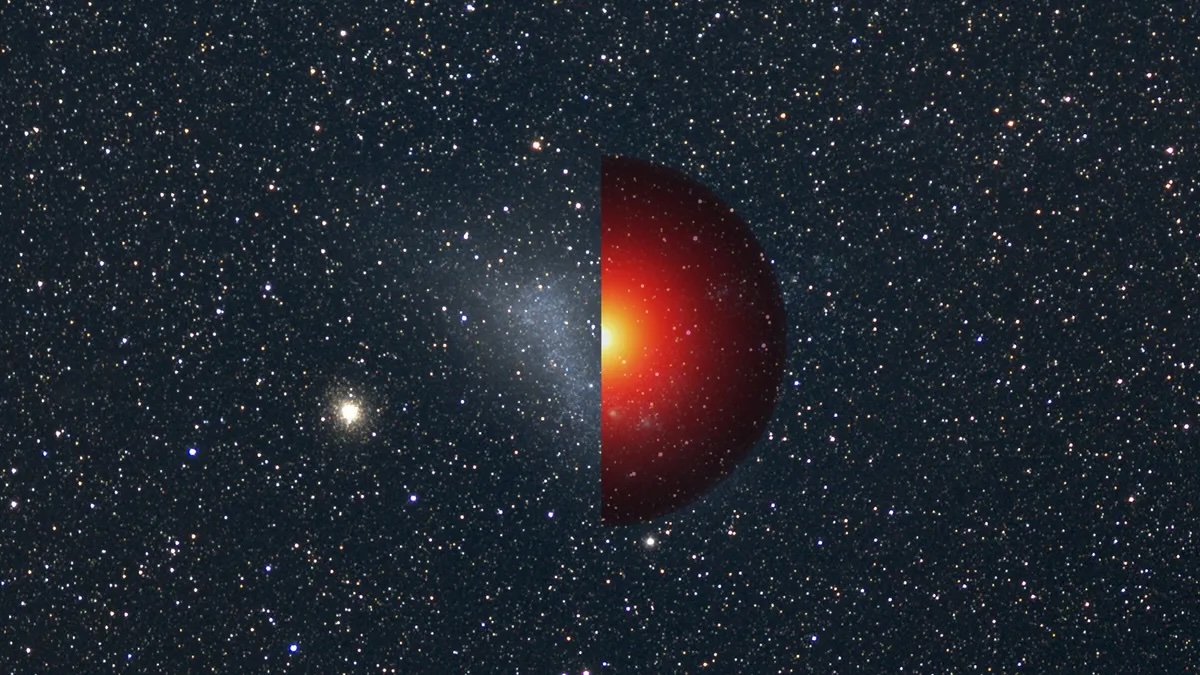
Dark matter can’t be too heavy or it might break our best model of the universe, new research suggests.
We have an abundance of evidence that something fishy is happening in the universe. Stars orbit within galaxies far too quickly. Galaxies move around inside clusters much too fast. Structures grow and evolve too rapidly. If we count only the matter we can see, there simply isn’t enough gravity to explain all of these behaviors.
The vast majority of cosmologists believe all of these phenomena can be explained through the presence of dark matter, a hypothetical form of matter that is massive, electrically neutral and hardly, if ever, interacts with normal matter. This dark matter makes up most of the mass in the universe, far outweighing the amount of luminous matter.
The identity of dark matter remains a mystery, as experiments designed to detect a stray, rare collision have failed to turn up anything. But these experiments have focused on targeting a specific mass range: roughly 10 to 1,000 giga-electron volts (GeV). (A GeV is equivalent to 1 billion electron volts.) That’s in the range of the heaviest known particles, like the W boson and the top quark. For decades, theorists favored this mass range because several simple extensions of the Standard Model of particle physics predicted the existence of such particles.
Because we haven’t found anything yet, though, we’ve started to wonder if dark matter might be lighter or heavier than we thought. But heavier dark matter runs into some serious issues, according to a new paper published to the preprint database arXiv.
The problem is that dark matter does sometimes interact with normal matter, if only rarely. But in the early universe, when the cosmos was much hotter and denser, these interactions were much more frequent. Eventually, as the universe expanded and cooled, these interactions slowed and then stopped, leading the dark matter to “freeze out” and remain silent in the background.
Related: Something invisible and ‘fuzzy’ may lurk at the Milky Way’s center, new research suggests
While there are many, many models of potential dark matter candidates, many interact with regular particles through exchanges involving the Higgs boson — a fundamental particle that interacts with almost all other particles and, through those interactions, imbues those particles with mass.
We know the mass of the Higgs boson: around 125 GeV. The researchers found that this mass puts a fundamental upper limit on the possible mass of most dark matter candidates.
The problem is that all interactions in physics are two-way streets. The Higgs talks to both dark matter and regular matter and, in many models, mediates interactions between them. But both kinds of matter also talk back to the Higgs. These interactions appear as slight modifications to the Higgs boson’s mass.
For Standard Model particles, we can calculate these corrections and feedback interactions, which is how theorists predicted the mass of the Higgs boson well before it was detected.
The researchers found that if the dark matter particle had a mass greater than a few thousand GeV, its contribution to the Higgs mass would be incredibly important, driving it away from its observed value. And because the Higgs is so central to determining many other fundamental physics, it would essentially shut down particle interactions altogether.
There are possibilities to get around this restriction, however. Dark matter might not interact with regular particles at all, or the interaction might happen through some exotic mechanism that doesn’t involve the Higgs. But those models are few and far between and require a lot of fine-tuning and extra steps.
Or it could be that dark matter is lighter than we thought. If we don’t think heavy dark matter is a viable candidate, then as we continue to learn about this mysterious component of the universe, we can instead focus our efforts in the other direction. There has already been a surge of interest in axions, ultralight particles that are predicted in some particle physics models and might be a viable dark matter candidate.
On the experimental side, if this result is confirmed and holds to be a widespread restriction on dark matter particle mass, we can refine and redesign our experiments to search for low-mass, instead of high-mass, particles.
Originally posted on Space.com.
