Close Menu
  • Home
  • UNSUBSCRIBE
  • News
  • Lifestyle
  • Tech
  • Entertainment
  • Sports
  • Travel
Facebook X (Twitter) WhatsApp
Trending
  • Lemur used in ‘lemur yoga’ session dies of human herpesvirus, study finds
  • ‘A fine line between reducing stigma and trivialising conditions’: Social media, self-diagnosis and the glamorization of ADHD
  • New 2D memory device stores data on just a single electron
  • Before we ban kids from social media completely, here’s what we should try first | Jonathan Bellack and Mariana Olaizola Rosenblat
  • Scientists uncover a better way to beat ‘the bends’ — using deep-diving pigs
  • Mars may have been losing its water more than 4 billion years ago, oldest-known Martian meteorite suggests
  • ‘The lance head was still inside the pelvis’: Mass grave found in Austria may hold casualties of unknown ancient Roman battle
  • ‘Full-on berserker mode’: Archaeologists solve mystery of medieval soldiers with gruesome square holes in their skull
Facebook X (Twitter) WhatsApp
Baynard Media
  • Home
  • UNSUBSCRIBE
  • News
  • Lifestyle
  • Tech
  • Entertainment
  • Sports
  • Travel
Baynard Media
Home»Lifestyle»Gold coin discovered by a metal detectorist in the UK may have been dropped by a Viking invader from the Great Heathen Army
Lifestyle

Gold coin discovered by a metal detectorist in the UK may have been dropped by a Viking invader from the Great Heathen Army

EditorBy EditorMarch 4, 2026No Comments3 Mins Read
Share Facebook Twitter Pinterest LinkedIn Tumblr Reddit Telegram Email
Share
Facebook Twitter LinkedIn Pinterest Email

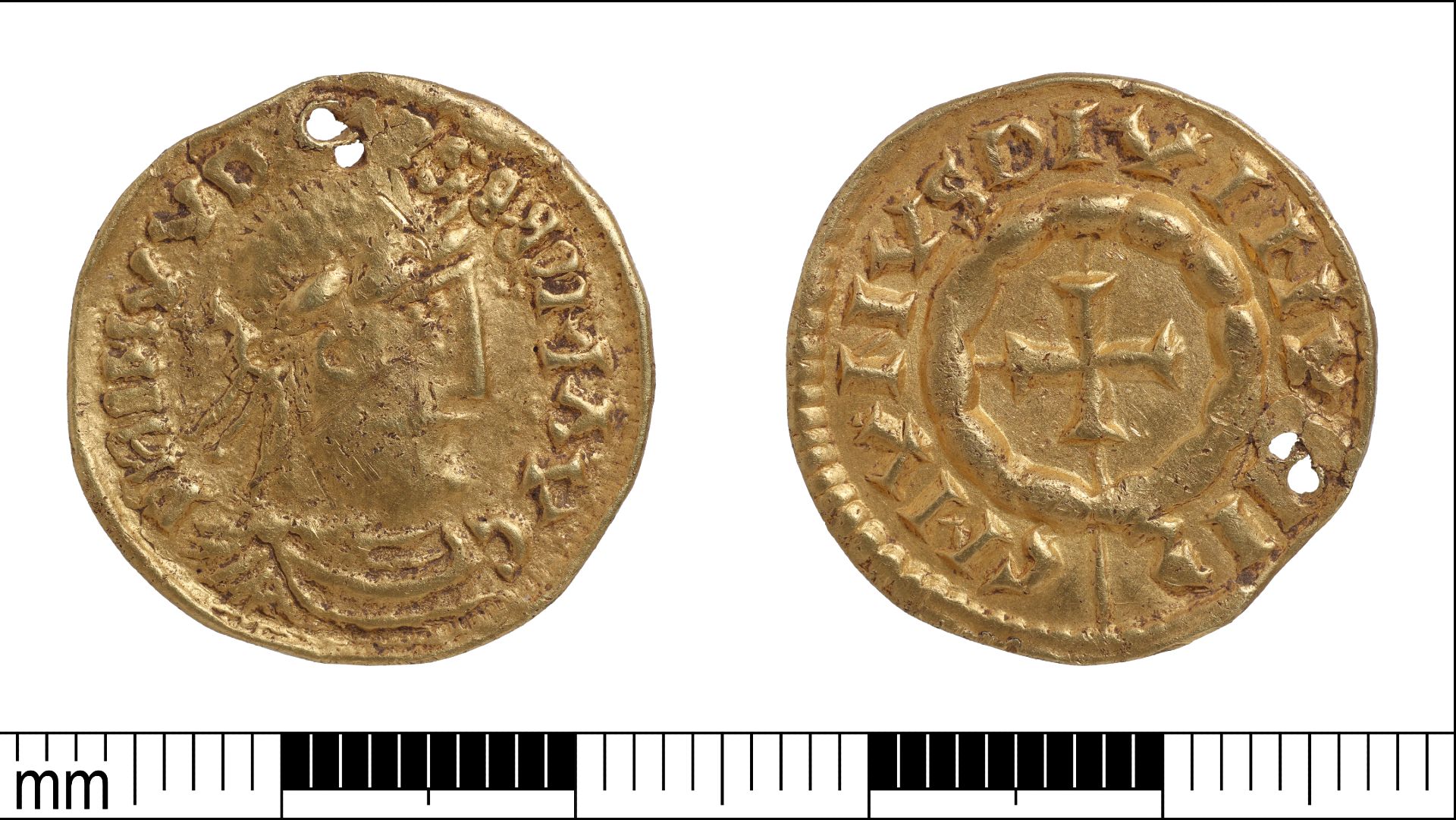
A gold coin minted more than 1,000 years ago as an imitation of a more famous coin may be a relic of the “Great Heathen Army” that invaded England in 865 — an invasion that led to the Viking kingdom there known as the Danelaw.

According to the Portable Antiquities Scheme, which is run by the British Museum and Amgueddfa Cymru – Museum Wales, a metal detectorist discovered the coin in 2024 in a field near Elsing, a village in Norfolk on England’s east coast, which was among the areas first invaded by the Viking army.

The coin had been converted into a pendant or medallion so that it could be worn on a cord around the neck, and independent numismatist Simon Coupland told BBC News that it had probably belonged to one of the invaders.


You may like

Importantly, the coin was a solid-gold imitation of earlier “solidus” coins minted by the Carolingian emperor Louis the Pious — the son of Charlemagne — about 50 years earlier.

The original solidi were awarded to high-ranking Carolingian nobles, but the later copies — probably made in Frisia, an area now covered by the northern Netherlands and the western edge of Germany — were used as “portable wealth” throughout Scandinavia, he said.

It is likely this one was worn as an amulet by one of the Viking invaders. “The Norfolk find is a particularly fine specimen compared with most,” Coupland said.

Gold pendant

The object is now going through an official inquiry to determine if it is “treasure” that must be given or sold to a museum, and Norfolk’s Norwich Castle Museum has expressed interest.

Get the world’s most fascinating discoveries delivered straight to your inbox.

According to its entry on the Portable Antiquities Scheme’s website, the gold coin is pierced through twice above the head of the emperor Louis it portrays, which suggests the “head” side was meant to be facing forward when it was worn as a medallion.

The other side of the coin features a Christian cross, which probably wasn’t favored by the Viking invader who wore it. (The Vikings and other Norse, beginning in the central Danish kingdom, didn’t start converting to Christianity until the late 10th century.)

The Viking force, which the Christian English dubbed the “Great Heathen Army,” began their invasion in 865 under the Danish chieftains Ivar the Boneless (it is unclear what his name means), Halfdan and Ubba. All three chieftains claimed to be sons of the legendary Viking hero and king Ragnar Lothbrok, who appeared in Norse sagas.

A painting showing six longboat Viking ships with oarsmen wearing green and red with long oars sailing across wavy blue water with fish in them

The Scandinavian “Great Heathen Army,” portrayed here in a 10th-century manuscript, invaded England in 865. (Image credit: Zev Radovan via Alamy)

Experts debate whether the army comprised as few as 1,000 Viking warriors or more than 5,000, but as the fighting continued, they were reinforced from Scandinavia in 871, and in 878, Viking leaders negotiated the Danelaw with the English king Alfred the Great.

The deal kept the invaders out of Alfred’s lands and established a Viking kingdom — with unique laws — over much of eastern and northern England for more than 50 years. In the following decades, Alfred’s successors once again amalgamated the Viking territories into the English kingdom, which fell to the Norman Conquest in 1066.


Viking quiz: How much do you know about these seaborne raiders, traders and explorers?

Source link

Share. Facebook Twitter Pinterest LinkedIn Tumblr Email
Previous ArticleHow to preorder Apple’s new M5 MacBook Airs
Next Article Texas Senate results and voters itching for change send a message
Editor
  • Website

Related Posts

Lifestyle

Lemur used in ‘lemur yoga’ session dies of human herpesvirus, study finds

August 15, 2026
Lifestyle

‘A fine line between reducing stigma and trivialising conditions’: Social media, self-diagnosis and the glamorization of ADHD

August 15, 2026
Lifestyle

New 2D memory device stores data on just a single electron

August 15, 2026
Add A Comment

Comments are closed.

Categories
  • Entertainment
  • Lifestyle
  • News
  • Sports
  • Tech
  • Travel
Recent Posts
  • Lemur used in ‘lemur yoga’ session dies of human herpesvirus, study finds
  • ‘A fine line between reducing stigma and trivialising conditions’: Social media, self-diagnosis and the glamorization of ADHD
  • New 2D memory device stores data on just a single electron
  • Before we ban kids from social media completely, here’s what we should try first | Jonathan Bellack and Mariana Olaizola Rosenblat
  • Scientists uncover a better way to beat ‘the bends’ — using deep-diving pigs
calendar
August 2026
M T W T F S S
 12
3456789
10111213141516
17181920212223
24252627282930
31  
« Jul    
Recent Posts
  • Lemur used in ‘lemur yoga’ session dies of human herpesvirus, study finds
  • ‘A fine line between reducing stigma and trivialising conditions’: Social media, self-diagnosis and the glamorization of ADHD
  • New 2D memory device stores data on just a single electron
About

Welcome to Baynard Media, your trusted source for a diverse range of news and insights. We are committed to delivering timely, reliable, and thought-provoking content that keeps you informed
and inspired

Categories
  • Entertainment
  • Lifestyle
  • News
  • Sports
  • Tech
  • Travel
Facebook X (Twitter) Pinterest WhatsApp
  • Contact Us
  • About Us
  • Privacy Policy
  • Disclaimer
  • UNSUBSCRIBE
© 2026 copyrights reserved

Type above and press Enter to search. Press Esc to cancel.