
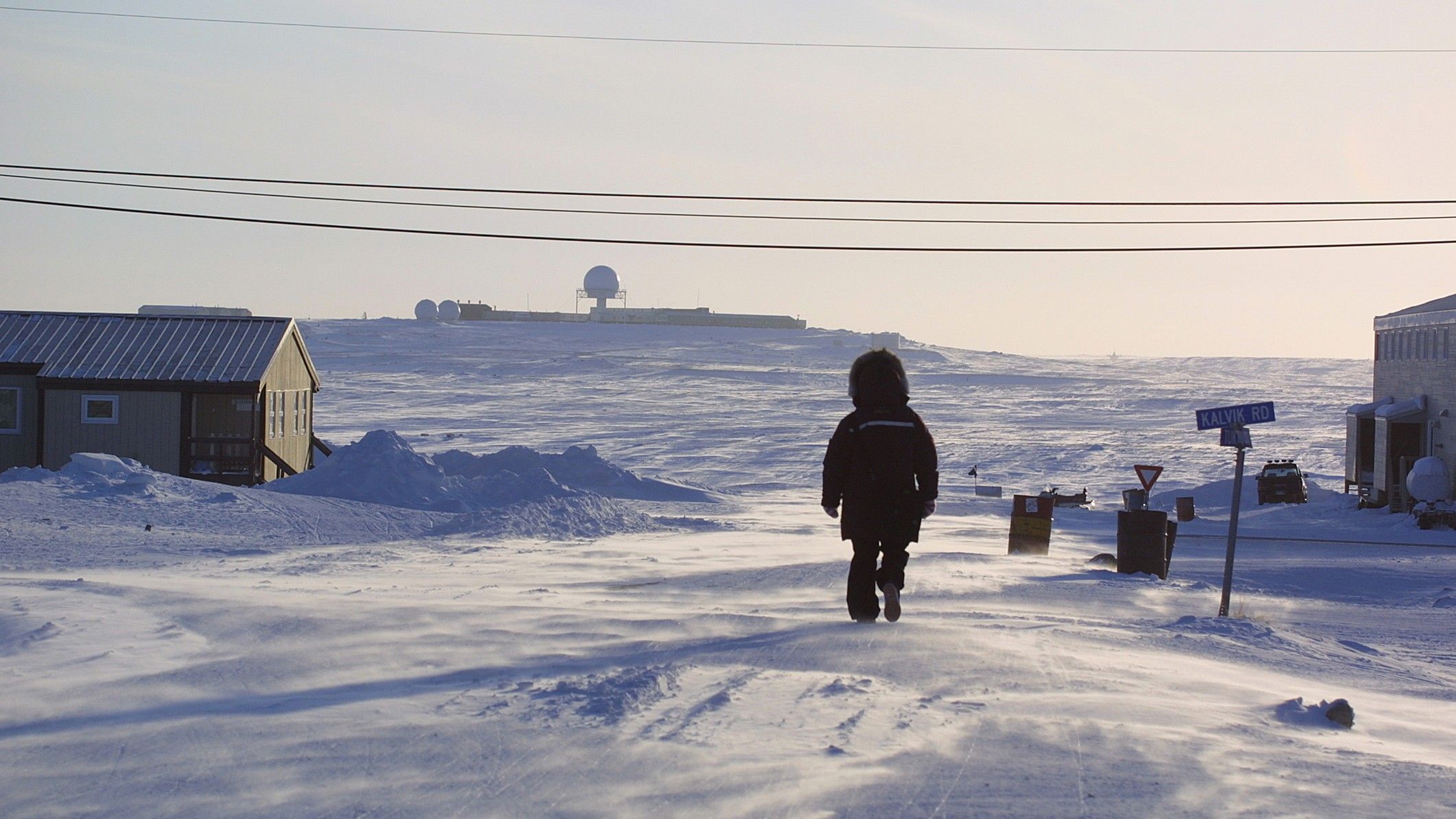
A simple method to thicken Arctic sea ice has shown promising results in its very first field experiment, performed in Cambridge Bay, Nunavut, Canada.
Researchers are considering several controversial geoengineering techniques to slow the catastrophic melt of Arctic sea ice, including stratospheric aerosol injection, which involves shooting tiny sulfur particles into the sky to blot out the sun. But in a new study, scientists evaluated the merits of a much safer and more straightforward approach: pumping seawater onto existing sea ice in winter and letting it freeze into a reinforcing layer.
Known as sea ice thickening, this method has been used by Nordic and Arctic communities for decades, and ice hockey rinks employ a similar technique to keep their ice sturdy, two of the study’s authors told Live Science in an email.
“Practical applications [that already exist] include building ice roads and creating platforms for offshore oil exploration,” said Edward Blanchard-Wrigglesworth, a research associate professor in the University of Washington’s Department of Atmospheric Sciences, and Andrea Ceccolini, an honorary professor at University College London and the CEO of the startup Real Ice, which studies artificial sea ice thickening methods and receives funding from the U.K. government.
Modeling work hints that sea ice thickening could become a climate adaptation tool for Arctic communities by limiting coastal erosion near towns, facilitating travel and supporting animal migrations and hunting.
Now, researchers have assessed the method’s efficacy in the field for the first time. Their results, published May 22 in the journal Earth’s Future, indicate that both the thickness and brightness of sea ice can be enhanced significantly on small scales — making the ice more reflective, and therefore more resilient to melting.
In the experiment, the team set up eight test areas and three control sites in Cambridge Bay during the winter of 2024 to 2025. Using submersible pumps that each consume less power than a toaster, they flooded the test areas either once or twice with up to 8 inches (20 centimeters) of seawater, while the control sites were never flooded. In spring, one control site was used for a melt pond drainage experiment, which involved drilling small holes in the ice to remove meltwater and expose the brighter ice underneath.
Get the world’s most fascinating discoveries delivered straight to your inbox.
Overall, the test areas grew up to 12.6 inches (32 cm) thicker than the control sites by the end of winter, which is roughly equivalent to the ice thinning that has happened in the Arctic over the past 50 years, according to the study. Test areas that were flooded twice showed greater thickening than those flooded once. And in the melt period from late May to September, sea ice in the test areas appeared brighter and had slower melt rates, remaining thicker than the ice in the control sites. The melt pond drainage experiment also resulted in brighter sea ice than the other control sites.
When water is pumped onto sea ice, it saturates the snow that sits on top of the ice. “The snow-water mixture freezes into a new layer of ice, while the reduction in snow insulation allows colder atmospheric temperatures to accelerate natural ice growth from below,” Blanchard-Wrigglesworth and Ceccolini explained.

Sea ice thickening could boost the amount of sunlight that is reflected back to space in the Arctic, thus cooling the region.
(Image credit: Mario Tama/Getty Images)
Thicker sea ice is usually brighter than thin sea ice, which boosts the amount of sunlight that is reflected back into space. “The broader implication is that these effects could enhance the Arctic’s reflectivity through both increased surface brightness and longer-lasting sea ice,” the researchers said. “If similar results could eventually be achieved at larger scales, increased Arctic albedo could contribute to regional cooling, with potential knock-on benefits such as slowing permafrost thaw and reducing ice loss from Greenland.”
However, there is still a big question mark over how scalable and economically viable sea ice thickening is, given that it requires people and machines working in the field. According to a 2016 study, 10 million wind-powered pumps would be needed to cover just 10% of the Arctic Ocean, and 100 million to cover the entire Arctic. “It is reasonable to ask whether such an endeavor is financially feasible or even logistically possible,” the authors of that study wrote.
Yearly sea ice extent in the Arctic has shrunk by 20% since 1979, and this loss is accelerating with global warming. Therefore, if we want Arctic sea ice thickening to work at a large scale, “the pumps must be deployed almost immediately, while there is still a sufficient area of sea ice over which to flood,” researchers wrote in a 2021 study.
The ecological and social impacts of Arctic sea ice thickening are not well understood, and further research will delay deployment, meaning it might be too late to roll out sea ice thickening by the time scientists have the data they need to ensure its safety and feasibility.
For these reasons and others, including governance issues and high maintenance needs, “sea-ice thickening is simply not feasible for use at a scale and at a rate that would be meaningful for sea ice protection,” researchers wrote in a review published last year.
Deployment on anything but local scales would be challenging, Blanchard-Wrigglesworth and Ceccolini agreed. Nevertheless, the researchers said their most recent winter trials, which have yet to be published, showed encouraging results. In those trials, the sea ice in test areas grew 20 inches (50 cm) thicker than in control sites, The Guardian reported.
“We expect to have a clearer picture once the current melt season is complete,” the researchers told Live Science. “In parallel, we are developing underwater robotic technology that could support autonomous deployments. Earlier this year, we conducted the first Arctic field tests of a prototype re-icing drone in Finland.”
The drone is currently being refined in collaboration with the BioRobotics Institute in Pisa, Italy, according to The Guardian.
Blanchard-Wrigglesworth, E., Ceccolini, A., Smith, A., Woods, A., Sherwin, C., Borowski, K., Martin-Daguet, P., Woods, S., Clipston, T., Di Gioacchino, T., Wieringa, M., Pantling, J., Oglethorpe, K., Fitzgerald, S., Desch, S., Hartnett, H., Kelly, B. P., Tan, A., Steffin, B., . . . Emingak, R. (2026). Artificial flooding leads to thicker and brighter Arctic Sea ice. Earth S Future, 14(5). https://doi.org/10.1029/2025ef007894
