The enigmatic Scythians, a diverse group of nomadic tribes known for their ferocity in battle, were organized around elite dynasties of powerful men and women over 2,500 years ago, a new DNA study finds. The results reveal that social inequality arose in these nomadic groups around 900 B.C., during the Iron Age.
Most of what archaeologists know about the Scythians comes from ancient Greek and Roman accounts of the accomplished equestrians and from their large, mound-shaped tombs, called kurgans, that dot the Eurasian steppe grassland. The Scythians’ tattooed mummies and intricate, animal-themed jewelry were as well-known in ancient times as their women warriors, who may have inspired the myth of the Amazons. But the Scythians left no written records of their own and were likely absorbed by other cultural groups after suffering several military defeats around 200 B.C.
In a study published Friday (July 3) in the journal Science Advances, researchers sequenced DNA from 85 Iron Age Scythians to better understand how these geographically spread-out groups were related and how their society was politically structured. They discovered that elite family dynasties ruled the nomadic groups from centralized locations, revealing the origin of social inequality among the Scythians.
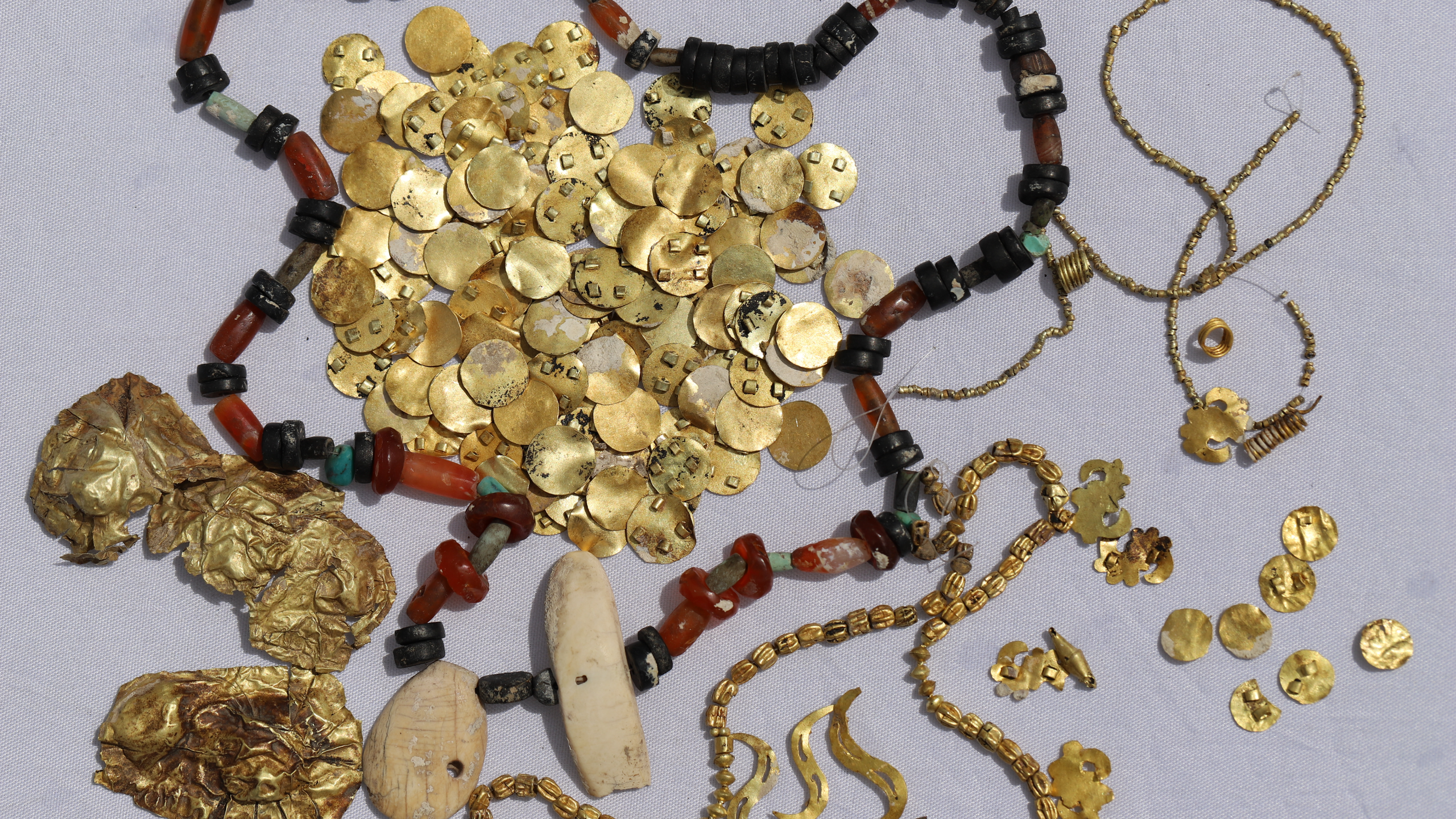
The researchers generated genomes from the skeletons of 38 elite and 47 non-elite people buried in kurgan tombs across 20 archaeological sites between 900 and 200 B.C. The non-elite tombs were smaller than the elite tombs, and they lacked the impressive weapons and gold artifacts of the elite tombs.
Based on DNA, the researchers discovered that elite people were 11 times more likely to be related to each other than they were to be related to non-elite people, suggesting there was a powerful extended family group that ruled the steppe nomads.
Among the elite, they discovered two pairs of biological brothers, a brother and a sister, and a parent and child. In one case, the two brothers were buried at different sites some distance apart. They also found two elite grandfathers and grandsons buried in different cemeteries. But the elite people were still buried closer together than the non-elite people were.
One of the tombs, called a kurgan, prior to excavation.
(Image credit: Rinat Zhumatayev)
“It is possible that this indicates some degree of geographic centralization of the elite burials being on average closer to each other,” study co-author Ainash Childebayeva, a genetic anthropologist at the University of Texas at Austin, told Live Science in an email. “For example, in Siberia there is an area known as the ‘Valley of the Kings‘ that contains many large mounds that are likely elite of the similar time period as in our study.”
Get the world’s most fascinating discoveries delivered straight to your inbox.
The researchers also investigated the historical claim by Greek authors such as Herodotus that women held high-status positions.
“An important observation from our study was the noticeable presence of elite women,” study first author Ayshin Ghalichi, an archaeogeneticist at the Max Planck Institute for Evolutionary Anthropology in Germany, said in a statement. “Nearly half of the elite individuals in our dataset were female, indicating that women held high social status within Iron Age Scythian society.”
Mysterious “Golden Man”
A reconstruction of the “Golden Man,” whose DNA was sequenced in the study.
DNA evidence also solved a long-standing question about the “Golden Man.” This skeleton of a teenager, discovered in 1969 in a kurgan in Kazakhstan, was found with more than 4,000 gold ornaments and a silver bowl with an inscription that has never been deciphered. Although the skeleton’s sex could not be determined based on the bones, experts assumed the person was a powerful male warrior, even though women held nearly equal power among the Scythians.
“Although the data we were able to generate is low coverage, we found that the individual was a lot more likely to be genetically male than female,” Childebayeva said, but “we did not identify any relatedness for the Golden Man.”
The young age of the Golden Man – 17 based on his bones – and his elite burial status together provide clear evidence of elite dynastic rule, Childebayeva noted. An additional example that is “even more striking” comes from the pairing of a grandfather and his 1-year-old grandson, both buried in elite kurgans, Childebayeva said. These burials of elite children reinforce the conclusion that Iron Age steppe nomads inherited their social status.
“The results presented here further our understanding of the rise of social inequality and differentiation among ancient Eurasian nomadic groups and highlight the practices of the earliest nomadic groups of Central Eurasia in the first millennium BCE,” the researchers wrote in the study.
Ghalichi, A., Seidualy, M., Rohrlach, M.B., Musralina, L., Gnecchi-Ruscone, G., Hermes, T., Khussainova, E., Kahbatkyzy, N., Bekmanov, B., Iksan, O., Altynova, N., Tuke, J., Roughan, M., Baitanayev, B., Onggaruly, A., Mukhtarova, G., Toleubayev, A., Zhumatayev, R., Rysbek, B., … Childebayeva, A. (2026). Ancient DNA reveals elite dynastic rule among Iron Age Eurasian Steppe nomads. Science Advances. https://doi.org/10.1126/sciadv.aef0108
Can you identify these historical objects of war? Test your smarts with our weapons of the world quiz!