Close Menu
  • Home
  • UNSUBSCRIBE
  • News
  • Lifestyle
  • Tech
  • Entertainment
  • Sports
  • Travel
Facebook X (Twitter) WhatsApp
Trending
  • ‘A turning point in history’: Gene therapy improves hearing in 90% of patients with congenital deafness in largest trial of its kind
  • Artemis moon landing could face long delay while NASA waits for next-generation spacesuits
  • NASA’s Curiosity rover finds a surprising number of giant ‘dragon scales’ littered across Mars
  • Diagnostic dilemma: A teen’s classic diabetes symptoms didn’t improve with treatment — revealing she also had a much rarer syndrome
  • Strange mammal ancestor laid huge, leathery eggs —‬ and it was key to surviving the world’s worst mass extinction
  • Ancient process that created rare earth elements discovered — and it could help us locate desperately needed deposits
  • This humanoid robot does all your housework for you ‪—‬ and its makers say it’s ready for your home
  • ‘Nations need to prepare now’: Key Atlantic ocean current is much closer to collapse than scientists thought
Facebook X (Twitter) WhatsApp
Baynard Media
  • Home
  • UNSUBSCRIBE
  • News
  • Lifestyle
  • Tech
  • Entertainment
  • Sports
  • Travel
Baynard Media
Home»Lifestyle»Dyson spheres could really exist — but there’s a catch
Lifestyle

Dyson spheres could really exist — but there’s a catch

EditorBy EditorApril 21, 2025No Comments4 Mins Read
Share Facebook Twitter Pinterest LinkedIn Tumblr Reddit Telegram Email
Share
Facebook Twitter LinkedIn Pinterest Email

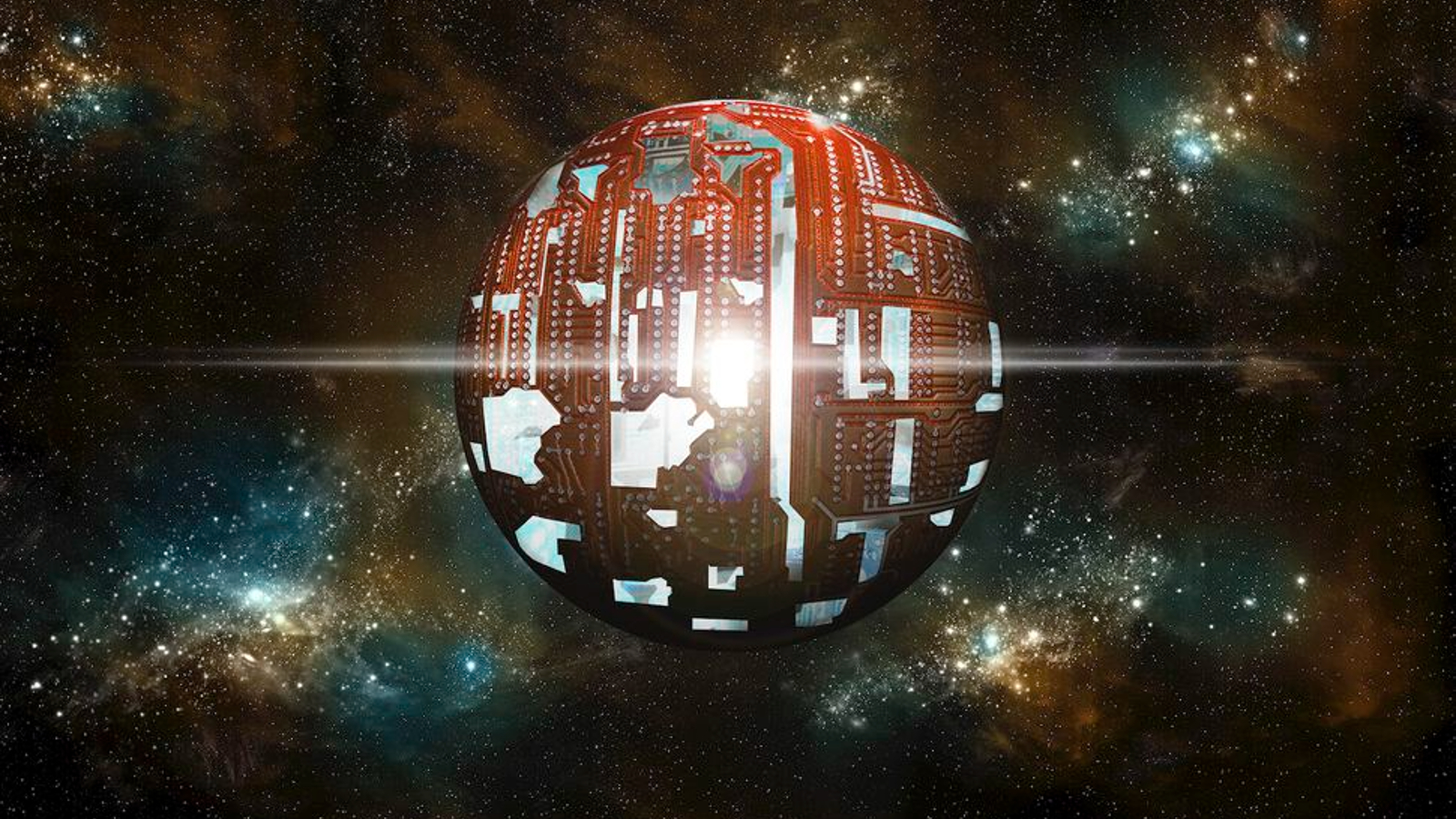
Dyson spheres, the hypothetical mega-structures that advanced alien civilizations might use to enclose a star and harness its energy, suffer from a fatal flaw: They are catastrophically unstable. But now an engineer claims to have figured out a way to stabilize these structures — and all it takes is two stars.

In the 1960s, physicist and polymath Freeman Dyson cooked up the idea of these eponymous spheres. He envisioned that a sufficiently advanced society would have an insatiable need for living space and energy. And if they were industrious enough, they could solve both challenges by taking apart a planet and turning it into an enormous spherical shell. This sphere would enclose a star, providing billions of planets’ worth of surface area and capturing vast amounts of solar energy.

Dyson calculated that a shell made from a planet with the mass of Jupiter could completely enclose the sun at roughly the orbit of Earth. But the gravity inside a hollow shell cancels out, which means there’s nothing tethering the shell to the star. They are free to move in independent directions, which means that soon enough a star hosting a Dyson sphere will simply crash into the shell, destroying it.

In a paper published Jan. 29 in the journal Monthly Notices of the Royal Astronomical Society, Colin McInnes, an engineer at the University of Glasgow, found a way to theoretically stabilize a Dyson sphere. The trick is that you need a system with at least two stars.

Hunting for stable Dyson spheres

McInnes started by searching for any points within a binary star system that could host a stable Dyson sphere arrangement, where the sphere could stay in place and the gravitational forces exerted on it would be uniform. He found one arrangement, where the sphere surrounds both stars. But that situation was only mildly stable and likely to suffer the same problem as the single-star case.

Another stable point arises when the sphere orbits independently, surrounding neither star. While this might be useful for space station outposts, it doesn’t provide the energy-capturing benefits of englobing a star.

Related: ‘Perhaps it’s only a matter of time’: Intelligent life may be much more likely than first thought, new model suggests

Get the world’s most fascinating discoveries delivered straight to your inbox.

But McInnes did find one stable — and useful — configuration. This only happens in binary systems in which one star is much smaller than the other. In that specific case, the Dyson sphere can enclose the smaller of the two stars. The motion of that smaller star acts like a gravitational anchor, keeping the Dyson sphere in motion with the same orbit around the larger star, preventing a catastrophic collision.

There are several caveats to this. The smaller star has to be no bigger than around one tenth the mass of the larger companion, otherwise the gravitational stable point disappears. And the sphere has to be extremely light and thin compared with the two stars, otherwise its own gravitational influence mixes into the dynamics of the system and destroys the stability.

And, of course, this analysis ignores any practical engineering considerations, like the stresses and tensions the sphere might experience, or how to build the thing in the first place.

While it’s unlikely humans will build a Dyson sphere in the distant future — if ever — this research does help inform searches for extraterrestrial civilizations. Presumably, a sufficiently advanced civilization would have made the same realization before building its own Dyson sphere, and so we shouldn’t look for them around solitary stars.

Instead, scientists could look for large, bright stars with a diffuse, infrared companion — the telltale sign of the heat leaking out of a Dyson sphere enclosing the smaller star of a larger companion.

This article was originally published April 12, 2025.

Source link

Share. Facebook Twitter Pinterest LinkedIn Tumblr Email
Previous ArticleSchrödinger’s cat-inspired qubits can be up 160 times more reliable thanks to ‘squeezing’ technique
Next Article Nearly 3 million extra deaths by 2030 could result from HIV funding cuts, study suggests
Editor
  • Website

Related Posts

Lifestyle

‘A turning point in history’: Gene therapy improves hearing in 90% of patients with congenital deafness in largest trial of its kind

April 22, 2026
Lifestyle

Artemis moon landing could face long delay while NASA waits for next-generation spacesuits

April 22, 2026
Lifestyle

NASA’s Curiosity rover finds a surprising number of giant ‘dragon scales’ littered across Mars

April 22, 2026
Add A Comment

Comments are closed.

Categories
  • Entertainment
  • Lifestyle
  • News
  • Sports
  • Tech
  • Travel
Recent Posts
  • ‘A turning point in history’: Gene therapy improves hearing in 90% of patients with congenital deafness in largest trial of its kind
  • Artemis moon landing could face long delay while NASA waits for next-generation spacesuits
  • NASA’s Curiosity rover finds a surprising number of giant ‘dragon scales’ littered across Mars
  • Diagnostic dilemma: A teen’s classic diabetes symptoms didn’t improve with treatment — revealing she also had a much rarer syndrome
  • Strange mammal ancestor laid huge, leathery eggs —‬ and it was key to surviving the world’s worst mass extinction
calendar
April 2026
M T W T F S S
 12345
6789101112
13141516171819
20212223242526
27282930  
« Mar    
Recent Posts
  • ‘A turning point in history’: Gene therapy improves hearing in 90% of patients with congenital deafness in largest trial of its kind
  • Artemis moon landing could face long delay while NASA waits for next-generation spacesuits
  • NASA’s Curiosity rover finds a surprising number of giant ‘dragon scales’ littered across Mars
About

Welcome to Baynard Media, your trusted source for a diverse range of news and insights. We are committed to delivering timely, reliable, and thought-provoking content that keeps you informed
and inspired

Categories
  • Entertainment
  • Lifestyle
  • News
  • Sports
  • Tech
  • Travel
Facebook X (Twitter) Pinterest WhatsApp
  • Contact Us
  • About Us
  • Privacy Policy
  • Disclaimer
  • UNSUBSCRIBE
© 2026 copyrights reserved

Type above and press Enter to search. Press Esc to cancel.