Close Menu
  • Home
  • UNSUBSCRIBE
  • News
  • Lifestyle
  • Tech
  • Entertainment
  • Sports
  • Travel
Facebook X (Twitter) WhatsApp
Trending
  • Mars may have been losing its water more than 4 billion years ago, oldest-known Martian meteorite suggests
  • ‘The lance head was still inside the pelvis’: Mass grave found in Austria may hold casualties of unknown ancient Roman battle
  • ‘Full-on berserker mode’: Archaeologists solve mystery of medieval soldiers with gruesome square holes in their skull
  • Rare belching disorder could be treated with singing, study hints — but not everyone is convinced
  • ‘If this is the new normal, then we are in very deep trouble’: Brazil’s drying aquifers could have ripple effects across the world
  • Foodborne illnesses: Is the US really being hit harder this year?
  • James Webb telescope just spotted the oldest, closest pair of black holes in the early universe
  • Saving old trees may protect people’s health more than planting new ones, study of Chicago neighborhoods finds
Facebook X (Twitter) WhatsApp
Baynard Media
  • Home
  • UNSUBSCRIBE
  • News
  • Lifestyle
  • Tech
  • Entertainment
  • Sports
  • Travel
Baynard Media
Home»Lifestyle»Doomed Soviet spacecraft tumbling toward Earth may already have its parachute out, new images hint: The latest on Kosmos 482
Lifestyle

Doomed Soviet spacecraft tumbling toward Earth may already have its parachute out, new images hint: The latest on Kosmos 482

EditorBy EditorMay 2, 2025No Comments3 Mins Read
Share Facebook Twitter Pinterest LinkedIn Tumblr Reddit Telegram Email
Share
Facebook Twitter LinkedIn Pinterest Email

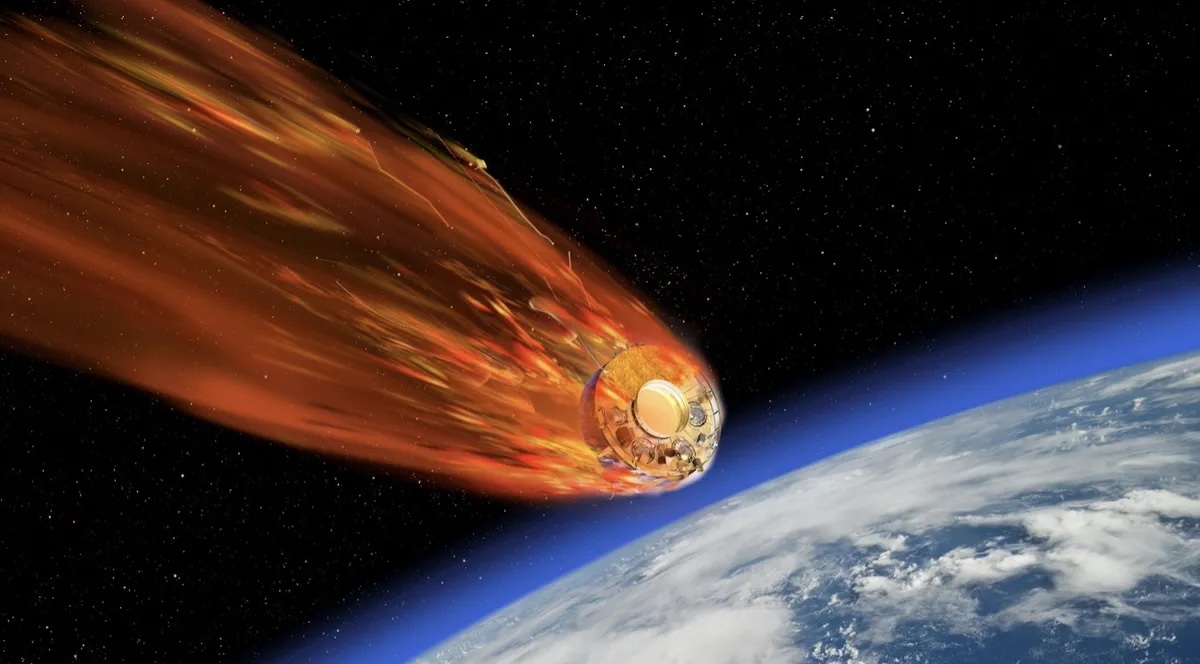
A doomed 53-year-old Soviet lander currently tumbling back to Earth could be trailing a parachute, new images of the spacecraft reveal.

The Kosmos 482 probe, which launched in 1972, was built to land on Venus as part of the former U.S.S.R.’s Venera program. But a malfunction in the rocket it was mounted on caused the spacecraft to split in two, with the main body crashing back to Earth in 1981 and the lander section remaining trapped in orbit ever since.

Now, after news broke that the lander will finally return to our planet sometime around May 10, satellite trackers have analyzed photos of the craft and revealed an unknown object trailing behind it.

“Some structure is connected to the capsule,” Ralf Vandebergh, a Dutch astronomer and astrophotographer, wrote on the social platform X. “Not impossible that it’s the parachute, but this is still speculation!”

These images of Kosmos 482 in orbit, taken ten years apart, apear to show a faint structure trailing behind the craft.

These images of Kosmos 482 in orbit, taken ten years apart, apear to show a faint structure trailing behind the craft. (Image credit: Ralf Vandebergh)

Kosmos 482 was built as a sister probe to Venera 8, which launched in July 1972 to become the second craft (following Venera 7) to land on Venus. Once there, Venera 8 beamed data from Venus for just over 50 minutes before being fried by the planet’s blisteringly hot atmosphere.

Related: 5,000-pound European satellite burns up over Pacific Ocean after 30 years in orbit

Designed to survive passage through Venus’ atmosphere, the 1,091-pound (495 kilograms), 3-foot (1 meter) lander is likely to return to Earth intact.

Get the world’s most fascinating discoveries delivered straight to your inbox.

Vanderbergh snagged this first set of high-resolution images in July 2024 and posted them on X on April 29, 2025. In side-by-side comparisons with photos captured in June 2014, both sets of images appear to show “a compact ball” with “a weak elongated structure at one particular side of the ball” appearing in several frames, he said.

Even if this trailing material is indeed the lander’s parachute, it’s unlikely that it will survive the craft’s approximate 150 mph (242 km/h) reentry through our planet’s atmosphere.

“If it is true that this is the parachute that came out a long time ago in space, this would mean it is likely to burn up on reentry and will have no function in slowing down the spacecraft,” Vanderberg wrote on X.

With satellite watchers avidly tracking the spacecraft’s descent, further images and up-to-date projections of where it will land are sure to follow. Watch this space.

Source link

Share. Facebook Twitter Pinterest LinkedIn Tumblr Email
Previous ArticleLa Niña is dead — what that means for this year’s hurricanes and weather
Next Article Planet Nine? Astronomers spot potential ninth planet far beyond Neptune — but not everyone is convinced
Editor
  • Website

Related Posts

Lifestyle

Mars may have been losing its water more than 4 billion years ago, oldest-known Martian meteorite suggests

August 14, 2026
Lifestyle

‘The lance head was still inside the pelvis’: Mass grave found in Austria may hold casualties of unknown ancient Roman battle

August 14, 2026
Lifestyle

‘Full-on berserker mode’: Archaeologists solve mystery of medieval soldiers with gruesome square holes in their skull

August 14, 2026
Add A Comment

Comments are closed.

Categories
  • Entertainment
  • Lifestyle
  • News
  • Sports
  • Tech
  • Travel
Recent Posts
  • Mars may have been losing its water more than 4 billion years ago, oldest-known Martian meteorite suggests
  • ‘The lance head was still inside the pelvis’: Mass grave found in Austria may hold casualties of unknown ancient Roman battle
  • ‘Full-on berserker mode’: Archaeologists solve mystery of medieval soldiers with gruesome square holes in their skull
  • Rare belching disorder could be treated with singing, study hints — but not everyone is convinced
  • ‘If this is the new normal, then we are in very deep trouble’: Brazil’s drying aquifers could have ripple effects across the world
calendar
August 2026
M T W T F S S
 12
3456789
10111213141516
17181920212223
24252627282930
31  
« Jul    
Recent Posts
  • Mars may have been losing its water more than 4 billion years ago, oldest-known Martian meteorite suggests
  • ‘The lance head was still inside the pelvis’: Mass grave found in Austria may hold casualties of unknown ancient Roman battle
  • ‘Full-on berserker mode’: Archaeologists solve mystery of medieval soldiers with gruesome square holes in their skull
About

Welcome to Baynard Media, your trusted source for a diverse range of news and insights. We are committed to delivering timely, reliable, and thought-provoking content that keeps you informed
and inspired

Categories
  • Entertainment
  • Lifestyle
  • News
  • Sports
  • Tech
  • Travel
Facebook X (Twitter) Pinterest WhatsApp
  • Contact Us
  • About Us
  • Privacy Policy
  • Disclaimer
  • UNSUBSCRIBE
© 2026 copyrights reserved

Type above and press Enter to search. Press Esc to cancel.