Close Menu
  • Home
  • UNSUBSCRIBE
  • News
  • Lifestyle
  • Tech
  • Entertainment
  • Sports
  • Travel
Facebook X (Twitter) WhatsApp
Trending
  • China’s real-life ‘transformer’ mech is a giant humanoid robot that can switch from bounding on 4 legs to walking on 2
  • How can we prevent AI models from cannibalizing themselves when human-generated data runs out? Scientists say they’ve found the answer.
  • ‘The system is likely to reach a breaking point’: Major Italian volcano is speeding toward a transition, and a major eruption could be on the way
  • China installs world’s largest floating wind turbine in deep water test — it generates enough energy to power 4,200 homes annually
  • Diagnostic dilemma: A biopsy of a woman’s cancerous tumor caused it to vanish
  • Physicists confirm ‘negative time’ is real in mind-bending quantum experiment
  • Complex animals evolved up to 10 million years earlier than previously thought, fossil discovery shows
  • Scurvy-plagued whalers’ remains discovered at ‘Corpse Point’ on Arctic island
Facebook X (Twitter) WhatsApp
Baynard Media
  • Home
  • UNSUBSCRIBE
  • News
  • Lifestyle
  • Tech
  • Entertainment
  • Sports
  • Travel
Baynard Media
Home»Lifestyle»Chinese scientists create multicolored glow-in-the-dark succulents that recharge in sunlight
Lifestyle

Chinese scientists create multicolored glow-in-the-dark succulents that recharge in sunlight

EditorBy EditorAugust 28, 2025No Comments3 Mins Read
Share Facebook Twitter Pinterest LinkedIn Tumblr Reddit Telegram Email
Share
Facebook Twitter LinkedIn Pinterest Email

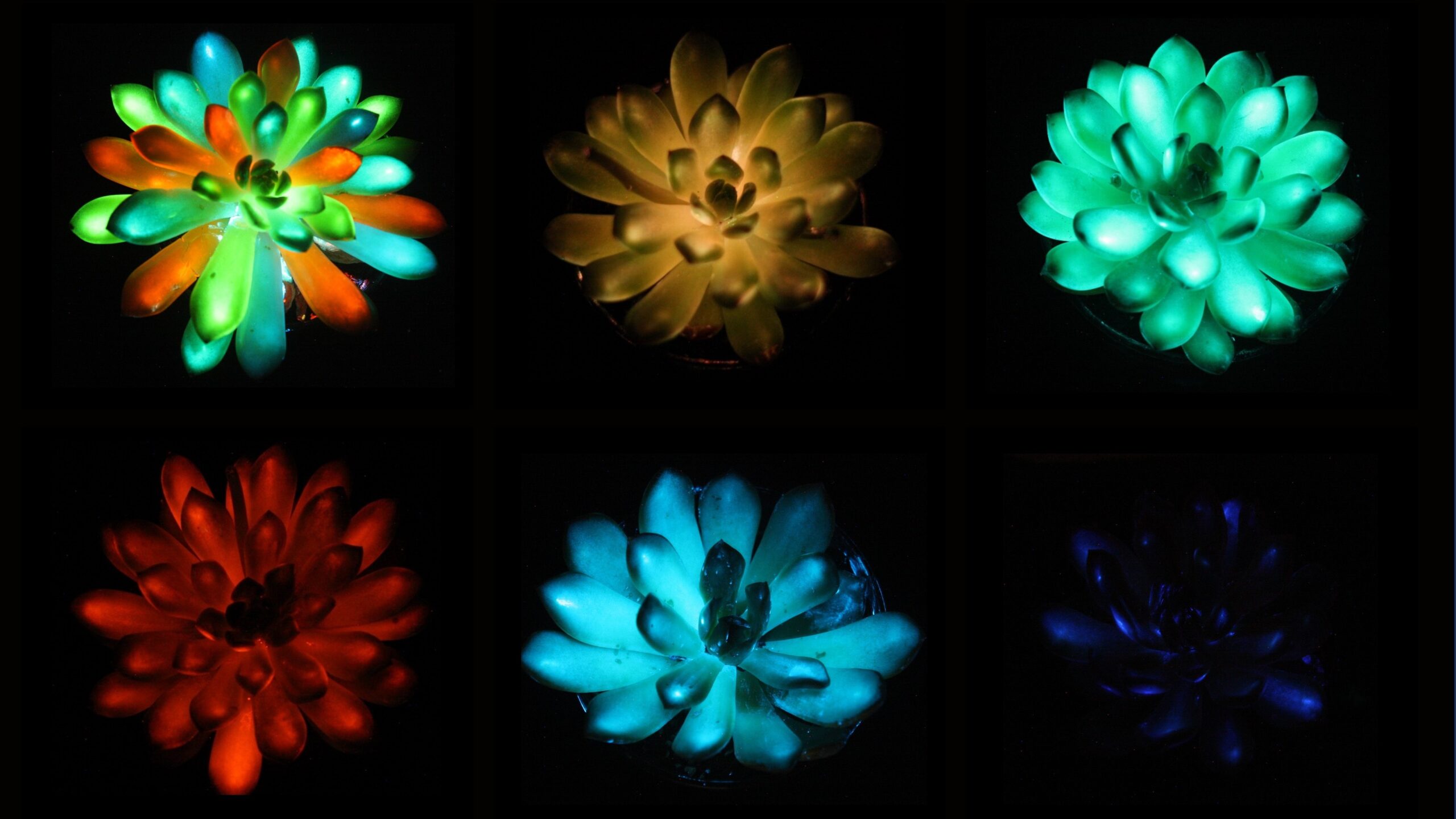
Scientists in China have created rainbow, glow-in-the-dark succulents by injecting colorful “afterglow” particles into the leaves that absorb, and then gradually release, light.

The luminescent succulents shone for up to two hours, outperforming similar, material-engineered plants, according to a new study. The invention paves the way for sustainable, plant-based lighting to illuminate outdoor and indoor spaces, researchers said.

“Imagine glowing trees replacing streetlights,” study lead author Shuting Liu, a researcher at South China Agricultural University, said in a statement. “The particles diffused in just seconds, and the entire succulent leaf glowed.”


You may like

Researchers have made glow-in-the-dark plants before, both with genetic engineering and material engineering. Genetic engineering approaches harness bioluminescent genes that already exist in certain plants, such as phytoplankton — but these genes have a limited, mostly green, color range, according to the study. Material engineering techniques involve injecting light-emitting particles into plant leaves to make them glow, but these methods have so far only generated dim light.

For strong luminescence, light-emitting particles have to be small enough to diffuse through a plant’s tissues, but also big enough to emit a visible glow. Previous experiments using nanoparticles derived from firefly luciferase, the enzyme that creates bioluminescence in fireflies, produced only a faint glow that dropped sharply after 30 minutes.

For the new study, Liu and her colleagues used light-emitting phosphor particles that were roughly the width of a human red blood cell (6 to 8 micrometers). The micron-sized particles were large enough to produce a strong glow while traveling through the plants freely, Liu said. “Smaller, nano-sized particles move easily within the plant but are dimmer,” she said.

Related: Scientists invent photosynthetic ‘living’ material that sucks CO2 out of the atmosphere

Get the world’s most fascinating discoveries delivered straight to your inbox.

The researchers published their findings Wednesday (Aug. 27) in the journal Matter.

Micron-sized particles worked for succulents but not for other plants tested in the study, including bok choy (Brassica rapa chinensis) and golden pothos (Epipremnum aureum). The researchers used Echeveria “Mebina” succulents, which have blue-green leaves with red tips. Unlike bok choy and golden pothos, these succulents have relatively large gaps between their cells, meaning that micron-sized particles can travel through the plant, according to the study.

The researchers injected phosphor particles into the leaves of Echeveria “Mebina” and charged the plants in sunlight or indoor LED light for a few minutes, obtaining the same afterglow effect in both experiments. Green particles produced the longest glow, with the plants emitting light for up to 2 hours and rivaling a small night lamp at their brightest, according to the study.

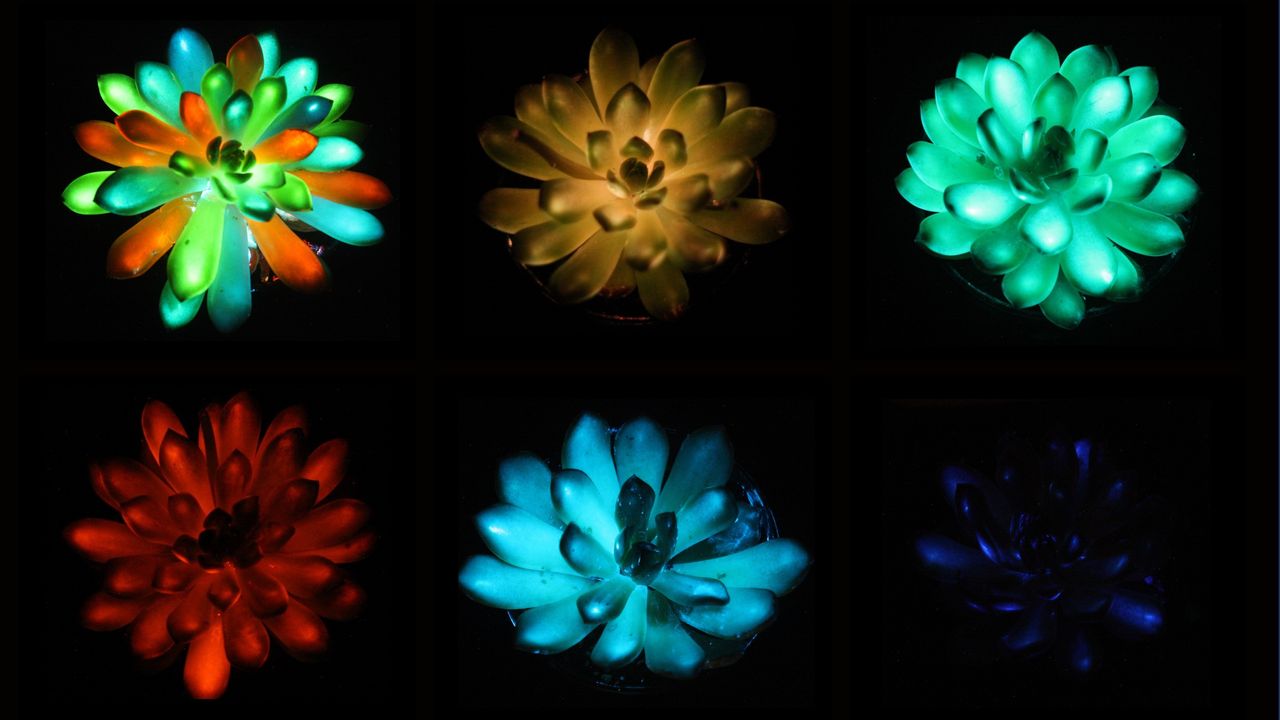
The team produced the world’s first multicolored luminescent plants by injecting blue, green, red and blue-violet phosphor particles into the leaves of some succulents. The scientists also built a plant wall of 56 succulents that produced enough light to see nearby objects and read text in the dark, according to the statement.

“I just find it incredible that an entirely human-made, micro-scale material can come together so seamlessly with the natural structure of a plant,” Liu said. “The way they integrate is almost magical.”

Luminescent succulents could one day be a low-carbon lighting solution, according to the study. The researchers hope to produce the same effect in other plants, which could be exposed to sunlight and charged up like batteries to provide decorative and practical lighting.

“The process is straightforward and cost-effective and achieves luminescence within 10 min, paving the way for practical applications in plant-based lighting,” the researchers wrote in the study.

Source link

Share. Facebook Twitter Pinterest LinkedIn Tumblr Email
Previous ArticlePritzker says he will respond if Trump deploys National Guard to Chicago
Next Article Student describes comforting friends during Minneapolis shooting
Editor
  • Website

Related Posts

Lifestyle

China’s real-life ‘transformer’ mech is a giant humanoid robot that can switch from bounding on 4 legs to walking on 2

May 21, 2026
Lifestyle

How can we prevent AI models from cannibalizing themselves when human-generated data runs out? Scientists say they’ve found the answer.

May 21, 2026
Lifestyle

‘The system is likely to reach a breaking point’: Major Italian volcano is speeding toward a transition, and a major eruption could be on the way

May 21, 2026
Add A Comment

Comments are closed.

Categories
  • Entertainment
  • Lifestyle
  • News
  • Sports
  • Tech
  • Travel
Recent Posts
  • China’s real-life ‘transformer’ mech is a giant humanoid robot that can switch from bounding on 4 legs to walking on 2
  • How can we prevent AI models from cannibalizing themselves when human-generated data runs out? Scientists say they’ve found the answer.
  • ‘The system is likely to reach a breaking point’: Major Italian volcano is speeding toward a transition, and a major eruption could be on the way
  • China installs world’s largest floating wind turbine in deep water test — it generates enough energy to power 4,200 homes annually
  • Diagnostic dilemma: A biopsy of a woman’s cancerous tumor caused it to vanish
calendar
May 2026
M T W T F S S
 123
45678910
11121314151617
18192021222324
25262728293031
« Apr    
Recent Posts
  • China’s real-life ‘transformer’ mech is a giant humanoid robot that can switch from bounding on 4 legs to walking on 2
  • How can we prevent AI models from cannibalizing themselves when human-generated data runs out? Scientists say they’ve found the answer.
  • ‘The system is likely to reach a breaking point’: Major Italian volcano is speeding toward a transition, and a major eruption could be on the way
About

Welcome to Baynard Media, your trusted source for a diverse range of news and insights. We are committed to delivering timely, reliable, and thought-provoking content that keeps you informed
and inspired

Categories
  • Entertainment
  • Lifestyle
  • News
  • Sports
  • Tech
  • Travel
Facebook X (Twitter) Pinterest WhatsApp
  • Contact Us
  • About Us
  • Privacy Policy
  • Disclaimer
  • UNSUBSCRIBE
© 2026 copyrights reserved

Type above and press Enter to search. Press Esc to cancel.