Close Menu
  • Home
  • UNSUBSCRIBE
  • News
  • Lifestyle
  • Tech
  • Entertainment
  • Sports
  • Travel
Facebook X (Twitter) WhatsApp
Trending
  • If humans are getting smarter, why are our brains shrinking?
  • ‘Feuding tech bros’ go head to head in legal showdown. But what does it mean for the future of AI?
  • Pregnancy quiz: Can you deliver on the science of growing babies?
  • Science news this week: The latest on the cruise ship hantavirus infections, a shortcut to Mars, and a fast-charging quantum battery
  • Hantavirus cruise LIVE: Cruise passengers monitored in at least 5 US states as American passengers set to receive repatriation flight
  • Mangroves clean up $8.7 billion of nitrogen pollution every year, study finds
  • Flowering plants transformed into ‘hopeful monsters’ in 9 dire bursts across evolutionary time, study finds
  • US government declassifies nearly 200 UAP files, including strange sightings from Apollo astronauts
Facebook X (Twitter) WhatsApp
Baynard Media
  • Home
  • UNSUBSCRIBE
  • News
  • Lifestyle
  • Tech
  • Entertainment
  • Sports
  • Travel
Baynard Media
Home»Lifestyle»Astronomers spotted a pair of monster black holes that could collide in just 100 years — and Earth will feel it
Lifestyle

Astronomers spotted a pair of monster black holes that could collide in just 100 years — and Earth will feel it

EditorBy EditorApril 16, 2026No Comments4 Mins Read
Share Facebook Twitter Pinterest LinkedIn Tumblr Reddit Telegram Email
Share
Facebook Twitter LinkedIn Pinterest Email

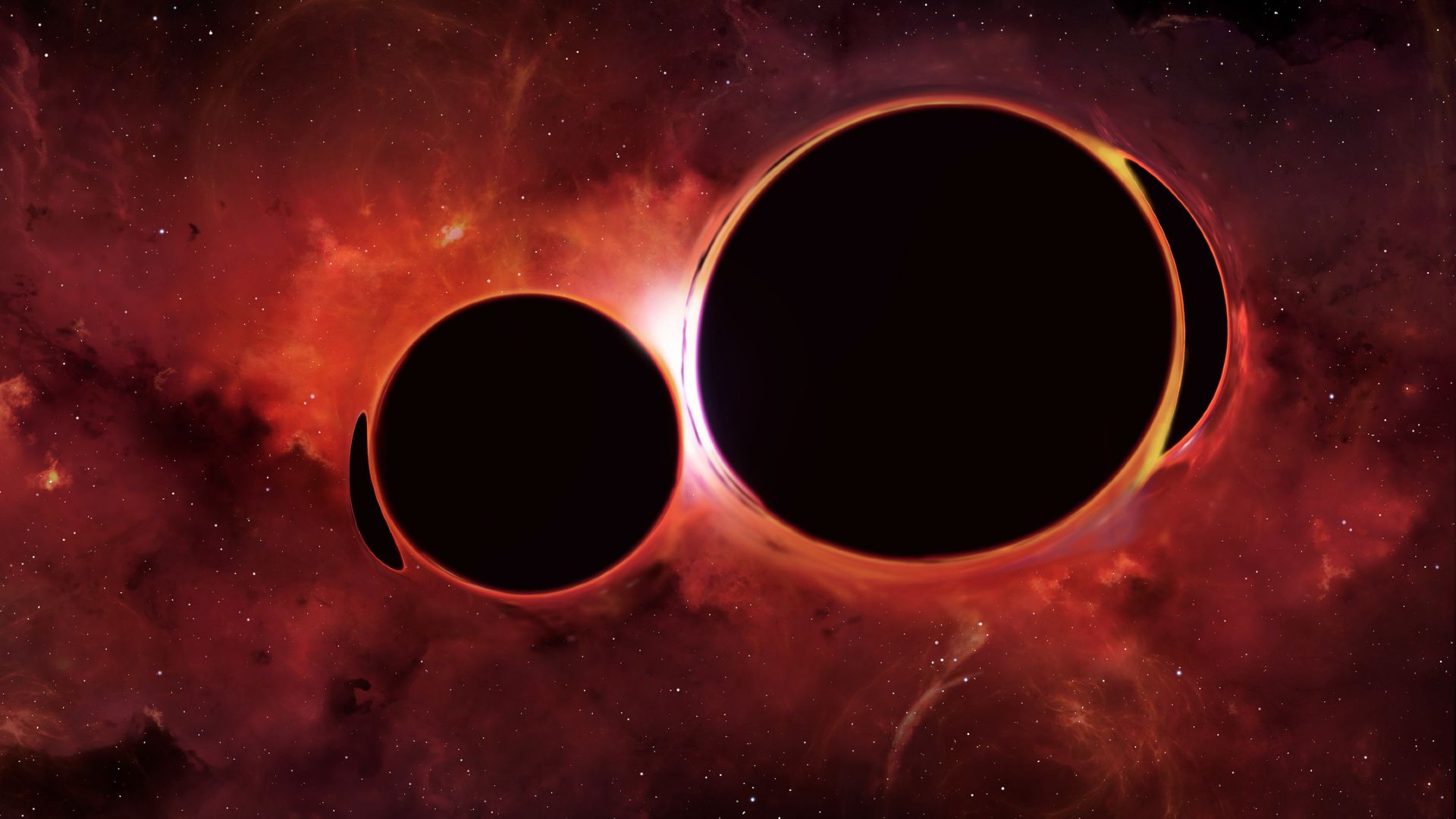
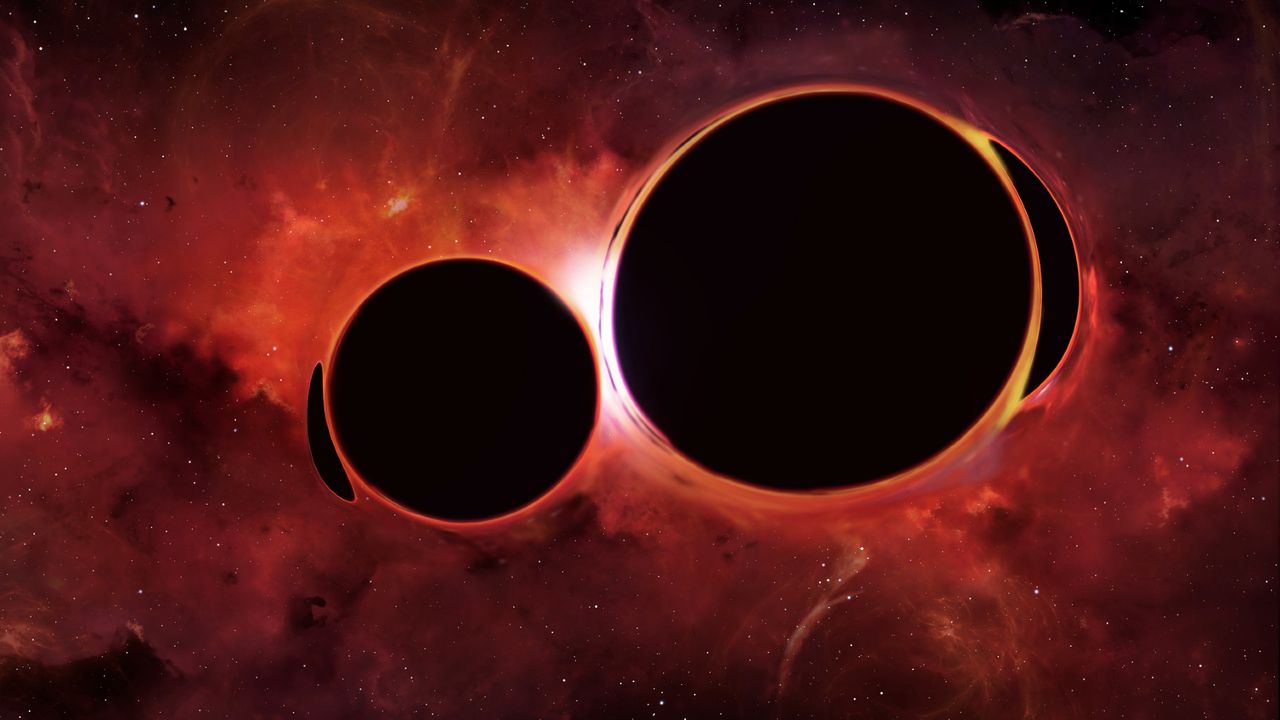
Astronomers may have discovered an extreme pair of light-spewing black holes that are spiraling toward an enormous collision — the effects of which could be felt in the next century.

Using decades of radio telescope observations, the astronomers studied an ultrabright object that was previously thought to be a blazar — a glowing core of a galaxy usually powered by a black hole — some 500 million light-years from our solar system. The observations revealed a hidden jet of energy that suggests the intensely bright object is actually two black holes on the verge of colliding, perhaps less than 100 years from now.

“We expect one (merged) black hole to remain,” study co-author Silke Britzen, an astronomer at the Max-Planck Institute for Radio Astronomy, told BBC Science Focus. “I am really curious to observe how this ‘dance’ will continue.”


You may like

The findings were published March 27 in the journal Monthly Notices of the Royal Astronomical Society.

Finding two black holes

Blazars are some of the most luminous objects in the universe. They’re classified as active galactic nuclei — actively feeding objects at the centers of galaxies, usually powered by supermassive black holes — and typically shoot jets of high-energy radiation toward Earth. Usually, a central black hole is the source for this jet, but in the case of the blazar in the galaxy Markarian 501, something didn’t quite add up.

For years, astronomers had observed different orientations of the jet using radio telescope data, making it difficult to determine if its core really did harbor a supermassive black hole. To answer this question, the researchers analyzed over 83 datasets from the Very Long Baseline Array, an international network of 10 radio telescopes.

The results revealed that, instead of one large jet, there was also a second jet looping counterclockwise around the blazar’s center. The team believes each of these jets is powered by a supermassive black hole, each weighing between 100 million and a billion times the sun’s mass.

Get the world’s most fascinating discoveries delivered straight to your inbox.

“Realising that [there] was a second jet was awesome,” Britzen told BBC Science Focus. “For me it was like: that’s how it works? I was so amazed and overwhelmed — and wanted to tell everybody what we just found.”

In June 2022, the two black holes lined up perfectly so that the primary black hole’s gravity bent the light emitted by the second jet into a near-perfect circle known as an Einstein ring. Thanks to a phenomenon called gravitational lensing — a sort of natural magnifying glass created by intense gravitational forces — this finding adds further evidence to the idea that the blazar is powered by a pair of supermassive black holes.

“Since these jets are directed towards us, an Einstein ring supports the scenario,” Britzen said.

The two black holes are thought to circle each other clockwise about once every 121 days and are separated by only 250 to 540 times the distance between Earth and the sun — relatively close in the world of astronomy. Gradually, this distance will close until the two objects ultimately merge.

The researchers think that when the doomed black holes do inevitably collide, they will release gravitational waves — ripples in the fabric of space-time unleashed by the most intense events in the universe — that could be more powerful than those from previously studied black hole mergers. If that’s the case, gravitational wave detectors on Earth will pick up the signal, offering new clues about the properties of the original black hole pair.

Britzen, S., Olivares, H., Gopal-Krishna, Jaron, F., Pashchenko, I. N., Kun, E., Schinzel, F. K., González, J. B., Paneque, D., & MacDonald, N. R. (2026). Detection of a second jet within the nuclear core of Mrk 501. Monthly Notices of the Royal Astronomical Society. https://doi.org/10.1093/mnras/stag291


How much do you know about black holes? Try our black hole quiz!

Source link

Share. Facebook Twitter Pinterest LinkedIn Tumblr Email
Previous ArticleLynette Hooker’s daughter slams stepfather for leaving Bahamas search
Next Article Ex-Alabama football player accused of wearing wigs to impersonate NFL players in loan fraud scheme
Editor
  • Website

Related Posts

Lifestyle

If humans are getting smarter, why are our brains shrinking?

May 9, 2026
Lifestyle

‘Feuding tech bros’ go head to head in legal showdown. But what does it mean for the future of AI?

May 9, 2026
Lifestyle

Pregnancy quiz: Can you deliver on the science of growing babies?

May 9, 2026
Add A Comment

Comments are closed.

Categories
  • Entertainment
  • Lifestyle
  • News
  • Sports
  • Tech
  • Travel
Recent Posts
  • If humans are getting smarter, why are our brains shrinking?
  • ‘Feuding tech bros’ go head to head in legal showdown. But what does it mean for the future of AI?
  • Pregnancy quiz: Can you deliver on the science of growing babies?
  • Science news this week: The latest on the cruise ship hantavirus infections, a shortcut to Mars, and a fast-charging quantum battery
  • Hantavirus cruise LIVE: Cruise passengers monitored in at least 5 US states as American passengers set to receive repatriation flight
calendar
May 2026
M T W T F S S
 123
45678910
11121314151617
18192021222324
25262728293031
« Apr    
Recent Posts
  • If humans are getting smarter, why are our brains shrinking?
  • ‘Feuding tech bros’ go head to head in legal showdown. But what does it mean for the future of AI?
  • Pregnancy quiz: Can you deliver on the science of growing babies?
About

Welcome to Baynard Media, your trusted source for a diverse range of news and insights. We are committed to delivering timely, reliable, and thought-provoking content that keeps you informed
and inspired

Categories
  • Entertainment
  • Lifestyle
  • News
  • Sports
  • Tech
  • Travel
Facebook X (Twitter) Pinterest WhatsApp
  • Contact Us
  • About Us
  • Privacy Policy
  • Disclaimer
  • UNSUBSCRIBE
© 2026 copyrights reserved

Type above and press Enter to search. Press Esc to cancel.