Close Menu
  • Home
  • UNSUBSCRIBE
  • News
  • Lifestyle
  • Tech
  • Entertainment
  • Sports
  • Travel
Facebook X (Twitter) WhatsApp
Trending
  • Some fungi can influence the weather ‪—‬ and now we know how they do it
  • Neanderthals’ brains weren’t to blame for their demise, new study suggests
  • NASA Curiosity rover uncovers rock with 7 new organic molecules on Mars
  • Mystery of golden orb found in depths of ocean off Alaska finally solved: ‘Everyone was like, What the heck? What is that?’
  • How everything you do is being monitored in an AI-fuelled ‘surveillance capitalism system’ that’s ramping up aggressively
  • Amazfit Active 3 Premium review: A wallet- and beginner-friendly running watch
  • Miniature camelid effigy: A silver llama with a wry smile that the Inca crafted 600 years ago
  • Antarctica’s sea ice suddenly started shrinking a decade ago — and deep-diving robots are revealing why
Facebook X (Twitter) WhatsApp
Baynard Media
  • Home
  • UNSUBSCRIBE
  • News
  • Lifestyle
  • Tech
  • Entertainment
  • Sports
  • Travel
Baynard Media
Home»Lifestyle»Astronomers find bizarre ‘Cosmic Grapes’ galaxy in the early universe. Here’s why that’s a big deal (photo)
Lifestyle

Astronomers find bizarre ‘Cosmic Grapes’ galaxy in the early universe. Here’s why that’s a big deal (photo)

EditorBy EditorAugust 14, 2025No Comments3 Mins Read
Share Facebook Twitter Pinterest LinkedIn Tumblr Reddit Telegram Email
Share
Facebook Twitter LinkedIn Pinterest Email

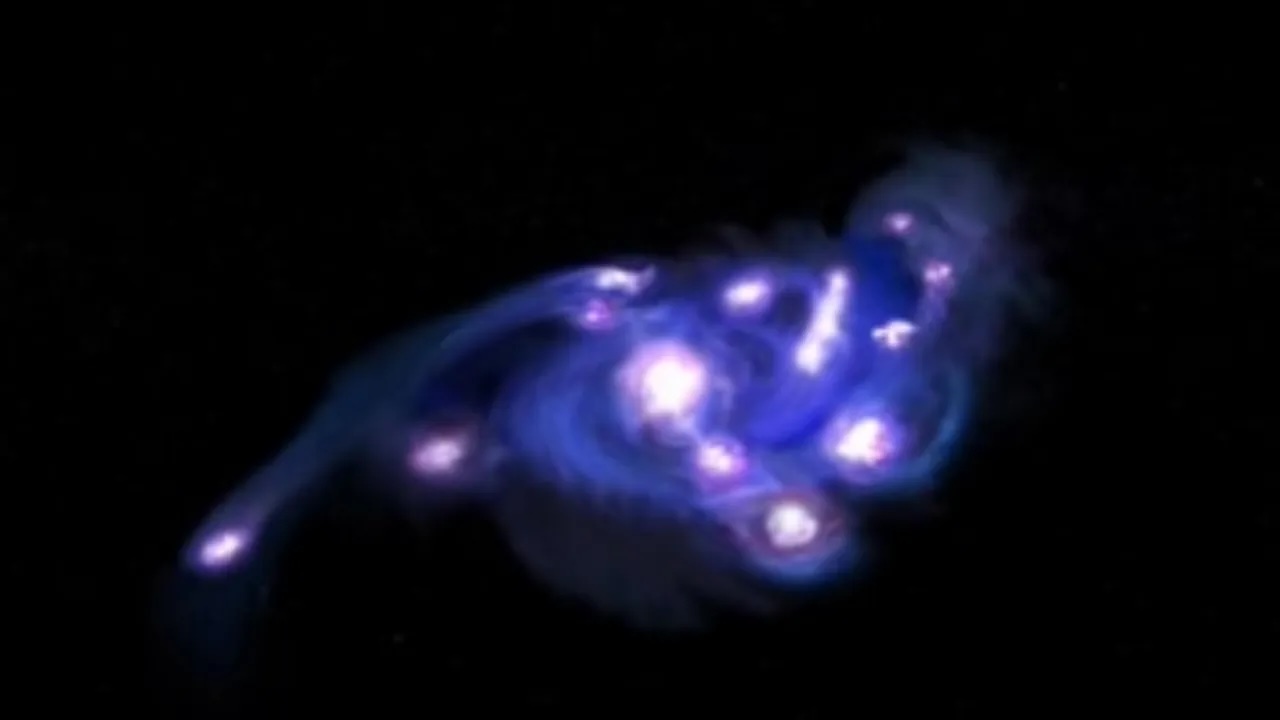
A distant galaxy appears to have more than a dozen tightly packed star-forming clumps arranged like a bunch of grapes — far more than astronomers thought possible in a galaxy from the early universe.

The galaxy, nicknamed “Cosmic Grapes,” is believed to have formed just 930 million years after the Big Bang. A new study has revealed that the galaxy has at least 15 massive star-forming clumps in its rotating disk, forming what appears to be a bunch of bright purple grapes in space.

Using NASA’s James Webb Space Telescope (JWST) and the Atacama Large Millimeter/submillimeter Array (ALMA), astronomers discovered the galaxy through a technique known as gravitational lensing, in which a foreground galaxy — in this case, an object known as RXCJ0600-2007 — serves as a magnifying glass for more distant objects.


You may like

“This object is known as one of the most strongly gravitationally lensed distant galaxies ever discovered,” study lead author Seiji Fujimoto, said in a statement from the University of Texas at Austin’s (UT Austin) McDonald Observatory.

“Thanks to this powerful natural magnification, combined with observations from some of the world’s most advanced telescopes, we had a unique opportunity to study the internal structure of a distant galaxy at unprecedented sensitivity and resolution,” added Fujimoto, who started the research while at UT Austin but is now at the University of Toronto.

The researchers collected more than 100 hours of telescope observations to study the primordial Cosmic Grapes galaxy. Earlier Hubble Space Telescope images of the object suggested a smooth, rotating disk, but the powerful resolution of ALMA and JWST revealed something juicier — the most detailed view yet of the galaxy’s inner structure and massive clumps of dense gas primed for star formation.

Related: ‘Time machine’ reveals hidden structures in the universe’s first galaxies

Get the world’s most fascinating discoveries delivered straight to your inbox.

A cluster of purple and white glowing stars with a pullout showing some of this light be stretched and warped.

Near-infrared images taken by JWST of the galaxy cluster “RXCJ0600-2007,” which causes a powerful gravitational lensing effect. Unprecedented high-resolution observations unveiled the structure of a distant galaxy in the early universe — composed of more than 15 compact star-forming clumps arranged like a “bunch of grapes” (zoom-in panel).  (Image credit: NASA/ESA/CSA/Fujimoto et al.)

“Our observations reveal that some early galaxies’ young starlight is dominated by several massive, dense, compact clumps rather than one smooth distribution of stars,” study co-author Mike Boylan-Kolchin, an astronomy professor at UT Austin, said in the same statement.

The discovery reshapes our understanding of early galaxy growth by revealing the first clear connection between a galaxy’s small internal structures — in this case, massive star-forming clumps — and its overall rotation, hinting that many seemingly smooth galaxies observed before may actually be filled with similar hidden clumps.

Their findings were published Aug. 7 in the journal Nature Astronomy.

Source link

Share. Facebook Twitter Pinterest LinkedIn Tumblr Email
Previous ArticleBorder negligence: How Biden lost track of thousands of migrant children
Next Article Trump’s unusual approach to business and mediation ordered in Ohio State lawsuits: Morning Rundown
Editor
  • Website

Related Posts

Lifestyle

Some fungi can influence the weather ‪—‬ and now we know how they do it

April 28, 2026
Lifestyle

Neanderthals’ brains weren’t to blame for their demise, new study suggests

April 28, 2026
Lifestyle

NASA Curiosity rover uncovers rock with 7 new organic molecules on Mars

April 27, 2026
Add A Comment

Comments are closed.

Categories
  • Entertainment
  • Lifestyle
  • News
  • Sports
  • Tech
  • Travel
Recent Posts
  • Some fungi can influence the weather ‪—‬ and now we know how they do it
  • Neanderthals’ brains weren’t to blame for their demise, new study suggests
  • NASA Curiosity rover uncovers rock with 7 new organic molecules on Mars
  • Mystery of golden orb found in depths of ocean off Alaska finally solved: ‘Everyone was like, What the heck? What is that?’
  • How everything you do is being monitored in an AI-fuelled ‘surveillance capitalism system’ that’s ramping up aggressively
calendar
April 2026
M T W T F S S
 12345
6789101112
13141516171819
20212223242526
27282930  
« Mar    
Recent Posts
  • Some fungi can influence the weather ‪—‬ and now we know how they do it
  • Neanderthals’ brains weren’t to blame for their demise, new study suggests
  • NASA Curiosity rover uncovers rock with 7 new organic molecules on Mars
About

Welcome to Baynard Media, your trusted source for a diverse range of news and insights. We are committed to delivering timely, reliable, and thought-provoking content that keeps you informed
and inspired

Categories
  • Entertainment
  • Lifestyle
  • News
  • Sports
  • Tech
  • Travel
Facebook X (Twitter) Pinterest WhatsApp
  • Contact Us
  • About Us
  • Privacy Policy
  • Disclaimer
  • UNSUBSCRIBE
© 2026 copyrights reserved

Type above and press Enter to search. Press Esc to cancel.