
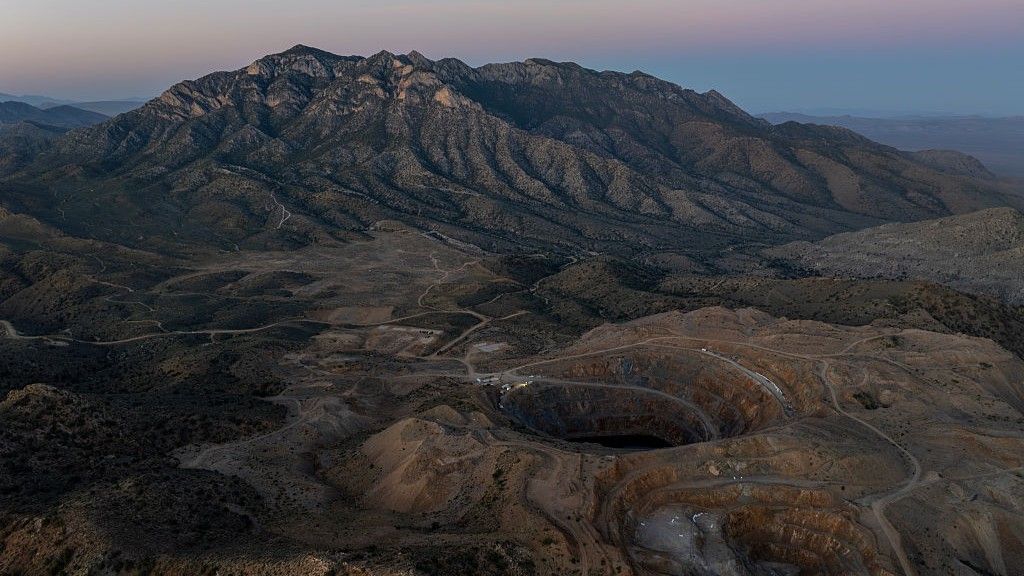
Researchers may have found a new way to locate deposits of rare earth elements that are vital to the tech and energy industries.
Rare earth elements crystallize in Earth’s mantle inside blobs of magma that are rich in alkali metals, such as sodium and potassium, and carbonate minerals, such as calcite and dolomite. In a new study, scientists found that these types of magma, known as alkaline and carbonatite magmas, form above ancient subduction zones, where one tectonic plate dives beneath another.
The study, published April 8 in the journal Science Advances, challenges previous theories that linked rare earth deposits primarily to mantle plumes — giant, mushroom-shaped columns of red-hot molten rock that originate near Earth’s core. It’s possible that mantle plumes are involved in making rare earth elements, the researchers wrote in the study. However, there is no clear overlap between the two, and plumes may be too hot to produce alkaline and carbonatite magmas.
In the study, the team used advanced modeling techniques to reconstruct Earth’s plate tectonics and subduction processes over the past 2 billion years. (Scientists think plate subduction started at least 3.1 billion years ago, but the best models go back only 2 billion years.) Then, the researchers compared the positions of subduction zones with the locations of present-day rare earth deposits and regions of the mantle where alkaline and carbonatite magma blobs are known to exist.
Spandler and his colleagues found that, globally, known deposits of rare earth elements and the pockets of magma that host them frequently appear above ancient subduction zones.
When a tectonic plate plunges beneath another plate at a subduction zone, fluids (such as water) and halogen elements (fluorine, chlorine, bromine, iodine, astatine and tennessine) are released into the overlying mantle. The researchers proposed that these substances react with rocks such as peridotite, creating “fertilized” mantle regions that can remain stable for millions of years, before gradually melting to produce alkaline or carbonatite magma and, subsequently, rare earth deposits.
Various geological processes could theoretically melt the fertilized mantle material, including a mantle plume, the stretching and thinning of continents above, and a decrease in pressure resulting from deglaciation at Earth’s surface, the researchers wrote in the study. Regardless of the specific process, the huge age gap between some subduction zones and overlying magma blobs and rare earth deposits in the study suggests that fertilized regions can endure for eons.
“This time lag is one of the most surprising aspects of our findings,” Spandler said in the statement. “It shows that the Earth’s mantle can store these enriched zones for incredibly long periods before the right conditions arise to form mineral deposits.”
The results showed that 67% of known alkaline and carbonatite magma blobs and 72% of known rare earth deposits sit on top of fertilized mantle material. Because older rare earth deposits tend to be larger and of a higher grade than newer ones, the researchers redid the analysis for deposits older than 540 million years — and found that 92% of them are located above fertilized mantle regions.

The rare earth deposits that weren’t connected to fertilized mantle regions in the study are probably linked to subduction zones older than 2 billion years, the researchers wrote. Notably, there were more alkaline and carbonatite magma blobs and rare earth deposits in regions of the world where multiple fertilized mantle areas overlap, they wrote.
There are 17 rare earth elements — yttrium, scandium and the 15 metallic elements found at the bottom of the periodic table. These elements are essential components in electric vehicle batteries, wind turbines and smartphones, but until now, locating deposits big enough to mine has been challenging.
The results could help countries and corporations find more rare earth element deposits, study co-author Andrew Merdith, a researcher in Adelaide University’s School of Physics, Chemistry and Earth Sciences, said in the statement. “By focusing on these ancient tectonic zones, exploration companies and governments can take a more targeted and efficient approach to finding new deposits,” Merdith said.
The best places to look may be areas that have ancient subduction zones, as well as magma that formed at low temperatures and highly stable crust and upper mantle regions, the researchers wrote in the study.
Refining the models and going further back in time could help scientists locate even more prospective regions, they added.
Spandler, C., Merdith, A. S., & Griffin, A. (2026). Linking carbonatites, rare earth ores, and subduction-fertilized mantle lithosphere. Science Advances, 12 (15), eaeb2942. https://doi.org/10.1126/sciadv.aeb2942
What’s inside Earth quiz: Test your knowledge of our planet’s hidden layers
