Close Menu
  • Home
  • UNSUBSCRIBE
  • News
  • Lifestyle
  • Tech
  • Entertainment
  • Sports
  • Travel
Facebook X (Twitter) WhatsApp
Trending
  • Are we more closely related to cats or dogs?
  • Declassified Apollo 12 images show UFOs on the moon — Space photo of the week
  • ‘More than 100 million years of evolution’: How snakes evolved and lost their legs
  • More polar bears are approaching human sites as the climate warms, and it’s not just the skinny ones
  • James Webb telescope zooms in on a black hole that could reveal the truth about ‘little red dots’
  • If humans are getting smarter, why are our brains shrinking?
  • ‘Feuding tech bros’ go head to head in legal showdown. But what does it mean for the future of AI?
  • Pregnancy quiz: Can you deliver on the science of growing babies?
Facebook X (Twitter) WhatsApp
Baynard Media
  • Home
  • UNSUBSCRIBE
  • News
  • Lifestyle
  • Tech
  • Entertainment
  • Sports
  • Travel
Baynard Media
Home»Lifestyle»‘Alien plant’ fossil discovered near Utah ghost town doesn’t belong to any known plant families, living or extinct
Lifestyle

‘Alien plant’ fossil discovered near Utah ghost town doesn’t belong to any known plant families, living or extinct

EditorBy EditorDecember 19, 2024No Comments3 Mins Read
Share Facebook Twitter Pinterest LinkedIn Tumblr Reddit Telegram Email
Share
Facebook Twitter LinkedIn Pinterest Email

Scientists have discovered that an “alien plant” first found near a Utah ghost town 55 years ago doesn’t appear to be related to any currently living family or genus.

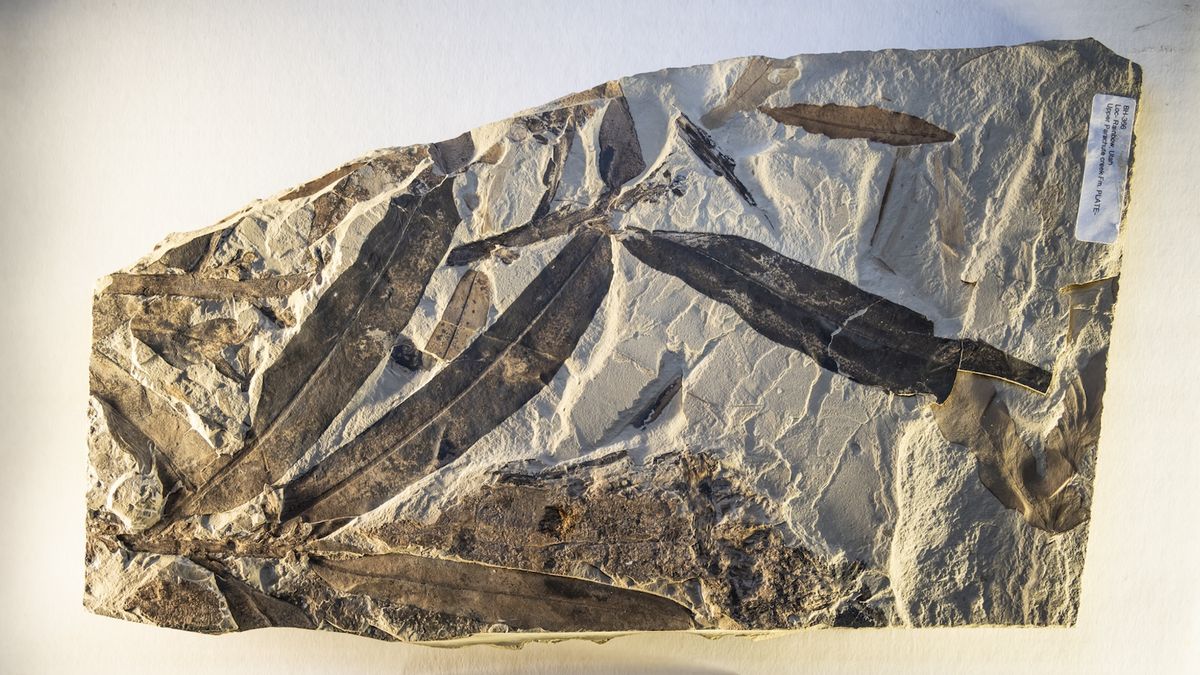
Paleontologists first found fossilized leaf specimens of the plant in 1969 and named it Othniophyton elongatum, which translates to “alien plant.” At the time, they believed the extinct species could be related to ginseng.

A more recent analysis, however, has challenged that hypothesis. Steven Manchester, curator of paleobotany at the Florida Museum of Natural History and Utah fossil expert, came across an unidentified plant fossil while visiting the University of California, Berkeley paleobotany collection. This plant fossil was well preserved, and had come from the same area as the alien plant leaves.

Manchester’s research team analyzed the fossils and concluded they were from the same plant species, according to their study published Nov. 9 in the journal Annals of Botany.

Both fossil specimens were excavated from the Green River Formation in eastern Utah, near the former town of Rainbow. Around 47 million years ago, when the plants lived, the region was a huge lake ecosystem near active volcanoes. Lake sediment and volcanic ash slowed decomposition in fish, reptile, bird and plant remains, enabling some to be extremely well preserved.

Related: Where did the 1st seeds come from?

The researchers analyzed both fossils’ physical features, and searched for living plant families that could be similar. Unlike the 1969 find, the specimen at UC Berkeley had leaves, flowers and fruits attached, which looked very different from those of plants related to ginseng. In fact, the researchers couldn’t match the fossils to any of the over 400 families of flowering plants living today, and extinct families.

Get the world’s most fascinating discoveries delivered straight to your inbox.

an illustration of a reconstruction of Othniophyton elongatum

A reconstruction of Othniophyton elongatum. (Image credit: Ashley Hamersma, Manchester et al., 2024)

When scientists studied the original fossils in 1969, they were working only with leaves, not with flowers, fruits or branches; based on the arrangement of the leaves’ vein patterns, they theorized the leaf structure could be similar to that of plants in the ginseng family. With the detail provided by the newer fossil, the researchers had a better picture of what the plant would have looked like and discounted the ginseng connection, but still couldn’t pinpoint the plant’s family.

A few years later, the Florida Museum of Natural History had access to new microscopy and artificial intelligence technology that enabled even more detailed viewing of the plant fossils. Micro-impressions of small, developing seeds were visible in the fossil’s fruits. The research team could also see stamens — flowers’ male reproductive organs — which in most plant species detach after fertilization.

“Usually, stamens will fall away as the fruit develops. And this thing seems unusual in that it’s retaining the stamens at the time it has mature fruits with seeds ready to disperse. We haven’t seen that in anything modern,” Manchester said in a statement.

Comparing these traits to extinct families didn’t result in any matches either, but this isn’t the only species from the Green River Formation that has stumped scientists. This region has previously produced other plant fossils, like Bonanzacarpum fruit and Palibinia leaves, that have surprised scientists and ultimately led to the discovery of extinct groups.

Source link

Share. Facebook Twitter Pinterest LinkedIn Tumblr Email
Previous Article'They are sleeping!' | Solanke slams in opener after Bayindir parries Porro shot
Next Article The 7 best Windows laptops for every budget (Dec. 2024)
Editor
  • Website

Related Posts

Lifestyle

Are we more closely related to cats or dogs?

May 11, 2026
Lifestyle

Declassified Apollo 12 images show UFOs on the moon — Space photo of the week

May 10, 2026
Lifestyle

‘More than 100 million years of evolution’: How snakes evolved and lost their legs

May 10, 2026
Add A Comment

Comments are closed.

Categories
  • Entertainment
  • Lifestyle
  • News
  • Sports
  • Tech
  • Travel
Recent Posts
  • Are we more closely related to cats or dogs?
  • Declassified Apollo 12 images show UFOs on the moon — Space photo of the week
  • ‘More than 100 million years of evolution’: How snakes evolved and lost their legs
  • More polar bears are approaching human sites as the climate warms, and it’s not just the skinny ones
  • James Webb telescope zooms in on a black hole that could reveal the truth about ‘little red dots’
calendar
May 2026
M T W T F S S
 123
45678910
11121314151617
18192021222324
25262728293031
« Apr    
Recent Posts
  • Are we more closely related to cats or dogs?
  • Declassified Apollo 12 images show UFOs on the moon — Space photo of the week
  • ‘More than 100 million years of evolution’: How snakes evolved and lost their legs
About

Welcome to Baynard Media, your trusted source for a diverse range of news and insights. We are committed to delivering timely, reliable, and thought-provoking content that keeps you informed
and inspired

Categories
  • Entertainment
  • Lifestyle
  • News
  • Sports
  • Tech
  • Travel
Facebook X (Twitter) Pinterest WhatsApp
  • Contact Us
  • About Us
  • Privacy Policy
  • Disclaimer
  • UNSUBSCRIBE
© 2026 copyrights reserved

Type above and press Enter to search. Press Esc to cancel.