Close Menu
  • Home
  • UNSUBSCRIBE
  • News
  • Lifestyle
  • Tech
  • Entertainment
  • Sports
  • Travel
Facebook X (Twitter) WhatsApp
Trending
  • Neanderthals’ brains weren’t to blame for their demise, new study suggests
  • NASA Curiosity rover uncovers rock with 7 new organic molecules on Mars
  • Mystery of golden orb found in depths of ocean off Alaska finally solved: ‘Everyone was like, What the heck? What is that?’
  • How everything you do is being monitored in an AI-fuelled ‘surveillance capitalism system’ that’s ramping up aggressively
  • Amazfit Active 3 Premium review: A wallet- and beginner-friendly running watch
  • Miniature camelid effigy: A silver llama with a wry smile that the Inca crafted 600 years ago
  • Antarctica’s sea ice suddenly started shrinking a decade ago — and deep-diving robots are revealing why
  • Why do cats and dogs shake their heads?
Facebook X (Twitter) WhatsApp
Baynard Media
  • Home
  • UNSUBSCRIBE
  • News
  • Lifestyle
  • Tech
  • Entertainment
  • Sports
  • Travel
Baynard Media
Home»Lifestyle»A dozen black holes may be ‘wandering’ through our galaxy — and they’re the rarest type in the universe
Lifestyle

A dozen black holes may be ‘wandering’ through our galaxy — and they’re the rarest type in the universe

EditorBy EditorMay 22, 2025No Comments3 Mins Read
Share Facebook Twitter Pinterest LinkedIn Tumblr Reddit Telegram Email
Share
Facebook Twitter LinkedIn Pinterest Email

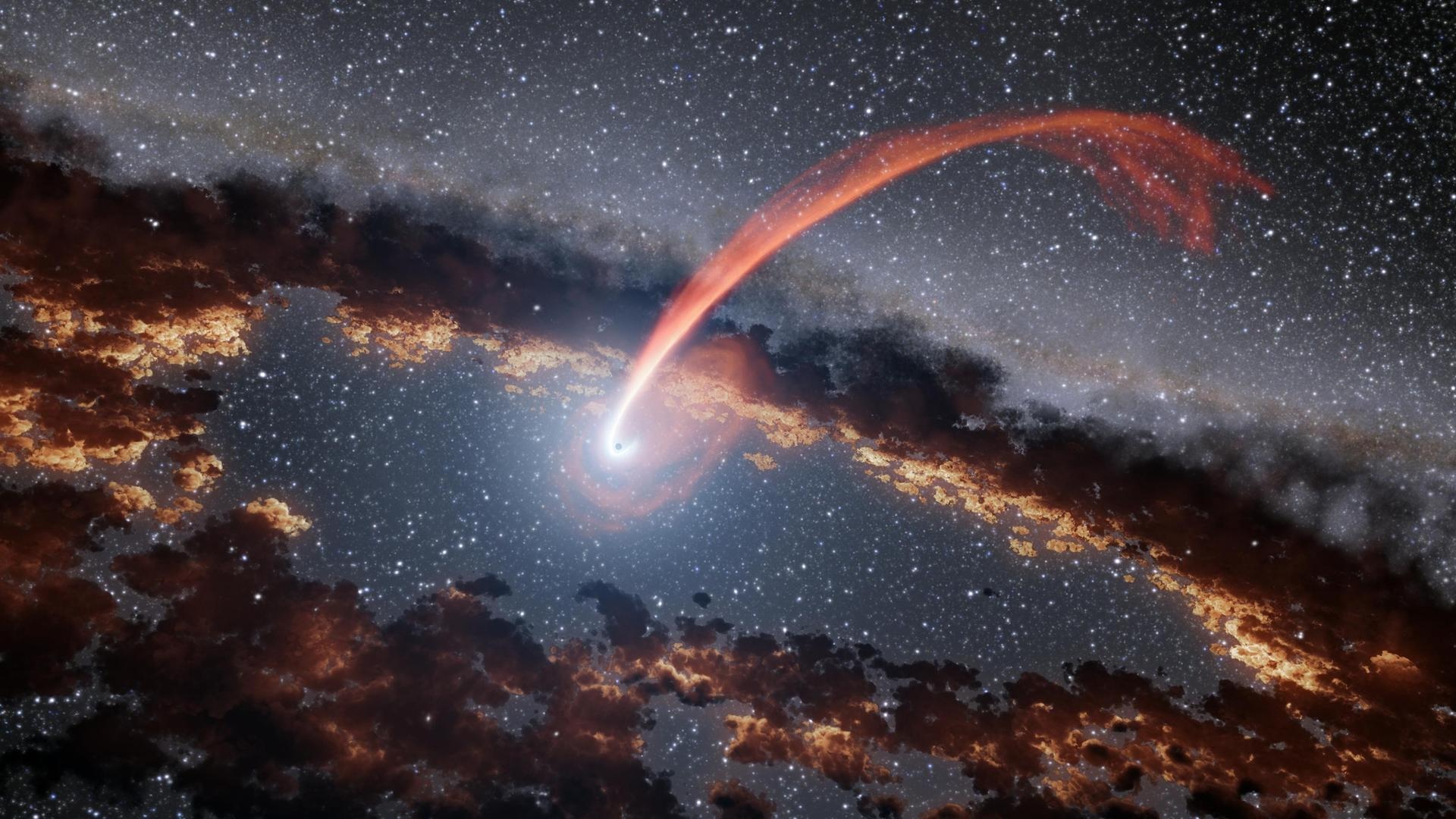
The Milky Way has millions of small black holes and one giant supermassive black hole at its center. But does the galaxy have any medium-sized black holes? New research suggests the answer is yes: Perhaps a dozen may inhabit the Milky Way, but they are wandering freely through space and are fiendishly difficult to detect.

For decades, researchers have wondered about the prevalence of intermediate-mass black holes (IMBHs). Certainly, every galaxy is capable of producing an enormous number — roughly a handful every century — of small black holes with masses of up to 100 or so times that of the sun. And it appears that when galaxies like the Milky Way first arrived on the cosmic scene, they already had companion supermassive black holes in their hearts. Our own supermassive black hole, Sagittarius A*, has a mass of 4.5 million suns.

But what about the IMBHs? Theoretically, they should have masses of 10,000 to 100,000 solar masses. Finding IMBHs — or disproving their existence — has enormous implications for our understanding of black hole growth and evolution. But so far, there have been only faint, sketchy hints of IMBHs residing in dwarf galaxies, and no direct evidence that they live in a galaxy like the Milky Way.


You may like

In April, a team of researchers at the University of Zurich in Switzerland explored whether our current simulations of the universe could conclusively predict if the Milky Way hosts a population of IMBHs. Their paper has been accepted for publication in the journal Monthly Notices of the Royal Astronomical Society.

Related: Is our universe trapped inside a black hole? This James Webb Space Telescope discovery might blow your mind

Cannibal galaxies

Galaxies do not grow up alone. Instead, they develop through the cannibalization of their neighbors, by incorporating their stars — and any black holes — within their volumes. The Milky Way has consumed over a dozen dwarf galaxies, and probably many more, in its long history. Presumably, some of those dwarf galaxies held IMBHs. But the common assumption was that large black holes tend to slink down the centers of their host galaxies, where they go on to merge with the central supermassive black hole.

Through their models, the researchers saw a different story unfold. They used a simulation of the evolution of a Milky Way-like galaxy and found that it can contain somewhere between five and 18 “wandering” IMBHs, which are not located near the central core but are left to roam within the disk of the galaxy. The exact number of IMBHs depends on whether they are born near the core of a soon-to-be-consumed dwarf galaxy or in its outskirts.

Get the world’s most fascinating discoveries delivered straight to your inbox.

Although the researchers were heartened to find that the Milky Way should host a population of IMBHs, they urged caution in interpreting their results. They could not conclusively state what masses these black holes should have or where they would ultimately reside. So, while the new research strongly hints that IMBHs are out there, we do not yet know where to look.

Source link

Share. Facebook Twitter Pinterest LinkedIn Tumblr Email
Previous Article‘Strange’ star pulses detected in search for extraterrestrial intelligence
Next Article Cucumbers recalled after multistate Salmonella outbreak leaves dozens sick
Editor
  • Website

Related Posts

Lifestyle

Neanderthals’ brains weren’t to blame for their demise, new study suggests

April 28, 2026
Lifestyle

NASA Curiosity rover uncovers rock with 7 new organic molecules on Mars

April 27, 2026
Lifestyle

Mystery of golden orb found in depths of ocean off Alaska finally solved: ‘Everyone was like, What the heck? What is that?’

April 27, 2026
Add A Comment

Comments are closed.

Categories
  • Entertainment
  • Lifestyle
  • News
  • Sports
  • Tech
  • Travel
Recent Posts
  • Neanderthals’ brains weren’t to blame for their demise, new study suggests
  • NASA Curiosity rover uncovers rock with 7 new organic molecules on Mars
  • Mystery of golden orb found in depths of ocean off Alaska finally solved: ‘Everyone was like, What the heck? What is that?’
  • How everything you do is being monitored in an AI-fuelled ‘surveillance capitalism system’ that’s ramping up aggressively
  • Amazfit Active 3 Premium review: A wallet- and beginner-friendly running watch
calendar
April 2026
M T W T F S S
 12345
6789101112
13141516171819
20212223242526
27282930  
« Mar    
Recent Posts
  • Neanderthals’ brains weren’t to blame for their demise, new study suggests
  • NASA Curiosity rover uncovers rock with 7 new organic molecules on Mars
  • Mystery of golden orb found in depths of ocean off Alaska finally solved: ‘Everyone was like, What the heck? What is that?’
About

Welcome to Baynard Media, your trusted source for a diverse range of news and insights. We are committed to delivering timely, reliable, and thought-provoking content that keeps you informed
and inspired

Categories
  • Entertainment
  • Lifestyle
  • News
  • Sports
  • Tech
  • Travel
Facebook X (Twitter) Pinterest WhatsApp
  • Contact Us
  • About Us
  • Privacy Policy
  • Disclaimer
  • UNSUBSCRIBE
© 2026 copyrights reserved

Type above and press Enter to search. Press Esc to cancel.