Two brothers from the wealthy and powerful Medici family died of malaria and were not poisoned as a rumor had suggested, archaeologists have confirmed based on a DNA analysis of the brothers’ skeletons. The analysis also revealed a unique, mutated strain of malaria that may hold the key to understanding the evolution of the disease in Europe.
The Medici family rose to power in the 15th century by creating the largest bank in Europe. The family used their extraordinary wealth to fund Renaissance artists and to start a political dynasty that eventually included numerous dukes, four popes and two queens of France.
In the 16th century, Cosimo I took over all of Tuscany as grand duke. But within a span of 25 years, at least five of his family members died from high fevers. This gave rise to a rumor that some of them had been poisoned with arsenic by another family member, although most people believed they died of malaria.
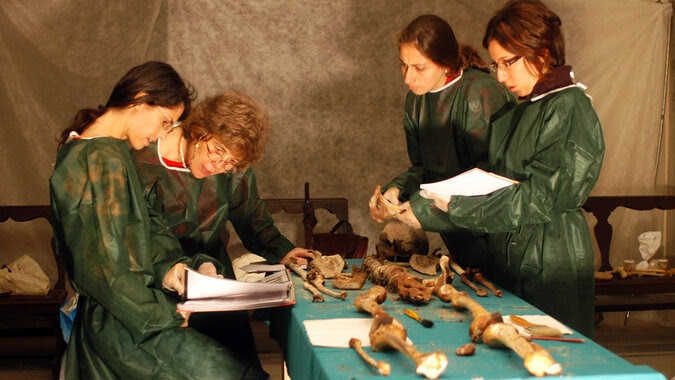
To get to the bottom of the 500-year-old Medici cold case, an international group of researchers tested the bones of two of Cosimo I’s sons: Cardinal Giovanni de’ Medici and Grand Duke Francesco I de’ Medici, for the DNA of Plasmodium falciparum, the parasite that causes the deadliest form of malaria and that is transmitted by mosquitoes.
The researchers extracted ancient DNA from the bones of Cardinal Giovanni, who died in 1562 at age 19 in the same month as his mother and younger brother Garzia, and from Grand Duke Francesco I, who died at age 46 in 1587 along with his wife. The team’s study was published online June 17 in the journal iScience.
Because of the almost simultaneous deaths of Grand Duke Francesco I and his wife, a rumor circulated that another brother had poisoned them over a long-standing feud. But the Medicis were known to have frequented their family villas in marshy and swampy areas of Tuscany, where malaria was prevalent well into the 20th century.
Researchers found evidence of P. falciparum in the bones of both Medici brothers, confirming reports from court physicians at the time that described the brothers as sick with “tertian fever,” a type of high fever that returns every three days and is a hallmark of malaria. The medical reports also revealed the brothers were treated with bloodletting.
Get the world’s most fascinating discoveries delivered straight to your inbox.
The name plate from the tomb of Grand Duke Francesco de’ Medici, who died of malaria in 1587.
(Image credit: Courtesy the University of Pisa)
“Now we can say with scientific certainty that malaria, not poisoning, killed Grand Duke Francesco de Medici,” study co-author Valentina Giuffra, a medical historian at the University of Pisa, said in a statement.
But the ancient-DNA study held two additional surprises.
The Grand Duke’s bones were positive not only for P. falciparum but also for Plasmodium malariae, a different parasite species that also causes malaria in humans, suggesting that both species contributed to the severe illness that killed him and his wife.
Cardinal Giovanni, on the other hand, had only P. falciparum, but the specific strain that infected him was previously unknown. The strain is similar to those found in ancient and early modern Europe, but with two mutations the researchers had never seen before, they wrote in the study.
“The study of ancient DNA offers us an opportunity not only to diagnose malaria in the remains of individuals from the past, but it also offers us a window for understanding the evolution of malaria species, Plasmodium falciparum in this case, which can help scientists better understand how the pathogen adapts over time,” study first author Alexander Ochoa, an evolutionary biologist at Yale University, said in the statement.
Further analysis of the brothers’ bones is needed to determine the evolutionary relationship between the strains of malaria they carried, the researchers wrote in the study.
Ochoa, A., Miller, S.L., Reilly, P.F., Fornaciari, G., Fornaciari, A., Riccomi, G., Giuffra, V., Caccone, A., Tucci, S. (2026). Ancient DNA analyses of remains of the Medici family (16th century) provide insights into the genetic variation of Plasmodium falciparum. iScience 29(7). https://doi.org/10.1016/j.isci.2026.116371
What do you know about the bones in your body? Test your knowledge with our human skeleton quiz.