
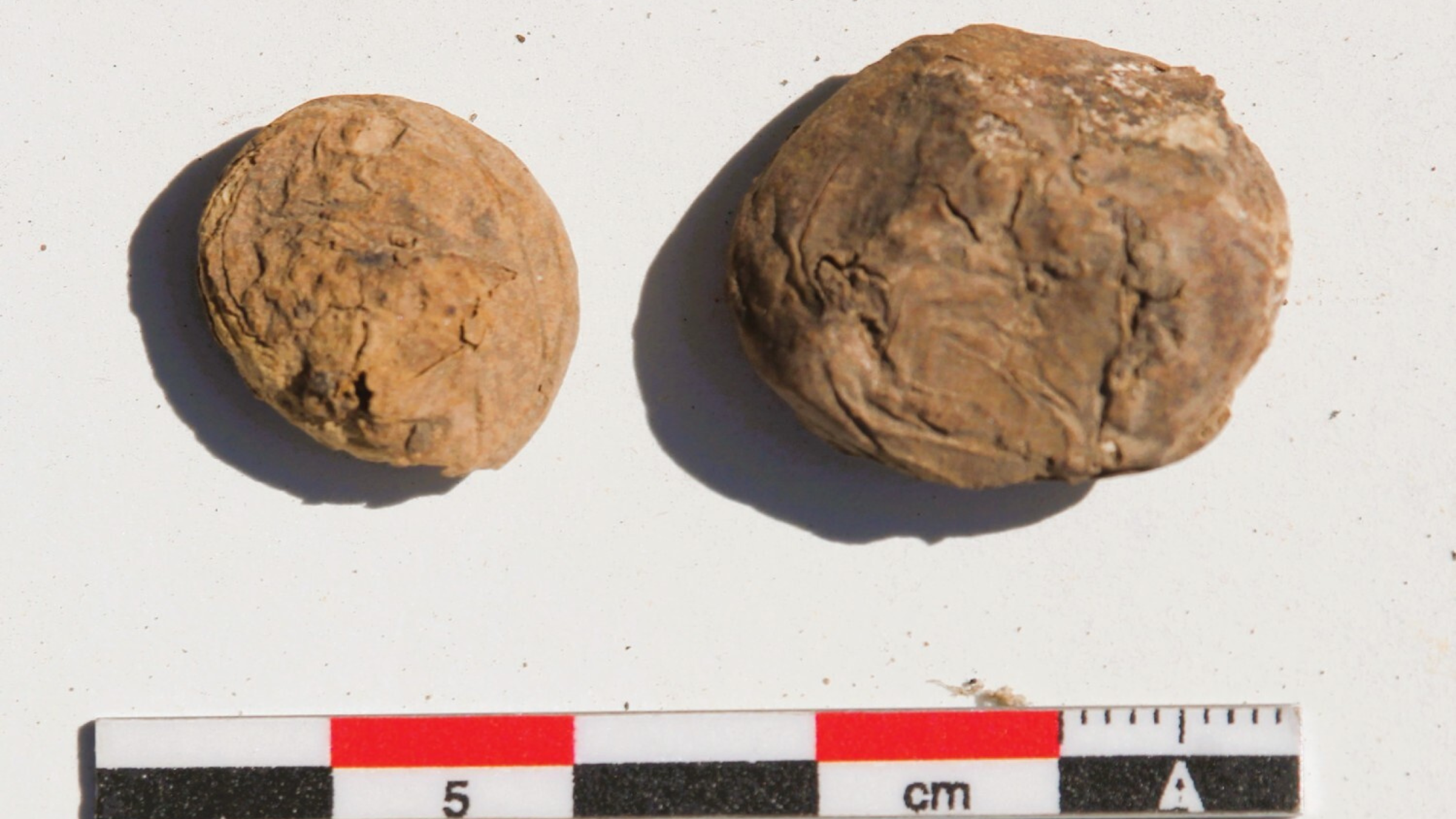
Two lumps of potato discovered in a roughly 500-year-old Inca storage room in Peru are a rare find: freeze-dried potatoes predating the Spanish invasion, a new study finds.
These freeze-dried potatoes, known as chuño, were once a backbone of the Inca Empire‘s food supply and a product so fragile that they almost never turn up at archaeological sites.
The new discovery, made along Peru’s arid south coast, is only the second time chuño has been recovered from an Inca site, researchers reported in the new study. It is concrete evidence that the empire directed one of its most important food sources hundreds of miles from the Andes, down to the Pacific Ocean.
Chuño is made by repeatedly exposing potatoes to nighttime frost and daytime sun until nearly all their moisture has evaporated, leaving a lightweight, long-lasting vegetable that can be stored for decades. This technique works only at high elevations where hard frost occurs regularly, so chuño had to be produced in the mountains and then transported using llama caravans, often hundreds of kilometers, to feed people living elsewhere in the empire.
The Inca used the same drying method to preserve meat, he said, producing a product called “charki” — the source of the English word “jerky,” study principal investigator Lidio Valdez, an adjunct professor in the Department of Anthropology and Archaeology at the University of Calgary, told Live Science in an email.
In the new study, published May 1 in the Journal of Field Archaeology, Valdez and study co-author Katrina Bettcher, an independent archaeologist, reported that the chuño was found alongside an Inca pottery fragment and a broken spindle whorl, a tool used to spin fibers, such as raw wool, into yarn or thread.
The discovery happened during the 2024 field season at Tambo Viejo, an Inca provincial center in the Acarí Valley, where an archaeological team had worked for several years. Inside a small storage room, the team uncovered a clay pot sunk into the dirt floor, its top half long gone. As researchers scooped soil out of the broken pot, they reached its bottom.
Get the world’s most fascinating discoveries delivered straight to your inbox.
“Almost at the base of the vessel, the two samples of freeze-dried potatoes were found,” Valdez said. “They showed me without knowing what they were, and right away I said: chuño!”

Llamas were used across the Inca empire to transport food and other items.
(Image credit: Photo by L.M. Valdez)
Potatoes are roughly 80% water, and they typically rot within a week at lower, warmer elevations — making them a poor food choice for long-distance storage. Valdez said freeze-drying was likely discovered long before the Inca rose to power in the 15th century, perhaps when potatoes that were accidentally exposed to frost at a high elevation became dried out and people realized the result was still edible.
Because chuño can be made only above roughly 11,800 feet (3,600 meters), the samples at Tambo Viejo must have traveled down from the highlands, most likely via a llama caravan along the Inca road network, Valdez said.
“Chuño being a light product probably also made its transportation easier,” he added.
The two freeze-dried potatoes survived thanks to the Acarí Valley’s extremely dry conditions, which help preserve organic remains that would otherwise decay — the same conditions that have previously yielded naturally mummified guinea pigs (Cavia porcellus) in Valdez’s previous work at the site.
Beyond its archaeological importance, the ancient preservation method has lessons for today. “We still have so much to learn from the people of the past,” Valdez said. “Food security is a main concern, even in our times; yet we waste food, perhaps more than at any time in human history.”
Relatively few Inca sites along Peru’s coast have been systematically excavated, and Valdez expects more evidence of chuño — and the long supply lines that carried it — to surface as archaeologists keep digging.
Do you know where pumpkins and blueberries come from? Find out with our fruits and vegetables quiz!
