
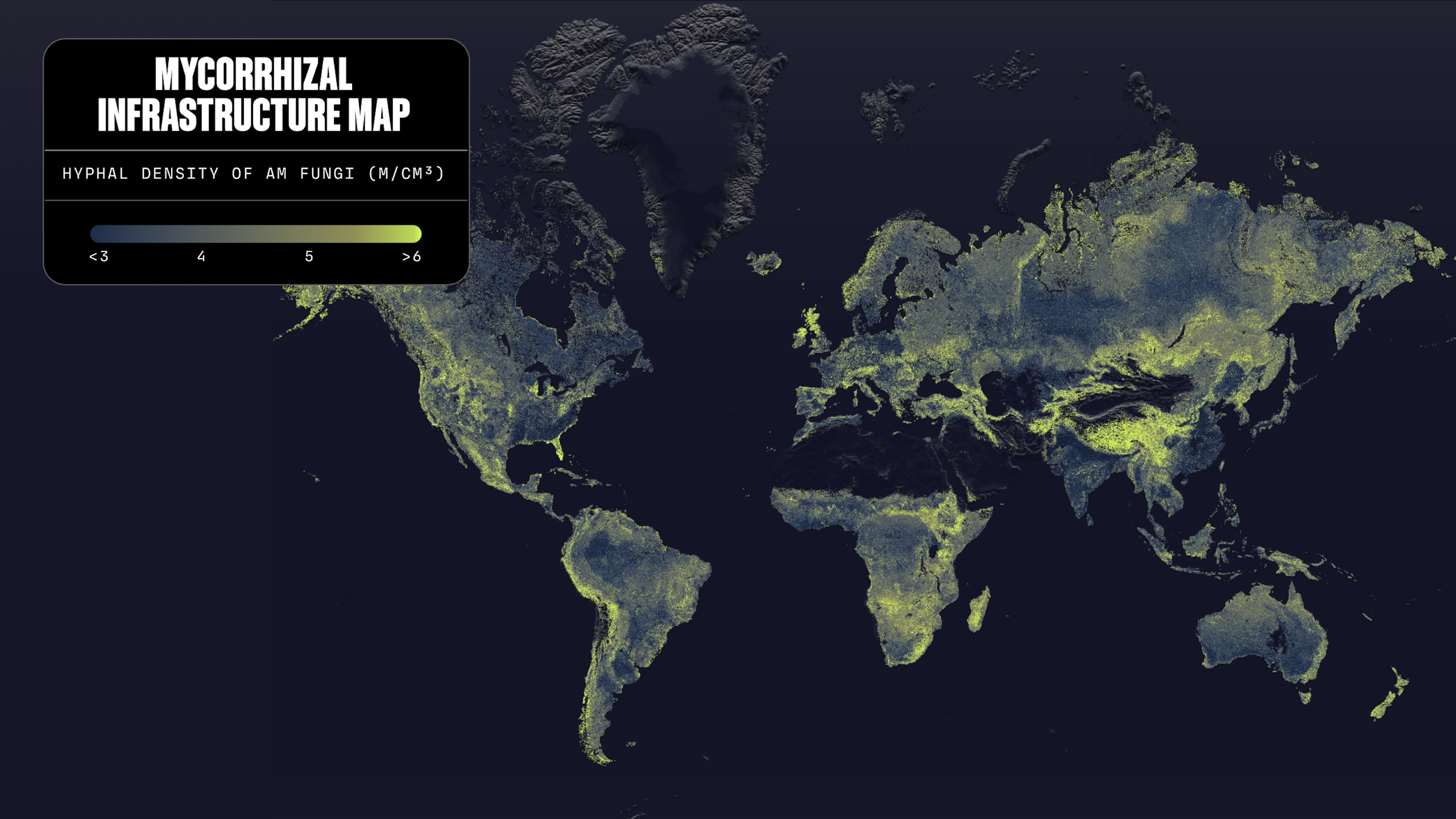
Earth’s underground fungal network is so vast that, if it were in outer space, it would span roughly 10% of the Milky Way if placed in a straight line, a new study finds.
These subterranean structures, called arbuscular mycorrhizal fungal networks, work in partnership with most of the world’s land plants, feeding plants nitrogen and phosphorus in return for their carbon. Now, the first global map of this fungal network has revealed where their intricate branching structures are most densely packed.
In grasslands that are high-altitude or flooded grasslands, such as the Everglades in Florida, the top 6 inches (15 centimeters) of soil are especially dense, containing around 40% of the global fungal biomass. This highlights that undisturbed grasslands are an essential, reliable carbon sink, according to the research, which was published Thursday (June 11) in the journal Science.
“This is the most dense fungal forest on Earth, and they’re under wild grasslands,” study first author Justin Stewart, an evolutionary biologist at the Society for the Protection of Underground Networks, a scientific research organization specializing in fungi which form symbiotic relationships with plants, told Live Science. “It’s changing the way that we’re discussing how life is distributed on Earth.”
“I hope this builds into the conversation for their protection because wild grasslands are going away quite quickly,” Stewart added. “These are areas that people are really ripping up because it’s much easier to rip up a grass than it is to rip up a tree.”
For instance, the map revealed that some agricultural practices are decimating this underground network, with the topsoil in croplands containing roughly 50% lower densities, on average.
The hidden fungal forest
Arbuscular mycorrhizal fungi are made up of tiny branching threads called hyphae. These hyphal networks form two-way pipes to channel nutrients and carbon to and from plants, respectively. As a result, the fungi gobble up vast amounts of carbon. One estimate found they take in around 4.3 billion tons (3.9 billion metric tons) of carbon dioxide equivalent each year, representing roughly 11% of global fossil fuel emissions in 2021.
Get the world’s most fascinating discoveries delivered straight to your inbox.
Even though these fungi are essential to Earth‘s health, it wasn’t known how they were distributed around the world. “That’s like saying we know every day 100 million cars move across Earth but we have no idea what road network facilitates that,” Stewart said.

The hyphae connect with plants and channel nutrients and carbon using two-way pipes.
(Image credit: Corentin Bisot – VU Amsterdam, AMOLF Justin Stewart – SPUN)
To establish the first global map showcasing the distribution and density of hyphal networks, Stewart and their colleagues compiled data from 16,669 soil cores collected in 322 previous studies. These cores provided data on hyphal density from both field studies and experiments in pots, with the field samples spanning every continent and nine biomes.
The team then used artificial intelligence to predict the distribution of arbuscular mycorrhizal fungi for every 0.4 square miles (1 square kilometer) of topsoil worldwide, using information on the climate, soil chemistry, vegetation and hyphal density.
The researchers found that there is an average hyphal density of 237 feet per cubic inch (4.4 meters per cubic cm) in land topsoil. If all hyphae were laid out in a straight line, the researchers estimated they would span approximately 68 quadrillion miles (110 quadrillion km). That’s nearly a billion times the distance of Earth to the sun, or around 10% the width of the Milky Way galaxy.
Wild grasslands had the highest density, at 355 feet per cubic inch (6.6 meters per cubic cm), while cultivated trees had the lowest, at 204 feet per cubic inch (3.8 meters per cubic cm). Although the team could not specify which agricultural practices had the greatest impact on hyphal density, fungicides and phosphorus and nitrogen fertilizers could explain the relative sparsity in cropland topsoil, the authors wrote in the study.
Some regions of the world, such as those in tropical rainforests and deserts, need more sampling to reduce the uncertainty on the map. Stewart said researchers are actively working on filling in these gaps. “Within the next five years, this map will be updated and we’re going to have a better picture of the distribution of these fungi,” they said.
A global map of arbuscular mycorrhizal fungal network density and biomass was “urgently needed” and “can inform more efficient strategies for biodiversity conservation and restoration, agricultural management, and climate change mitigation,” Andrea Genre, an expert in arbuscular mycorrhizal fungi at the University of Turin in Italy who was not involved in the research, told Live Science in an email.
This “seminal” research “makes part of the invisible visible,” Edouard Evangelisti, a plant scientist at Côte d’Azur University in France who was not involved in the research, told Live Science.
The map is a “major milestone,” Evangelisti said, and opens the door to investigating the functional importance of these gigantic underground networks, such as for drought tolerance and disease resistance. The dynamic nature of these fungi also needs to be investigated.
“The abundance of living hyphae is important, but for the carbon cycle, we also need to know how quickly these hyphae grow, die, and contribute to stable soil carbon,” he told Live Science in an email.
Stewart, J. D., Bisot, C., Cargill, R. I. M., Van Nuland, M. E., Hawkins, H.-J., Oyarte Galvez, L., Klein, M., van Son, M., Terry, V., Paré, L., Banchini, C., Stefani, F., Kahane, F., Lin, K.-K., Braghiere, R. K., Field, K. J., Soudzilovskaia, N. A., Elhance, J., Kokkoris, V. …Kiers, E. T. (2026). Global density and biomass of arbuscular mycorrhizal fungal networks. Science, 1171-1176. http://doi.org/10.1126/science.adu4373
