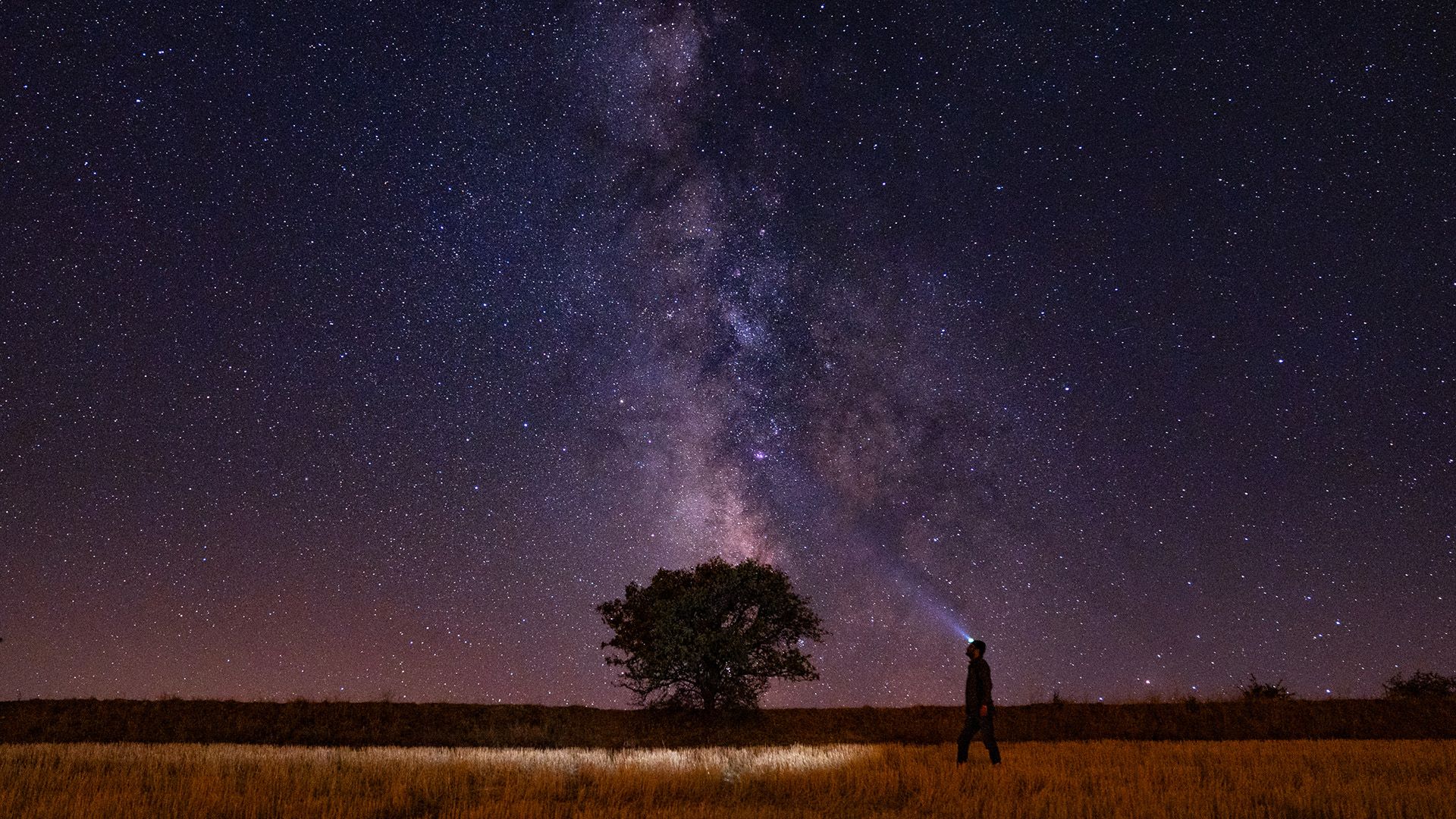
With the arrival of the summer solstice on June 21, stargazing becomes a late-night hobby. But June is one of the best months of the year to photograph the Milky Way from the Northern Hemisphere. As summer arrives, the brightest region of our galaxy — the galactic core — begins to climb into view in the southeastern sky. However, success will depend on timing, darkness and preparation.
The Milky Way is visible throughout the year, but its brightest and most photogenic section is best seen between May and September. In June, at midlatitudes, it becomes visible in the southeastern sky around 11:30 p.m. local time as true astronomical darkness begins, opening a roughly three-hour viewing window before the sky begins to lighten. Even so, you’ll need a dark sky, which can be found using a light-pollution map or searching for a nearby Dark Sky Place, Dark-Sky Preserve (Canada) or Dark Sky Discovery site (U.K.).
A good way to find the Milky Way is to identify the three bright stars — Vega, Deneb and Altair — that make up the Summer Triangle, a famous and very large asterism that’s prominent in the southeastern sky in June. The Milky Way will stream from Deneb to Altair and down to the southern horizon.
With the camera in manual mode, try an aperture of f/2.8 (or the widest your lens can handle), an ISO of 3200-6400, and a shutter speed between 10 and 25 seconds, Capture the Atlas recommends. However, there are other considerations, such as manually focusing to ensure the stars are sharp (using live view or zooming in on an image to check) and employing a shutter delay to avoid camera shake. Then, you can use Photoshop or other post-processing software to adjust the contrast, highlights, color temperature and clarity to reveal spectacular details hidden within RAW files.
What many beginners ignore is the importance of composition. A close-up of the Milky Way will produce a disappointing image. Instead, think about striking foregrounds, such as coastal cliffs, abandoned buildings, lakes, rock formations, lone trees and people to create depth, scale and interest.
Get the world’s most fascinating discoveries delivered straight to your inbox.
While June is an excellent month to begin Milky Way photography in the Northern Hemisphere, it will get even easier in July, August and September as the galaxy moves into the south and, ultimately, the southwest, before getting lost in the horizon once again around October. During that window, astrophotographers from the Northern Hemisphere often travel to dark-sky destinations farther south — such as the Canary Islands, Namibia, Chile, Australia and New Zealand — where darker skies and lower latitudes reveal more of the galaxy’s bright core.