
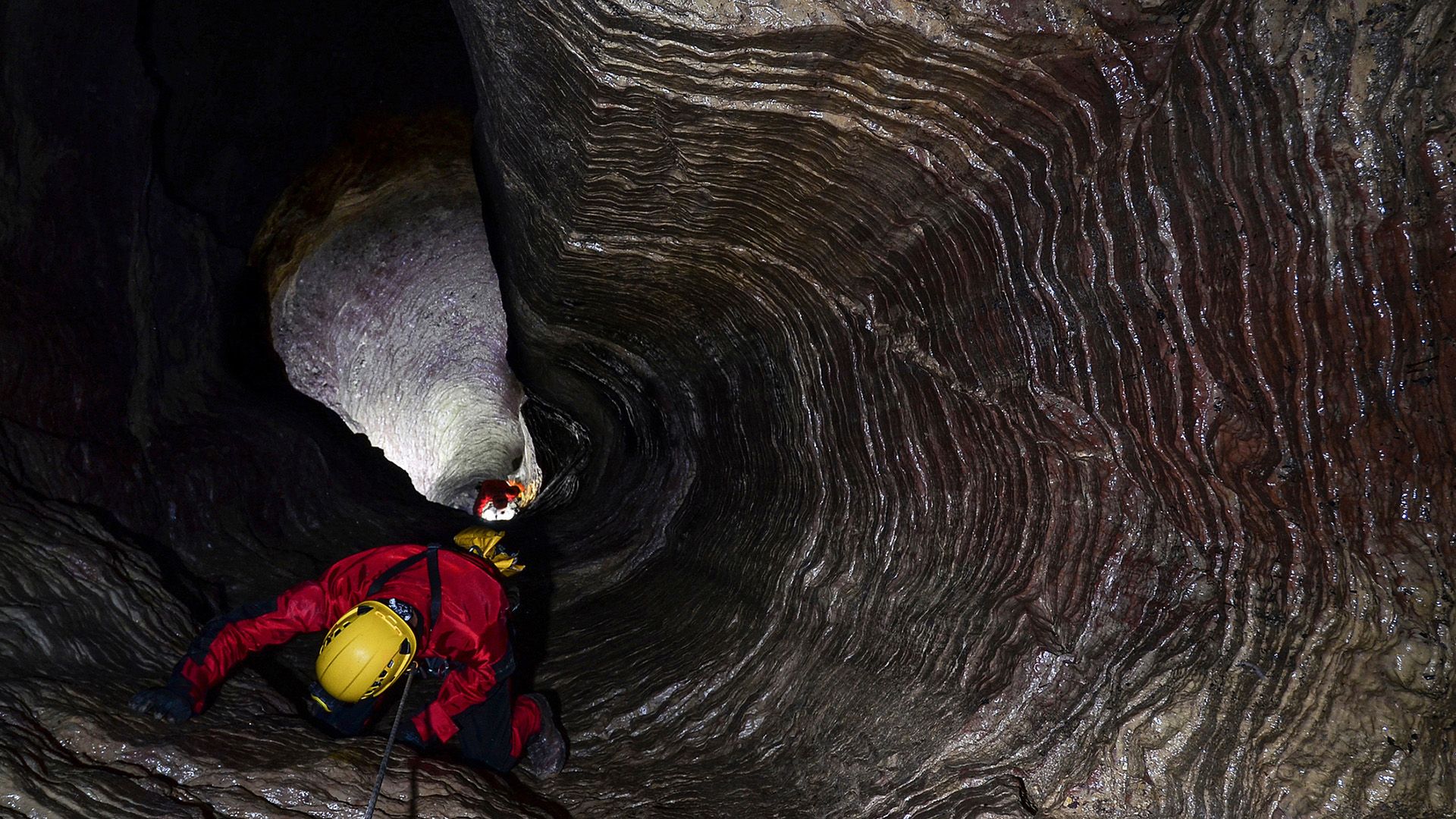
Caves pockmark the world, extending deep into the bowels of Earth. Many caves are record holders, including one in Kentucky that’s the longest known cave system, another in Vietnam that’s the largest cave, and one in Mexico that holds the title for the longest underwater cave. But caves are known for being dark abysses, so which is the deepest cave on Earth? And which strange animals live at their deepest depths?
There’s no clear winner, Live Science found. Instead, there are two caves that alternate as the record holders for the deepest cave on our planet: Veryovkina and Krubera-Voronya (also spelled Voronja), limestone caves in Abkhazia, an autonomous republic in the Republic of Georgia.
Both of these caves are more than 6,560 feet (2,000 meters, or 1.2 miles) deep, and they sit on the same remote mountain range, known as the Gagra Range. Explorers and scientists frequently update each cave’s measurements.
Sign up for our newsletter

(Image credit: Marilyn Perkins / Future)
Sign up for our weekly Life’s Little Mysteries newsletter to get the latest mysteries before they appear online.
According to a list of the world’s deepest caves maintained by geologist Paul Burger, a regional hydrologist in Alaska for the National Park Service, Veryovkina is currently in the lead, with a depth of 7,257 feet (2,212 m, or 1.37 miles). Krubera is close behind, at 7,215 feet (2,199 m, or 1.37 miles).
“Both caves are frequently reported with vertical errors of plus/minus tens of feet so first and second place can vary depending on how those data are interpreted,” Burger, who is also the author of the book “Cave Exploring: The Definitive Guide to Caving Technique, Safety, Gear, and Trip Leadership” (Myotis Publishing, 2022), told Live Science in an email.
The two caves are located in the Arabika Massif, a glacially eroded karst in the Caucasus. Karst is a type of landscape formed by soluble rocks like marble, gypsum and, in this case, limestone from the Late Jurassic and Early Cretaceous periods, or from about 163.5 million to 100.5 million years ago. Over time, the limestone lays down in layers, and then it gets compressed by tectonic forces and turns into vertical walls of rock, Hazel Barton, a microbiologist and geologist at the University of Alabama, told Live Science.

Krubera Cave in Abkhazia is one of the world’s deepest caves.
(Image credit: Cavan Images via Getty Images)
“If you can imagine all those layers, you’ve got a BLT sandwich,” she said. If you turn that BLT vertically, “when the water goes in, it’s always going to look for the easiest way down.” The water travels through cracks, eventually hitting the water table. “It’s basically a massive bathtub down there,” Barton said. Once the water hits the water table, it becomes groundwater and circulates in subterranean streams and rivers.
The reason this region has so many deep caves has to do with mountain building, Barton said “The limestone beds have been tilted near vertically, so the easiest route for the water is just straight down. You also have a large plateau that can collect the water, which helps push it one way or another.”
Life in the caves
These caves aren’t cozy. They’re extremely dark, wet and cold environments. Temperatures inside caves in this region average 35 to 37 degrees Fahrenheit (2 to 3 degrees Celsius) throughout the year, said Ana Sofia Reboleira, a subterranean ecologist at the University of Lisbon in Portugal.

The top two candidates for world’s deepest cave are both in the Gagra Range.
(Image credit: Lilkin via Getty Images)
These conditions are harsh, and any organisms living there must adapt in order to survive. The deeper you go into caves, the more limited the nutrients become there. Animals need to slow their metabolism so they can go long stretches without eating, which allows them to live longer, Reboleira said. Their features are also adapted to life underground; most animals living at such depths lack pigment and eyes. They also have long appendages, hair and antennae to help them move in the darkness and sense air vibrations inside the cave.
One of these deep-dwelling species is a type of wingless insect known as a springtail, which Reboleira and her colleagues discovered on a 2010 expedition to Krubera at about 6,500 feet (1,980 m, or 1.2 miles) below the surface. The hexapod, named Plutomurus ortobalaganensis, feeds on fungi and decomposing organic matter. Sixteen years later, it still holds the record for the deepest known land animal.
Subterranean microbes have also evolved mechanisms to survive deep underground. At extreme depths, these microbes rely on chemolithoautotrophy, a metabolic process that enables them to gain energy by oxidizing the bedrock and turning it into food, Barton explained.
By understanding these subterranean environments, scientists can learn more about what’s happening underneath our feet. “Caves are windows to the vast dimension of the underworld,” Reboleira said.
Caves are ultimately part of a system that is fundamental for all ecosystems on our planet. They provide water purification by filtering water their their many layers, play an important role in nutrient cycling, and sustain the carbon cycle by storing carbon in stone and hosting organisms that turn carbon dioxide into organic matter.
“Subterranean ecosystems are absolutely vital and strategic for ensuring life on Earth,” Reboleira said.
How much do you know about our blue planet? Test your terran knowledge with our Earth quiz!
TOPICS
