Close Menu
  • Home
  • UNSUBSCRIBE
  • News
  • Lifestyle
  • Tech
  • Entertainment
  • Sports
  • Travel
Facebook X (Twitter) WhatsApp
Trending
  • NASA is creating a fifth state of matter on the ISS, thanks to an upgrade to a mini-fridge-sized quantum lab
  • New sodium metal battery design charges in just 4 minutes and retains its capacity for years
  • Quantum computing wielded to create extremely rare material critical to nuclear fusion
  • Scientists build tiny ‘diving suit’ for cockroaches, turning them into search-and-rescue cyborgs
  • Physicists develop the first working model of quantum mechanics using only ‘real’ numbers
  • Dirty ‘button’ unearthed by metal detectorist turns out to be a rare 900-year-old coin from Norway’s last Viking king, Magnus Barefoot
  • Malaria had nearly been eliminated around a giant dam in the Amazon — but then it came roaring back. Experts just discovered why.
  • ‘800 seconds for a sick visit’: Some factors driving antibiotic resistance have nothing to do with biology, says medical sociologist Julia Szymczak
Facebook X (Twitter) WhatsApp
Baynard Media
  • Home
  • UNSUBSCRIBE
  • News
  • Lifestyle
  • Tech
  • Entertainment
  • Sports
  • Travel
Baynard Media
Home»Lifestyle»NASA is creating a fifth state of matter on the ISS, thanks to an upgrade to a mini-fridge-sized quantum lab
Lifestyle

NASA is creating a fifth state of matter on the ISS, thanks to an upgrade to a mini-fridge-sized quantum lab

EditorBy EditorJuly 10, 2026No Comments4 Mins Read
Share Facebook Twitter Pinterest LinkedIn Tumblr Reddit Telegram Email
Share
Facebook Twitter LinkedIn Pinterest Email

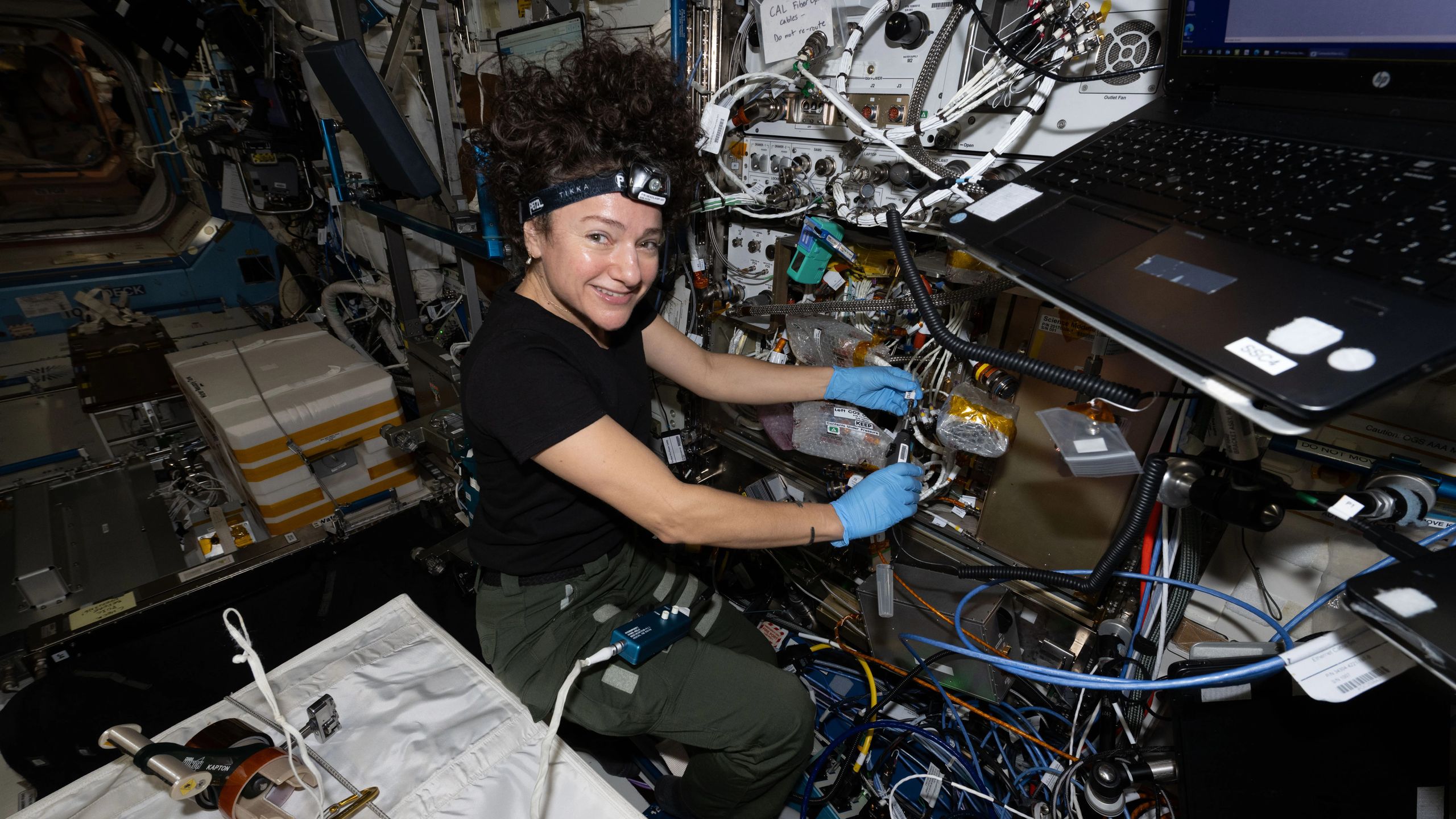
A new upgrade to the International Space Station’s (ISS) quantum laboratory is enabling NASA to probe the behavior of atoms further than ever before, the space agency has announced.

Combining the ISS’s newly upgraded “Cold Atom Laboratory” with the near zero-gravity of low Earth orbit, scientists are attempting to understand the properties of so-called “ultracold” atoms in an environment impossible to replicate on Earth. The aim of the mission is to study how clouds of atoms behave at temperatures close to absolute zero (minus 459.67 degrees Fahrenheit or minus 273.15 degrees Celsius) — the coldest possible temperature in the universe, where atoms lose all their energy of motion.

“At the coldest temperatures, matter behaves drastically different from anything we have experienced,” Jason Williams, project scientist for the Cold Atom Lab at NASA’s Jet Propulsion Laboratory in Southern California, which built the facility, said in a statement. “The wavelike nature of matter dominates, and ultracold matter can behave in ways that are not only unexpected, but that also enable extremely precise measurements of time, gravity, and motion. The lab has lots of tools — especially with this latest upgrade — to let us probe the nature of the universe.”

Rule-breaking particles

Atoms and their subatomic particles are quantum mechanical objects whose behavior is fundamentally different from that of the large-scale world. For example, the laws of quantum mechanics predict that particles can be in more than one place at the same time (quantum superposition); can be mysteriously linked with each other over great distances (quantum entanglement); and move through spacetime as waves as well as moving like fixed, solid objects.

But observing these behaviors is notoriously difficult. Firstly, atoms are so tiny that if an atom were the size of a golf ball, then a human teeing one off would stand roughly as tall as the distance from Earth to the moon. Secondly, it’s impossible to isolate measurements of these behaviors for atoms in “normal” environments (like on Earth), as the desired quantum behavior is disturbed by energy from heat and gravity.


You may like

To overcome these challenges, the ISS’s Cold Atom Laboratory — which is the size of a mini-fridge — uses lasers to cool gases of rubidium and potassium to just above absolute zero. At these temperatures, atoms form a state of matter known as a Bose-Einstein condensate, in which many atoms behave like a single wave of quantum matter.

Not only does this setup allow scientists to observe quantum behaviors on a much larger scale than that of single atoms, but the reduced gravity enables the condensate matter waves to expand and evolve undisturbed for much longer periods than would be possible on Earth.

Get the world’s most fascinating discoveries delivered straight to your inbox.

This is the fourth major upgrade to NASA’s Cold Atom Laboratory since it arrived aboard the ISS in 2018. According to NASA, the significant improvements in this most recent upgrade include a redesigned magnetic trap to contain the cloud of atoms, improved atom sources, and better measurement capabilities.

Scientists launched these upgrades to the ISS in April 2026, and they have since been installed, switched on, and started making state-of-the-art measurements. As well as enabling novel tests of fundamental physics, measurements of these effects are critical in demonstrating future, space-based, highly precise quantum technologies related to positioning, navigation, timing, and gravity sensing. These technologies could one day enable astronauts to navigate on the moon without GPS and produce high-precision maps of Earth’s gravity.

“In the previous century, there was a quantum revolution that led to lasers, cellphones, and MRIs for medical imaging,” Ethan Elliott, deputy project scientist at NASA’s Jet Propulsion Laboratory in California said in the statement. “We’re performing Quantum 2.0 – direct manipulation of large quantum states – and we hope for similar gains in quantum technology by advancing this science in orbit.”

TOPICS

international space station

Source link

Share. Facebook Twitter Pinterest LinkedIn Tumblr Email
Previous ArticleNew sodium metal battery design charges in just 4 minutes and retains its capacity for years
Editor
  • Website

Related Posts

Lifestyle

New sodium metal battery design charges in just 4 minutes and retains its capacity for years

July 10, 2026
Lifestyle

Quantum computing wielded to create extremely rare material critical to nuclear fusion

July 10, 2026
Lifestyle

Scientists build tiny ‘diving suit’ for cockroaches, turning them into search-and-rescue cyborgs

July 10, 2026
Add A Comment

Comments are closed.

Categories
  • Entertainment
  • Lifestyle
  • News
  • Sports
  • Tech
  • Travel
Recent Posts
  • NASA is creating a fifth state of matter on the ISS, thanks to an upgrade to a mini-fridge-sized quantum lab
  • New sodium metal battery design charges in just 4 minutes and retains its capacity for years
  • Quantum computing wielded to create extremely rare material critical to nuclear fusion
  • Scientists build tiny ‘diving suit’ for cockroaches, turning them into search-and-rescue cyborgs
  • Physicists develop the first working model of quantum mechanics using only ‘real’ numbers
calendar
July 2026
M T W T F S S
 12345
6789101112
13141516171819
20212223242526
2728293031  
« Jun    
Recent Posts
  • NASA is creating a fifth state of matter on the ISS, thanks to an upgrade to a mini-fridge-sized quantum lab
  • New sodium metal battery design charges in just 4 minutes and retains its capacity for years
  • Quantum computing wielded to create extremely rare material critical to nuclear fusion
About

Welcome to Baynard Media, your trusted source for a diverse range of news and insights. We are committed to delivering timely, reliable, and thought-provoking content that keeps you informed
and inspired

Categories
  • Entertainment
  • Lifestyle
  • News
  • Sports
  • Tech
  • Travel
Facebook X (Twitter) Pinterest WhatsApp
  • Contact Us
  • About Us
  • Privacy Policy
  • Disclaimer
  • UNSUBSCRIBE
© 2026 copyrights reserved

Type above and press Enter to search. Press Esc to cancel.