Close Menu
  • Home
  • UNSUBSCRIBE
  • News
  • Lifestyle
  • Tech
  • Entertainment
  • Sports
  • Travel
Facebook X (Twitter) WhatsApp
Trending
  • ‘In an unrecoverable state’: NASA confirms MAVEN spacecraft is officially dead after loss of signal behind Mars
  • 2 rivers merged to form the Euphrates 3.6 million years ago, eventually leading to the Fertile Crescent
  • NASA confirms fireball meteor exploded over northeastern US with force of 230 tons of TNT
  • Astronauts could use lightning-like plasma jets to kill germs on the moon and Mars, demo hints
  • First whole-genome sequence of a Greenland shark holds clues to their extreme longevity
  • Heading a soccer ball just once is enough to raise levels of proteins associated with brain damage
  • OpenAI’s internal AI model just solved an 80-year-old math problem ‪—‬ and mathematicians verified it
  • Skeletal remains of Queen Elisenda, one of the most powerful rulers in medieval Europe, unearthed in Barcelona — along with several others who bore unexplained stab wounds
Facebook X (Twitter) WhatsApp
Baynard Media
  • Home
  • UNSUBSCRIBE
  • News
  • Lifestyle
  • Tech
  • Entertainment
  • Sports
  • Travel
Baynard Media
Home»Lifestyle»‘In an unrecoverable state’: NASA confirms MAVEN spacecraft is officially dead after loss of signal behind Mars
Lifestyle

‘In an unrecoverable state’: NASA confirms MAVEN spacecraft is officially dead after loss of signal behind Mars

EditorBy EditorJune 3, 2026No Comments3 Mins Read
Share Facebook Twitter Pinterest LinkedIn Tumblr Reddit Telegram Email
Share
Facebook Twitter LinkedIn Pinterest Email

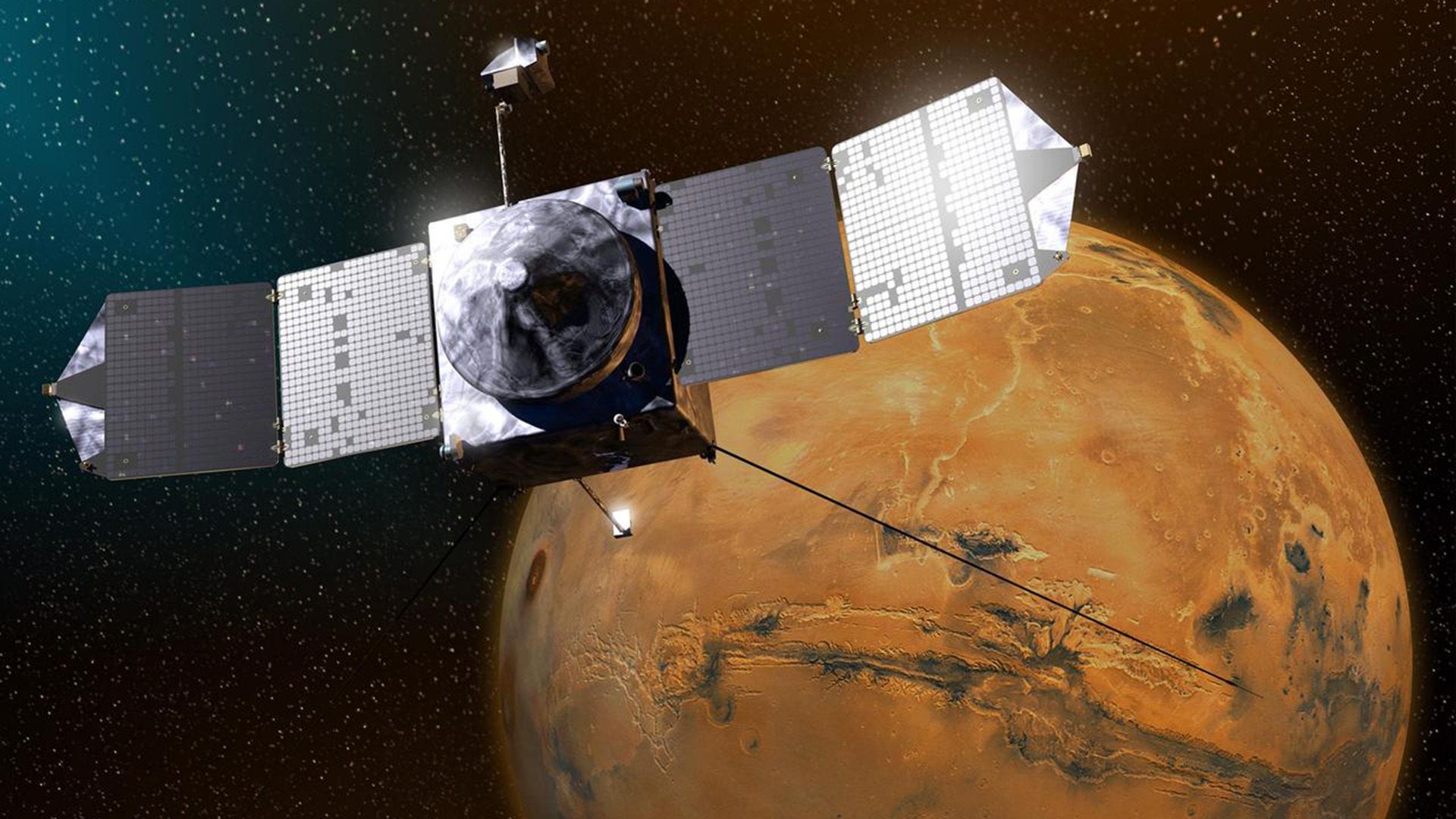
After 11 years studying Mars from above, NASA’s MAVEN spacecraft is officially dead, the agency announced in a statement on Wednesday (June 3). The culprit: a drained battery, triggered by an as-yet-unknown anomaly.

MAVEN (short for Mars Atmosphere and Volatile Evolution) began orbiting Mars on Sept. 21, 2014, on a mission to study the Red Planet’s mysterious atmosphere. Circling Mars roughly 6.6 times every Earth day, the spacecraft has facilitated countless discoveries over the last decade — including the first direct observations of a multi-million-year process that has been steadily stripping Mars of its atmosphere.

But on Dec. 6, 2025, NASA unexpectedly lost contact with the probe when it swung behind Mars during a regular orbit. At the time of the probe’s expected reemergence, NASA’s Deep Space Network (DSN) could not detect a signal from MAVEN. (DSN is an international array of radio antennas that connects Earth with various spacecraft).

The agency convened an anomaly review board in February to assess the probe’s status. Now, the team has shared their findings: The spacecraft is not recoverable, and its mission is officially at an end.

The precise cause of MAVEN’s death remains unknown, and NASA will continue its assessment over the coming months. However, the board did share some preliminary details. A “brief fragment of telemetry data” obtained by the DSN indicated that MAVEN was rotating at an unusually high rate when it reemerged from behind Mars in December, indicating a change in its orbital trajectory.


You may like

“The review board concluded that due to this rotation, the batteries on the spacecraft had drained, causing the communications system to lose power and rendering MAVEN in an unrecoverable state,” NASA officials wrote in the statement.

A close up of Mars' red surface, showing water rising from it

An illustration of water escaping Mars’ atmosphere, based on data collected by MAVEN.

(Image credit: NASA Goddard)

NASA will host a public media teleconference to discuss the anomaly, as well as highlights of MAVEN’s mission, on June 3 at 2 p.m. EDT.

Get the world’s most fascinating discoveries delivered straight to your inbox.

MAVEN’s discoveries

Even with MAVEN officially offline, data collected by the spacecraft will continue to inform scientific discoveries for years to come. Earlier this month, researchers used MAVEN data to identify a previously unknown phenomenon in Mars’ atmosphere, hinting that its thin magnetic shield defends the planet against solar radiation more than previously thought.

MAVEN has also revealed the first direct evidence of “sputtering” — a process by which solar wind collides with Mars’ upper atmosphere and flings particles into space, gradually eroding the Red Planet’s atmosphere. This could explain why Mars became a dry, ostensibly dead planet while Earth has flourished.

The spacecraft also detected several types of auroras on Mars, and showed that Mars’ magnetosphere can balloon outward by thousands of miles when solar wind calms down. All of these discoveries paint a more detailed and complex picture of how Mars’ atmosphere and magnetic shield interact with solar radiation — which will be crucial to understand before sending human astronauts to the Red Planet.


What do you know about the Red Planet? Test your knowledge with our Mars quiz!

Source link

Share. Facebook Twitter Pinterest LinkedIn Tumblr Email
Previous Article2 rivers merged to form the Euphrates 3.6 million years ago, eventually leading to the Fertile Crescent
Editor
  • Website

Related Posts

Lifestyle

2 rivers merged to form the Euphrates 3.6 million years ago, eventually leading to the Fertile Crescent

June 2, 2026
Lifestyle

NASA confirms fireball meteor exploded over northeastern US with force of 230 tons of TNT

June 2, 2026
Lifestyle

Astronauts could use lightning-like plasma jets to kill germs on the moon and Mars, demo hints

June 1, 2026
Add A Comment

Comments are closed.

Categories
  • Entertainment
  • Lifestyle
  • News
  • Sports
  • Tech
  • Travel
Recent Posts
  • ‘In an unrecoverable state’: NASA confirms MAVEN spacecraft is officially dead after loss of signal behind Mars
  • 2 rivers merged to form the Euphrates 3.6 million years ago, eventually leading to the Fertile Crescent
  • NASA confirms fireball meteor exploded over northeastern US with force of 230 tons of TNT
  • Astronauts could use lightning-like plasma jets to kill germs on the moon and Mars, demo hints
  • First whole-genome sequence of a Greenland shark holds clues to their extreme longevity
calendar
June 2026
M T W T F S S
1234567
891011121314
15161718192021
22232425262728
2930  
« May    
Recent Posts
  • ‘In an unrecoverable state’: NASA confirms MAVEN spacecraft is officially dead after loss of signal behind Mars
  • 2 rivers merged to form the Euphrates 3.6 million years ago, eventually leading to the Fertile Crescent
  • NASA confirms fireball meteor exploded over northeastern US with force of 230 tons of TNT
About

Welcome to Baynard Media, your trusted source for a diverse range of news and insights. We are committed to delivering timely, reliable, and thought-provoking content that keeps you informed
and inspired

Categories
  • Entertainment
  • Lifestyle
  • News
  • Sports
  • Tech
  • Travel
Facebook X (Twitter) Pinterest WhatsApp
  • Contact Us
  • About Us
  • Privacy Policy
  • Disclaimer
  • UNSUBSCRIBE
© 2026 copyrights reserved

Type above and press Enter to search. Press Esc to cancel.