
If you put more faith in predictions from the International Energy Agency than President Donald Trump’s haphazard assurances, we’re looking at years of restricted fossil fuel supplies. Thanks to the war in the Persian Gulf, expect gas price discussions to dominate political and water cooler conversations. For example, U.S. Senate candidate Michelle Tafoya recently suggested Minnesotans could “take one less trip to Starbucks.”
Here is some other advice about how to reduce your consumption of gasoline and cope with the turbulent economic state of the world.
1. Walk more
A fun fact: Half of U.S. trips are under three miles, about the distance you can walk in an hour. Believe it nor not, a long walk can be a pleasant experience, and in some countries is relatively common. If you’re trying to use less gas, try walking to a grocery store or other nearby destination instead of driving. You have to change your shopping habits, chaining trips or buying smaller amounts of food more frequently. But it can be a more engaged way to shop, meal-by-meal, even if it does not fit well with a Costco membership. Stop and smell the flowers. Look for migrating birds, more of whom are arriving every day.
(If you do this, report back to me what your walk was like.)
People often focus only on their commute to work, but it’s the other trips that might be more flexible. For example, instead of driving across town to a restaurant, make a list of restaurants in your neighborhood and start spending more time at those places. The most fun way to do this is to take out a map and draw a circle with a one- or two-mile radius. A brisk walk is a great way to digest a meal.
This is age-old wisdom, easy to talk about but harder to drum up the courage to walk into the world. The reward waiting at the end is a rich vein: not just less gas, but better personal health and more intimate knowledge of your neighborhood and community.
2. Take transit
If you can, swap out trips for transit. Twin Cities transit remains a great deal, an affordable $2 with free transfers for up to two-and-a-half hours. Compared to many other U.S. cities, that’s a bargain. If you’re a senior, low-income or under 12 years old, you qualify for a half-price fare, an almost negligible $1. If you happen to be in either city’s “downtown zone,” fares drop to only .50.
The only wrinkle is getting used to the payment and schedule process. Metro Transit will eventually be rolling up a new fare technology that will allow anyone to use a credit card on any vehicle, but for now the best thing to do is get the Metro Transit app – you simply show it to the bus operator – or a GoTo card. These are available at many grocery stores or Metro Transit offices.
The main cost here is time. Almost without exception, transit travel times are longer than driving, often double the minutes to your destination. (My commute to work is a rare exception, which is why I often feel privileged.) Ride times vary greatly depending on your geography. Some parts of the city are much more suited to transit than others, but if you find yourself living within a half-mile of one of Metro Transit’s high frequency routes, try to use it more often.
Bring a book and your favorite earbuds, and transit can be pleasant. You’ll have to be a bit more comfortable being around other people, and get used to adhering to a schedule. The life hack here is to use the Transit App, which makes transit schedules seamlessly visible.
3. Bike more
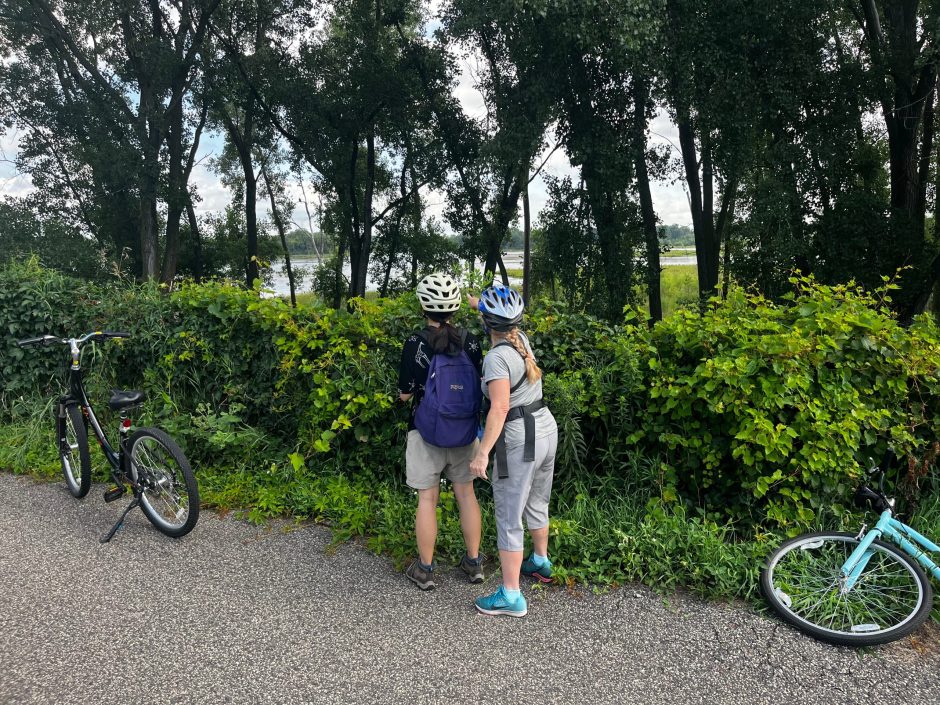
If you’re like most people in the Twin Cities, you have a bike in your garage or basement but don’t ride it all that often. This is a great time of year to get out there and give it a try. Just stay on the lookout for accumulated grit and gravel, or the omnipresent potholes.
(The St. Paul asphalt plant opened last week, but it’s going to take Public Works crews a while to get them filled in.)
There’s also a wonderful hack to this: Get an e-bike. Research shows e-bikes boost people’s activity marvelously. Try out an e-cargo bike from the Minneapolis bike library, a great hack for shopping or parenting. Springtime in Minnesota is the perfect time to get back in the saddle, no matter how long you’ve let the bicycle gather dust.
The goal of all of this is to drive less. If you succeed, you might even consider selling an internal-combustion engine car. A used EV remains a great deal, with minimal maintenance costs. Or if you live in their region (the central Twin Cities), try out the Evie car share program. It’s an all-electric shared car fleet that cuts out fossil fuels and relieves anxiety about transit and active transportation, knowing you have a car waiting for you as a backup plan.
Recalling the 1970s energy crisis
It’s worth remembering that this has happened before. The 1973 OPEC oil embargo and the subsequent gas shortage upended U.S. transportation patterns 50 years ago. There were picnics on the (unused portions) of interstate highways. Bicycles took off in an unprecedented “bike boom” that reshaped the industry. And in U.S. vehicular policy, we got highly conflicting approaches. On the one hand, federal guidelines set speed limits at 55 mph to save money and energy. (Folks called this the ol’ “double nickel.”)
Meanwhile, regulators legalized right-turn-on-red, allowing this nationally in order to save fuel and reduce congestion. Tens of thousands of people died from this new policy, which remains standard around the country in all but a few urban areas. In most other parts of the world, turning right on a red light has always been verboten.
The U.S. response to the 70s oil crisis was a mostly depressing mixed bag. It’s painful to dream about what might have happened if we had gone a different direction and embraced electrification and mass transportation. Other countries pivoted when faced with high oil prices, for example by investing in high-speed rail in places like France or Japan, or doubling down on transit and car-free spaces in the Netherlands.
In the U.S., many of the decisions driven by “energy independence” have been walked back or backfired, to the detriment of our energy flexibility. For example, we raised speed limits on freeways up to 80 mph in many places. The light truck loophole opened the door for big increases in vehicle sizes, as SUVs have become almost the only passenger vehicles available from American manufacturers today. Bicycle investments were waylaid by poor engineering and an intransigent “vehicular cycling” lobby. That left the country ill prepared for energy problems in 2026.
But individually, there’s hope. In case of emergencies like this, try embracing some useful tactics. Walk more. Bike more. Take transit. Get rid of a fossil-fueled car, if you can.
I’m not saying you should take one less trip to Starbucks; I’m suggesting you walk to Starbucks because I savor a good latté. These are tricks that will make your world, and your bank account, more resilient during what looks to be a turbulent year.
