
As the Minnesota Legislature skitters forward this session, lawmakers are set to craft omnibus bills, or even a single jumbo omnibus package. After all, committees are continually “laying over” bills dealing with everything from State Capitol security to regulating health care facilities for possible inclusion in an omnibus measure.
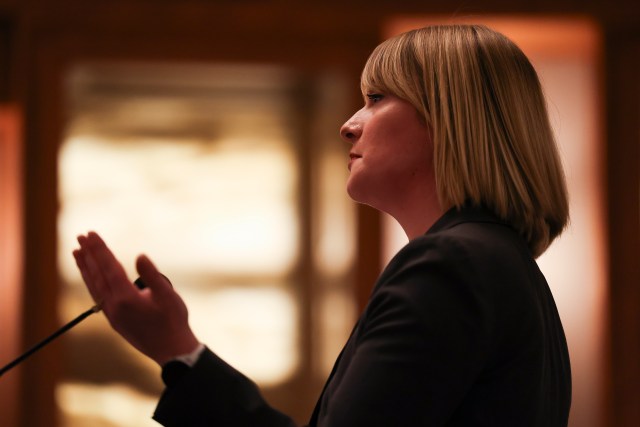
But at an oral argument Wednesday, a Minnesota Court of Appeals panel voiced openness to the idea that omnibus bills are actually illegal, or at least a court could nix specific bill parts.
The Minnesota Gun Owners Caucus already got a lower court judge to strike down a ban on binary triggers in guns, because it is part of a 1,430-page omnibus bill that the Legislature passed in the waning moments of their 2024 session.
Related: Are the omnibus bills the Minnesota Legislature relies on illegal?
The Gun Owners say that the bill violates the Minnesota constitution’s provision that legislation must have a single subject.
The 2024 omnibus bill has a title alone that spans over two-pages long. Leonardo Castro, a Ramsey County judge, found it defied the single subject rule. The state appealed Castro’s decision.
Now, the pro-gun group is asking for much, much more than the appeals court to uphold Castro’s decision. They want the whole 2024 bill voided.
“It would be healthy to the state and to the Legislature to have a clean and full invalidation here,” said Nicholson Nelson of Upper Midwest Law Center, the lawyer for the Gun Owners Caucus.
It is unclear if Nelson had sold the judges on this sweeping solution. The panel did not issue a decision and has 90 days to produce a written ruling.
Appeals judge Michelle Larkin noted that the only time Minnesota has ever struck down an entire omnibus bill was in a case the court considered 107 years ago. Subsequent cases have only ruled individual components unconstitutional.
Larkin said that people generally cannot “challenge a law unless you show you have been subject to injury.” She questioned if the Gun Owners Caucus can contest parts of a law that does not deal with gun ownership.
Nelson responded that the alternative is to have more interest groups sue over specific provisions, and since “most of this law is going to get struck down anyway” it would actually be a simpler solution to kill the entire gargantuan law.
The appeals judges also questioned the state of Minnesota’s assertions.
In fact, Emily Anderson, a lawyer at the Minnesota Attorney General’s office, brought up a novel legal argument she dubbed the “codification rule”: If a law has already taken effect, then someone is too late to sue to stop the law.
Here, the Gun Owners Caucus sued to end the binary trigger ban nine months after the omnibus bill became law, and after the law took effect. Therefore, their lawsuit ought to be dismissed.
The judges were skeptical, noted they had never heard this “codification” argument before.
“We understand if you are nervous” about employing a brand new legal argument, Anderson told the judges, but “if the court is nervous about applying a new rule of codification, then [invalidating the entire 2024 omnibus bill] should make you very nervous.”

Anderson also told the judges that the 2024 bill does have a single subject, and that is “operations and financing of state government.”
“Isn’t that two subjects?” Larkin responded.
Anderson replied that finances and operations go hand-in-hand in many legislative spending bills.
The oral arguments came one day after the Minnesota Private Business Council filed a lawsuit seeking to invalidate on single subject grounds provisions related to the state’s paid leave and earned sick time laws that were part of the 2024 omnibus.
Additionally, there is an active lawsuit filed by UnitedHealth against the 2024 law. The health care giant objected to it, because the measure prohibits for-profits from being managed care organizations in Minnesota Medicaid.
At least so far, these cases do not seem to have spooked lawmakers. On Wednesday afternoon, committees including Human Services began the public-facing portion of drafting omnibus policy measures.
