
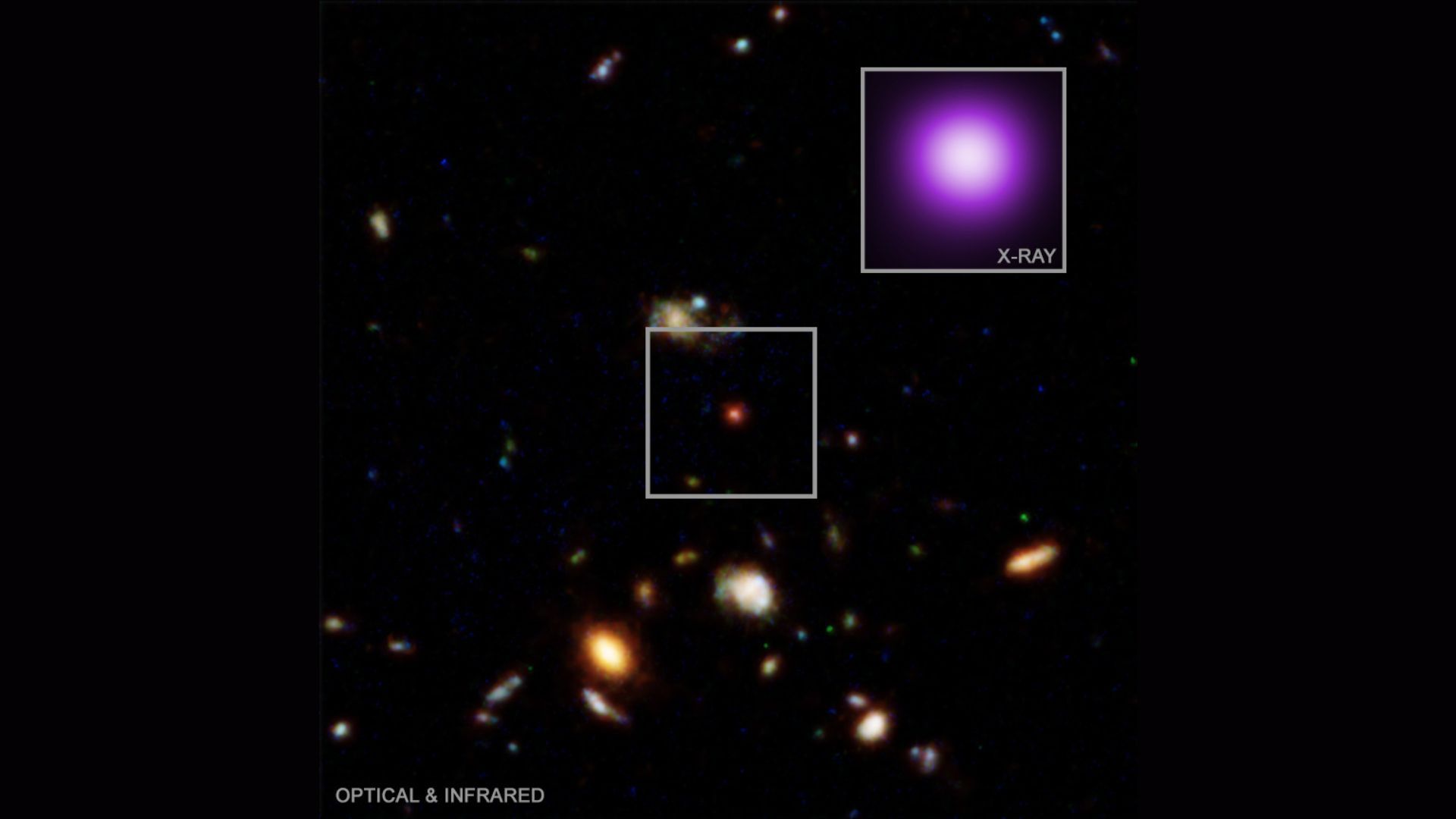
A unique, X-ray-spewing black hole may help to confirm the enigmatic identity of “little red dots,” a curious class of objects that are observed mostly in the very early universe, approximately 12 billion light-years away.
Astronomers have sought to classify little red dots (LRDs) since the James Webb Space Telescope (JWST) first spotted them shortly after it began science operations in 2022.
Now, in a paper published March 16 in The Astrophysical Journal Letters, astronomers have described an object that may illuminate the murky nature of LRDs.
Formally known as 3DHST-AEGIS-12014 and colloquially called the X-ray dot (XRD), this object had remained hidden in a survey conducted by NASA’s Chandra X-ray Observatory more than a decade ago. Its importance was revealed only recently, after JWST observed the same cosmic field.
“It is always wonderful to see archival data aid in solving mysteries that were completely unknown when the data were first taken,” Anthony Taylor, an astrophysicist at the University of Texas at Austin who was not involved in the study, told Live Science via email. “This is a prime example of legacy science programs that continue to provide scientific value both upon their initial release and far into the future.”
A single black hole may solve two cosmic mysteries
The XRD discovered by Chandra resembles an LRD, save for a few differences. The biggest one is that it is a bright source of X-ray light.
Normally, LRDs do not seem to emit X-rays. This anomaly has deepened the mystery of their identity, because active black holes commonly emit X-rays from their chaotic coronas, where infalling material reaches near light speeds and intense temperatures.
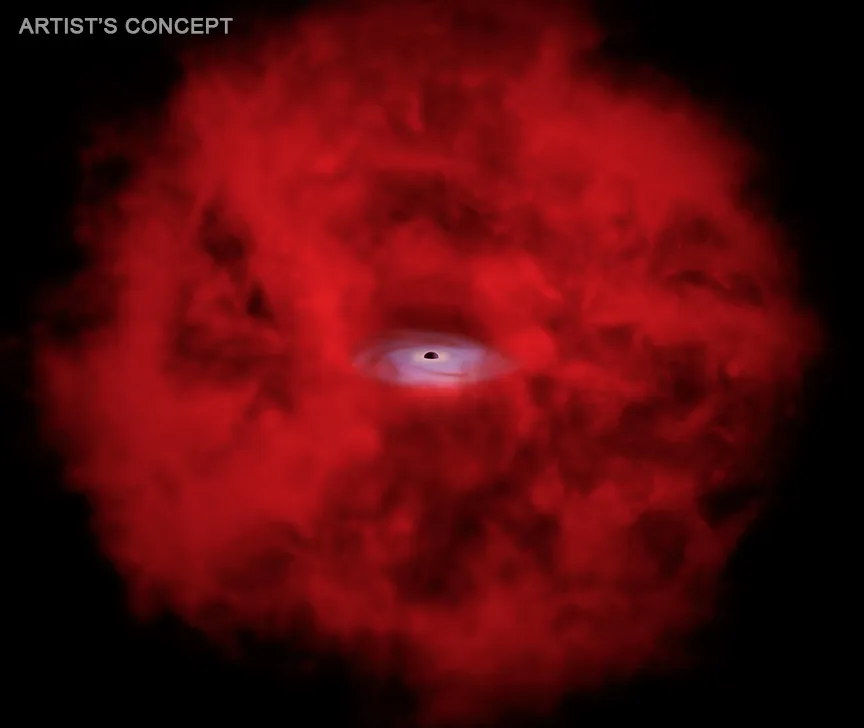
An illustration depicting a close-up view of the “X-ray dot.”
(Image credit: NASA/CXC/SAO/M. Weiss; adapted by K. Arcand & J. Major)
“If little red dots are rapidly growing supermassive black holes, why do they not give off X-rays like other such black holes?” co-author Anna de Graaff, an astrophysicist at the Harvard & Smithsonian Center for Astrophysics, said in a statement.
As suggested in this study and in previous research, the X-rays may be blocked by thick cocoons of gas surrounding LRDs.
The XRD offers evidence of this process. As the black hole at its heart gorges on the surrounding gas, it clears holes in its cocoon. This forms sight lines into the object’s interior and allows X-rays to escape, while also preserving its overall reddish appearance — picture a cosmic jack-o’-lantern with its eerie inner light bleeding into the dark.
“This single X-ray object may be — to use a phrase — what lets us connect all of the dots,” lead author Raphael Hviding, an astronomer at the Max Planck Institute for Astronomy in Germany, said in the statement.
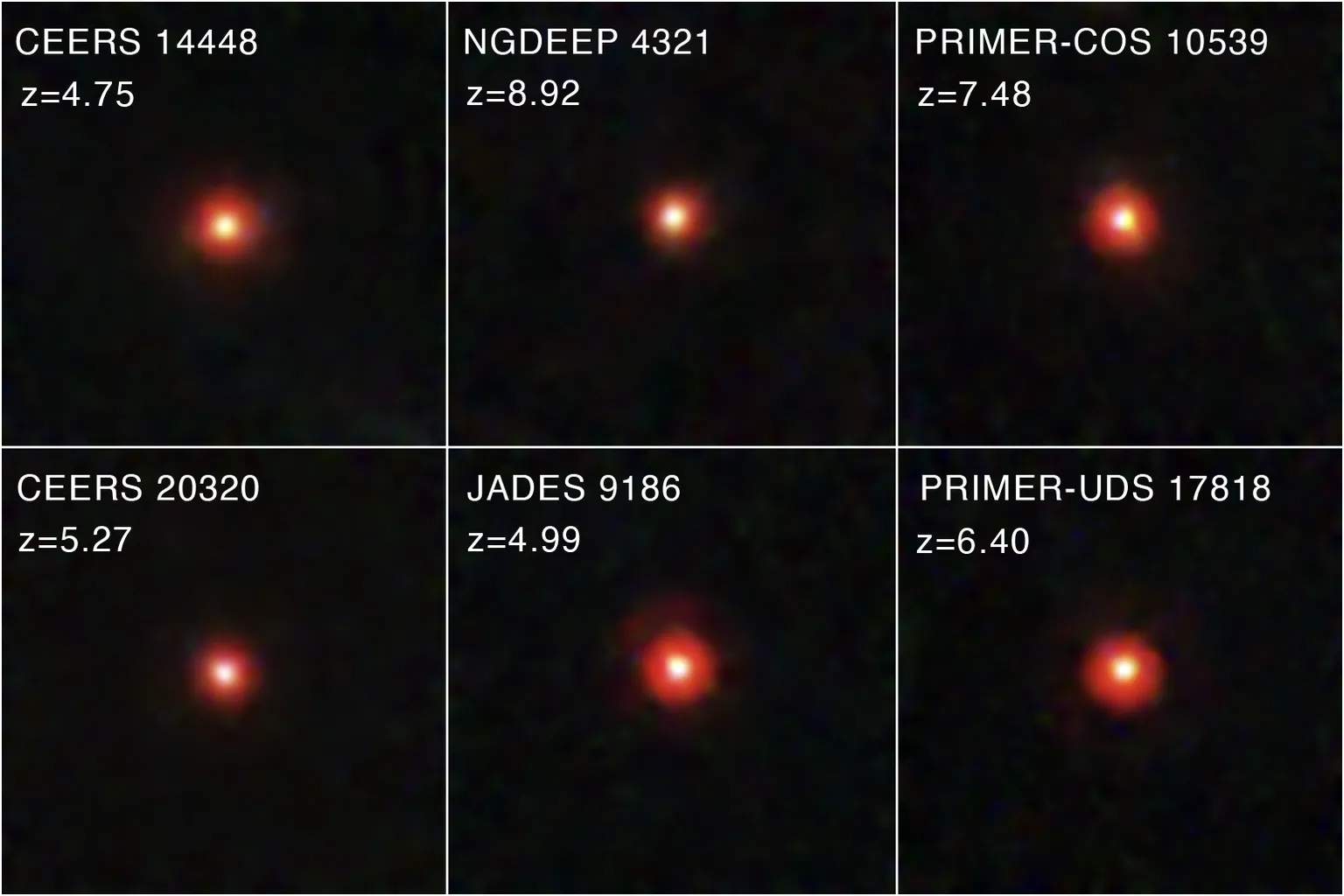
Little red dots, as they appeared more than 12 billion years ago, were discovered through early-universe surveys.
(Image credit: NASA, ESA, CSA, STScI, Dale Kocevski (Colby College))
Unveiling an early-universe enigma
Overall, the XRD may help strengthen the idea that LRDs are young black holes in the midst of a transitional phase, during which they’re enveloped in a dense cloud of gas. This gaseous shroud is similar in composition to some stellar atmospheres, earning LRDs an awe-inspiring appellation: “black hole stars.”
Accordingly, if LRDs represent a phase of rapid gas accretion by young black holes, this period of quick consumption may help to explain how early supermassive black holes (SMBHs) grew so fat, so fast, accumulating many millions or billions of solar masses when the universe was only about 10% of its current age.
It is essential to study the evolution of these objects in more recent times. “LRD-like objects have actually been found in the modern universe but it is clear that LRD analogues are exceedingly rare,” Hviding told Live Science via email. “Why? The short answer is that we don’t know.” One possibility is that giant gas reservoirs grow thinner as the universe evolves, he said.
Next-generation observatories like the Nancy Grace Roman Space Telescope will scan the sky for the rare, modern LRDs in the evolved universe. “They cannot go nearly as deep or as detailed as Webb,” Hviding added, “but because they survey wide areas of the sky, finding rare analogues becomes viable.”
In the meantime, the XRD warrants further observations. Maybe it isn’t an elderly LRD, after all, but a more common SMBH veiled in an exotic dust never seen before. Either way, astronomers appear to have made a distinctive discovery that may elucidate a chain of cosmic mysteries in the evolution of the universe.
Hviding, R. E., De Graaff, A., 刘 H. 翰. L., Goulding, A. D., 马 Y. 逸. M., Greene, J. E., Boogaard, L. A., Bunker, A. J., Cleri, N. J., Franx, M., Hirschmann, M., Leja, J., Matthee, J., Naidu, R. P., Setton, D. J., Übler, H., Venturi, G., & 王 B. 冰. 洁. W. (2026). The X-Ray dot: exotic dust or a late-stage little red dot? The Astrophysical Journal Letters, 1000(1), L18. https://doi.org/10.3847/2041-8213/ae4c88
See how much you know about black holes with our black hole quiz!
TOPICS
