
Close Menu
  • Home
  • UNSUBSCRIBE
  • News
  • Lifestyle
  • Tech
  • Entertainment
  • Sports
  • Travel
Facebook X (Twitter) WhatsApp
Trending
  • Aspen trees provide a natural buffer against wildfires, even as fire season intensifies, study shows
  • Ancient bullets reveal where a Roman camp hid in the Pyrenees of Spain before being ambushed
  • First deaths from Cyclospora outbreak reported in Michigan
  • Scientists uncover big clue as to how Antarctica’s mysterious Blood Falls came to be
  • ‘Poop pills’ may ease insomnia by reprogramming the gut microbiome, early study hints
  • Did fungi give mammals an evolutionary edge after the dinosaur-killing asteroid hit? New evidence revives a provocative hypothesis
  • Diagnostic dilemma: Rare ‘spinal stroke’ struck an 8-year-old and temporarily paralyzed her
  • Buck Moon 2026: July’s full moon rises tonight, setting up a month of solar and lunar eclipses
Facebook X (Twitter) WhatsApp
Baynard Media
  • Home
  • UNSUBSCRIBE
  • News
  • Lifestyle
  • Tech
  • Entertainment
  • Sports
  • Travel
Baynard Media
Home»Lifestyle»Are we more closely related to cats or dogs?
Lifestyle

Are we more closely related to cats or dogs?

EditorBy EditorMay 11, 2026No Comments4 Mins Read
Share Facebook Twitter Pinterest LinkedIn Tumblr Reddit Telegram Email
Share
Facebook Twitter LinkedIn Pinterest Email

They sleep on our beds, steal our food, and generally rule the house. Between them, cats and dogs make up two-thirds of pet ownership worldwide. But which of the two companion animals are we more closely related to?

The answer depends on how you look at the question.

“From an evolutionary perspective we are equally related to dogs and cats,” Mark Springer, a professor emeritus of evolution, ecology and organismal biology at the University of California, Riverside, told Live Science in an email.


You may like

Cats, dogs and humans are all mammals. In the mammalian family tree, which maps out how different mammal species are related to one another, both cats and dogs belong to the order Carnivora, while humans are primates. These two groups split from a common ancestor about 90 million to 95 million years ago, Springer said. Meanwhile, cats and dogs split from each other much later, around 55 million years ago.

In terms of common ancestry, “dogs and cats are more closely related to mammals such as pangolins, horses, cows, whales, bats, shrews and moles than they are to humans,” Springer said. And “humans are more closely related to colugos [flying lemurs], tree shrews, rabbits, rats, and mice than they are to cats and dogs.”

Genetic ties

Another way of deciding which species we are more closely related to is through a genetic lens.

If you measure how much the DNA code has changed over time, humans are about equally related to cats and dogs, William Murphy, a comparative genomicist at Texas A&M University, told Live Science in an email.

However, scientists also compare how DNA strands are organized within chromosomes. Here, a difference emerges.

Murphy explained that the ancestors of modern-day dogs went through extensive chromosome rearrangements over evolutionary time. (Such rearrangements are not unique to dogs; they occur across different animal and plant species, though scientists don’t fully understand why some lineages rearrange faster than others.) Cats, on the other hand, retained a genome organization that’s closer to ours. “In terms of how genes are arranged within chromosomes, humans and cats are twice as similar to each other as humans are to dogs,” he said.
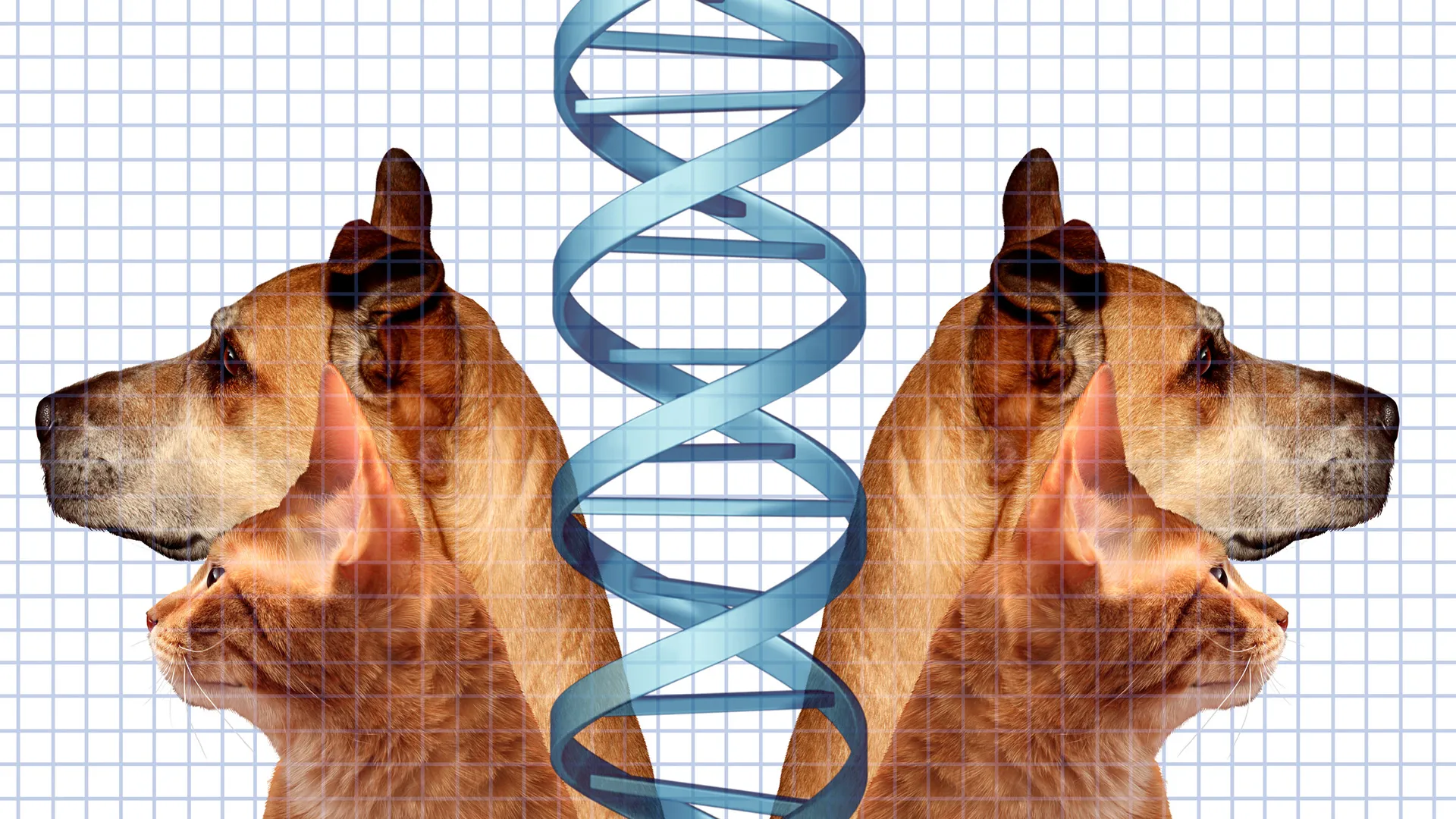
A large tan dog sits next to a small orange cat with a double helix behind them. The image is mirrored and there's a blue and white grid behind everything.

Humans and cats are twice as similar to each other as humans are to dogs in terms of how genes are arranged within chromosomes.

(Image credit: wildpixel via Getty Images)

Because the way DNA is organized affects how genes are switched on and off, cats may be a better model than dogs for understanding human gene regulation, Murphy said.


What to read next

That also makes them useful for studying genetic diseases. For example, polycystic kidney disease occurs in both humans and cats, and treatments developed for cats could help inform therapies for people.

Cats may also provide clues about cancer. A recent study found that cancer-related genes in cats are strikingly similar to those in humans, both in number and variety. One notable example involves a gene called FBXW7, which was mutated in more than half of the feline mammary tumors studied. In humans, mutations in the same gene are linked to worse outcomes in breast cancer

That said, dogs are also used to model and analyze human illness, including Alzheimer’s disease, idiopathic epilepsy, eye disease and heart disease.

Although cats may share more similarities with humans in gene regulation, to date more research has focused on dogs. This may be due in part to the fact that the complete feline genome became available later than the canine genome, as well as historical bias — cats have long been perceived as less cooperative in research settings.

So, which are we more closely related to? From an evolutionary standpoint, it’s a tie, but genetically, at least in terms of genome structure, we are closer to cats.


How much of a cat fan are you? Find out by taking our cat quiz!

TOPICS

Life’s Little Mysteries

Source link

Share. Facebook Twitter Pinterest LinkedIn Tumblr Email
Previous ArticleDeclassified Apollo 12 images show UFOs on the moon — Space photo of the week
Next Article Lion’s head pendant: An ancient Egyptian board game piece that was later repurposed into a magical religious object with baboons
Editor
  • Website

Related Posts

Lifestyle

Aspen trees provide a natural buffer against wildfires, even as fire season intensifies, study shows

August 4, 2026
Lifestyle

Ancient bullets reveal where a Roman camp hid in the Pyrenees of Spain before being ambushed

August 4, 2026
Lifestyle

First deaths from Cyclospora outbreak reported in Michigan

August 3, 2026
Add A Comment

Comments are closed.

Categories
  • Entertainment
  • Lifestyle
  • News
  • Sports
  • Tech
  • Travel
Recent Posts
  • Aspen trees provide a natural buffer against wildfires, even as fire season intensifies, study shows
  • Ancient bullets reveal where a Roman camp hid in the Pyrenees of Spain before being ambushed
  • First deaths from Cyclospora outbreak reported in Michigan
  • Scientists uncover big clue as to how Antarctica’s mysterious Blood Falls came to be
  • ‘Poop pills’ may ease insomnia by reprogramming the gut microbiome, early study hints
calendar
August 2026
M T W T F S S
 12
3456789
10111213141516
17181920212223
24252627282930
31  
« Jul    
Recent Posts
  • Aspen trees provide a natural buffer against wildfires, even as fire season intensifies, study shows
  • Ancient bullets reveal where a Roman camp hid in the Pyrenees of Spain before being ambushed
  • First deaths from Cyclospora outbreak reported in Michigan
About

Welcome to Baynard Media, your trusted source for a diverse range of news and insights. We are committed to delivering timely, reliable, and thought-provoking content that keeps you informed
and inspired

Categories
  • Entertainment
  • Lifestyle
  • News
  • Sports
  • Tech
  • Travel
Facebook X (Twitter) Pinterest WhatsApp
  • Contact Us
  • About Us
  • Privacy Policy
  • Disclaimer
  • UNSUBSCRIBE
© 2026 copyrights reserved

Type above and press Enter to search. Press Esc to cancel.