Close Menu
  • Home
  • UNSUBSCRIBE
  • News
  • Lifestyle
  • Tech
  • Entertainment
  • Sports
  • Travel
Facebook X (Twitter) WhatsApp
Trending
  • Newly discovered, blue-whale-size asteroid will fly super close to Earth Monday — and you can watch it live
  • Don Juan Pond: Antarctica’s salty, syrupy lake that never freezes, even when it’s minus 58 F
  • Withings ScanWatch 2 review: Style meets next-level health monitoring
  • AI Chatbots are turbo-charging violence against women and girls: We urgently need to regulate them | Yvonne McDermott Rees
  • ‘The biggest El Niño event since the 1870s’: ‘Super’ El Niño is now the most likely scenario by the end of this year ‪—‬ and the humanitarian cost could be huge
  • Antarctica’s sudden sea ice loss is one of the most extreme and confusing events in the modern climate record. Scientists now know why it’s happening.
  • ‘I heard gasps’: Artemis II astronauts reveal inside story of their mind-bending solar eclipse
  • A pill can stop people from developing COVID after being exposed to the virus, trial finds
Facebook X (Twitter) WhatsApp
Baynard Media
  • Home
  • UNSUBSCRIBE
  • News
  • Lifestyle
  • Tech
  • Entertainment
  • Sports
  • Travel
Baynard Media
Home»Lifestyle»NASA’s Lucy spacecraft snaps peanut-shaped asteroid on solar system origins mission
Lifestyle

NASA’s Lucy spacecraft snaps peanut-shaped asteroid on solar system origins mission

EditorBy EditorApril 23, 2025No Comments3 Mins Read
Share Facebook Twitter Pinterest LinkedIn Tumblr Reddit Telegram Email
Share
Facebook Twitter LinkedIn Pinterest Email

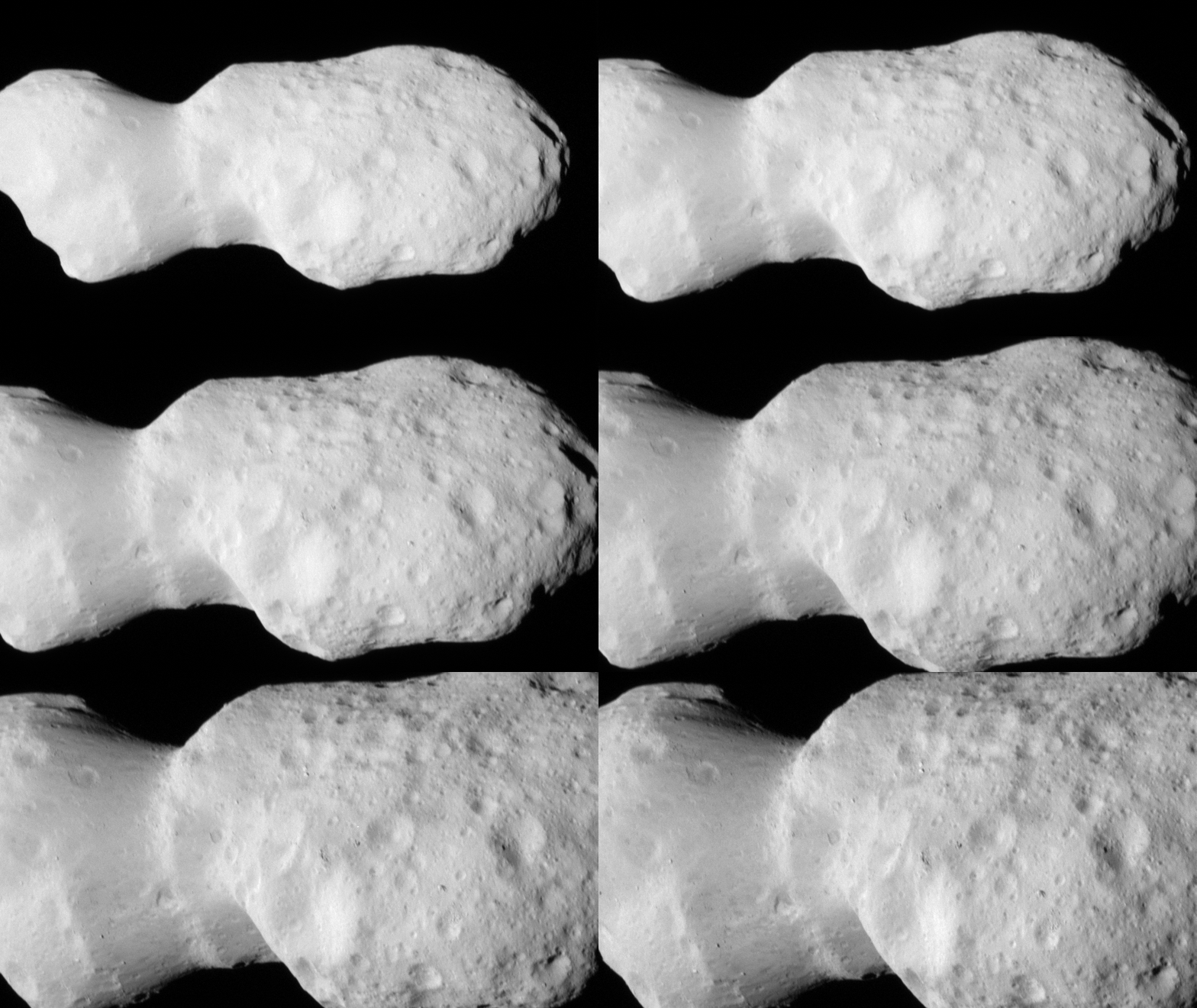
NASA’s Lucy spacecraft has captured its first high-resolution images of an asteroid, revealing a bizarrely shaped 150-million-year-old space rock.

The asteroid Donaldjohanson formed when two smaller objects smashed into each other. Donaldjohanson is narrow in the middle with two lobes on either side, like a misshapen peanut with one kernel larger than the other.

Lucy flew as close as 600 miles (960 kilometers) — about the width of Montana — from Donaldjohanson on Sunday (April 20), capturing the first detailed images of the asteroid. Researchers hope that studying Donaldjohanson will help shed light on how our solar system’s planets formed.

“Asteroid Donaldjohanson has strikingly complicated geology,” Hal Levison, the principal investigator for Lucy at the Southwest Research Institute in Colorado, said in a statement from NASA. “As we study the complex structures in detail, they will reveal important information about the building blocks and collisional processes that formed the planets in our Solar System.”

Related: ‘City-killer’ asteroid that might hit moon has ‘unexpected’ shape, astronomers say

The Lucy mission launched in 2021 and is on its way to study ancient asteroids orbiting the sun in the main asteroid belt, around 445 million miles (715 million km) from Earth. Lucy’s main targets are the Trojan asteroids, which are billions of years old — far older than Donaldjohanson — and orbit in two groups on either side of Jupiter.

The Trojan asteroids are likely made from the same ancient material that formed planets like Jupiter, Neptune and Saturn, and thus have the potential to provide scientists with a window into the formation of our solar system.

Get the world’s most fascinating discoveries delivered straight to your inbox.

Donaldjohanson is a medium-sized asteroid in the main asteroid belt between Mars and Jupiter, orbiting the sun from a distance that ranges between around 180 million and 260 million miles (290 million and 420 million km), according to Space Reference.

Researchers estimated that Donaldjohanson is around 5 miles (8 km) long and 2 miles (3.5 km) wide at its widest point. That makes the peanut-shaped rock peanut-sized compared with some of the Trojan asteroids Lucy aims to study. Lucy’s first Trojan target, Eurybates, is estimated to be around 40 miles (64 km) wide.

Donaldjohanson is an appropriate stop-off for Lucy: The asteroid is named after American paleoanthropologist Donald Johanson, who discovered the Australopithecus fossil “Lucy” — the remains of an extinct human relative — with his graduate student Tom Gray in 1974. NASA named the Lucy mission after that fossil because, in the same way that the fossil provided insights into the evolution of humans, researchers hope that this mission will achieve the same for the origins of planets.

Lucy captured the new images using the Lucy Long-Range Reconnaissance Imager, although not all of the asteroid is visible in the images because Donaldjohanson is larger than Lucy’s field of view. Researchers will learn more about the asteroid’s full shape as they receive more data from the spacecraft, according to the statement.

Lucy first tested its systems with a flyby of the asteroid Dinkinesh in 2023. However, a NASA spokesperson described the recent encounter with Donaldjohanson as a “full dress rehearsal” ahead of the spacecraft’s visit to the first Trojan asteroid in 2027.

“These early images of Donaldjohanson are again showing the tremendous capabilities of the Lucy spacecraft as an engine of discovery,” Tom Statler, a program scientist for the Lucy mission at NASA, said in the statement. “The potential to really open a new window into the history of our solar system when Lucy gets to the Trojan asteroids is immense.”

Source link

Share. Facebook Twitter Pinterest LinkedIn Tumblr Email
Previous ArticleScientists create ultra-tough copper alloy that is stronger than steel and can withstand temperatures of 1500 F
Next Article Lion mauled gladiator to death 1,800 years ago in Roman Britain, controversial study suggests
Editor
  • Website

Related Posts

Lifestyle

Newly discovered, blue-whale-size asteroid will fly super close to Earth Monday — and you can watch it live

May 16, 2026
Lifestyle

Don Juan Pond: Antarctica’s salty, syrupy lake that never freezes, even when it’s minus 58 F

May 16, 2026
Lifestyle

Withings ScanWatch 2 review: Style meets next-level health monitoring

May 15, 2026
Add A Comment

Comments are closed.

Categories
  • Entertainment
  • Lifestyle
  • News
  • Sports
  • Tech
  • Travel
Recent Posts
  • Newly discovered, blue-whale-size asteroid will fly super close to Earth Monday — and you can watch it live
  • Don Juan Pond: Antarctica’s salty, syrupy lake that never freezes, even when it’s minus 58 F
  • Withings ScanWatch 2 review: Style meets next-level health monitoring
  • AI Chatbots are turbo-charging violence against women and girls: We urgently need to regulate them | Yvonne McDermott Rees
  • ‘The biggest El Niño event since the 1870s’: ‘Super’ El Niño is now the most likely scenario by the end of this year ‪—‬ and the humanitarian cost could be huge
calendar
May 2026
M T W T F S S
 123
45678910
11121314151617
18192021222324
25262728293031
« Apr    
Recent Posts
  • Newly discovered, blue-whale-size asteroid will fly super close to Earth Monday — and you can watch it live
  • Don Juan Pond: Antarctica’s salty, syrupy lake that never freezes, even when it’s minus 58 F
  • Withings ScanWatch 2 review: Style meets next-level health monitoring
About

Welcome to Baynard Media, your trusted source for a diverse range of news and insights. We are committed to delivering timely, reliable, and thought-provoking content that keeps you informed
and inspired

Categories
  • Entertainment
  • Lifestyle
  • News
  • Sports
  • Tech
  • Travel
Facebook X (Twitter) Pinterest WhatsApp
  • Contact Us
  • About Us
  • Privacy Policy
  • Disclaimer
  • UNSUBSCRIBE
© 2026 copyrights reserved

Type above and press Enter to search. Press Esc to cancel.